ALA accreditation is granted by the Committee on Accreditation and applies only to master's-level library and information studies degrees.
Roughly 47 to 50 ALA-accredited MLIS programs operate across the United States and Canada as of 2025.
Online and on-campus MLIS degrees carry equal professional weight when both hold ALA accreditation.
Verify a program's current status directly through the ALA's official directory before applying or paying any deposit.
Choosing the wrong MLIS program can quietly close doors. Most professional librarian roles in academic, public, and federal libraries require a master's degree from a program accredited by the American Library Association (ALA), and a non-accredited degree, however rigorous, often will not satisfy that requirement.
ALA accreditation is the recognized standard for graduate library and information studies education in the United States and Canada. It signals that a program meets published quality benchmarks for curriculum, faculty, and student outcomes.
This guide walks through how the accreditation process works, why it matters for your library science career, how to verify a program's status, and what to look for beyond the seal.
What ALA Accreditation Means (And Which Degrees Qualify)
ALA accreditation is a form of specialized quality assurance for graduate library and information studies education. It is granted by the American Library Association's Committee on Accreditation (CoA), an independent body that reviews master's-level programs against published standards covering curriculum, faculty, students, administration, and resources. A program that earns the seal has demonstrated, through self-study and peer review, that it prepares graduates to enter the profession at a competent, entry-level standard.
The Seal Applies to the Program, Not the University
This is one of the most common points of confusion for prospective students. ALA accreditation is awarded to a specific degree program within a school or department, not to the parent university as a whole. A university may be highly ranked overall and still offer a library studies degree that has never been reviewed by the CoA. When you research schools, you are looking for accreditation of the actual MLIS (or equivalent) you plan to enroll in.
Which Degree Names Qualify
The degree title varies by institution, and the CoA reviews several naming conventions. Any of the following can be ALA-accredited if the program has gone through the review process:
Master of Library Science (MLS)
Master of Library and Information Science (MLIS)
Master of Information Studies (MIS)
Master of Information (MI)
Master of Science in Library Science (MSLS) and similar variants
What matters is not the acronym on the diploma but whether that specific program appears on the CoA's list of accredited programs.
Not the Same as Regional Accreditation
ALA accreditation is separate from regional or institutional accreditation such as SACSCOC, MSCHE, HLC, or WSCUC. Regional accreditors evaluate the university as a whole and govern things like federal financial aid eligibility and credit transfer. The ALA seal is a programmatic, profession-specific credential layered on top. Most employers expecting an ALA-accredited degree will not accept regional accreditation as a substitute.
Recognition Across the U.S. and Canada
Through reciprocal agreements between the ALA and the Canadian Federation of Library Associations, an ALA-accredited degree earned in either country is generally recognized in both. This cross-border portability is a meaningful advantage for librarians who anticipate moving for work.
Why ALA Accreditation Matters for Your Career
An ALA-accredited MLIS is widely treated as the professional baseline for librarian roles in academic, public, and federal libraries.3 While job titles and responsibilities vary, hiring managers across the field use the accreditation seal as a quick signal that your coursework meets recognized standards in cataloging, reference, information ethics, and management. For most career-track librarian positions, especially those above paraprofessional grades, the accredited librarian degree is the entry ticket.
Federal Hiring and the GS-1410 Series
The federal Librarian series (GS-1410), governed by the U.S. Office of Personnel Management, sets formal education and experience standards.1 At the GS-9 level, candidates typically need a master's degree in library science or one full year of graduate study, with higher grades requiring three years of graduate study or a Ph.D., or progressively more specialized experience. OPM's written qualification standard references an accredited college or university rather than mandating ALA accreditation specifically. However, the Library of Congress and the Federal Library and Information Center Committee (FLICC) have publicly advocated for requiring an ALA-accredited master's at GS-9 and above, and many federal job announcements reflect that preference in practice.2 If federal librarianship is on your radar, an ALA-accredited program is the safest path.
State School Librarian Licensure
If you want to work as a K-12 school librarian or media specialist, state licensure rules become decisive. Several states tie their school library media credentials to completion of an ALA-accredited program, or to a state-approved program that is itself built on ALA standards.4 Requirements vary widely, so prospective school librarians should check their target state's department of education before enrolling. A non-accredited degree can leave you ineligible for licensure even if the coursework looks similar on paper.
Mobility Across States and Borders
One of the strongest practical arguments for ALA accreditation is portability. The seal is recognized across all U.S. states and in Canada, where the ALA and the Canadian Federation of Library Associations coordinate on accreditation. That means a graduate of an accredited program in one state can generally apply for library science jobs in another without re-credentialing the degree itself. Graduates of non-accredited programs often face additional scrutiny, supplemental coursework, or outright disqualification when they cross state lines.
As of 2025, roughly 47 to 50 ALA-accredited MLIS programs operate across the United States and Canada, with most holding full status and a smaller number listed as conditional or in candidacy. For the current count and each program's exact status, check the ALA Office for Accreditation directory, then confirm details on the university's own program page.
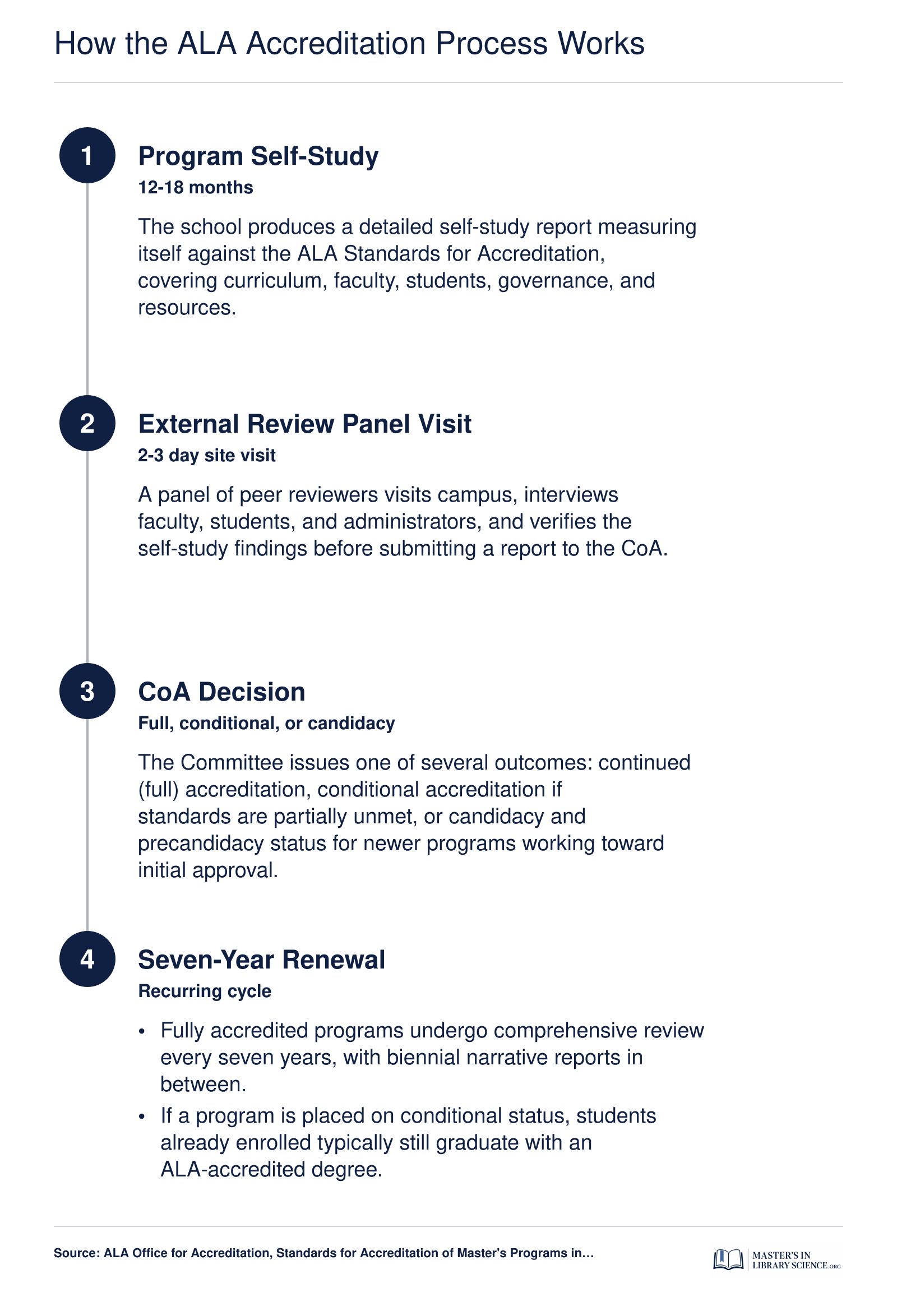
How the ALA Accreditation Process Works
ALA accreditation is granted by the Committee on Accreditation (CoA), which reviews master's programs in library and information studies on a recurring cycle. Here is how a program moves through that process.
Online Vs. On-Campus Ala-Accredited MLIS Programs
One of the most common questions prospective students ask is whether an online MLIS carries the same weight as a traditional on-campus degree. The short answer: yes, when both are ALA-accredited.
Delivery Format Does Not Affect Accreditation
The American Library Association evaluates programs based on curriculum, faculty, student support, and learning outcomes, not on whether classes meet in a physical seminar room or through a learning management system. A fully online MLIS that holds ALA accreditation has met the exact same standards as its on-campus counterpart. In fact, the majority of accredited MLIS degree programs in the United States now offer some form of online or hybrid delivery, and several top-ranked schools have moved their entire MLIS to a distance format.
What to Evaluate Beyond the Seal
Because delivery format does not affect accreditation, the format question becomes one of fit, not quality. When comparing online and on-campus options, look closely at:
Synchronous vs. asynchronous coursework. Synchronous classes meet at scheduled times by video, which builds community but demands a fixed weekly commitment. Asynchronous coursework lets you log in around work and family, but requires more self-discipline.
Residency requirements. Some online programs are 100% remote, while others require one or more short on-campus immersions.
Practicum and internship logistics. Find out whether the program helps place distance students at libraries near them, or whether you are responsible for sourcing your own site.
Technology and advising support. Strong online programs offer dedicated remote advisors, library access, and tech help.
The Employer Perception Myth
A persistent worry is that hiring managers view online degrees as lesser. For ALA-accredited MLIS programs, the evidence does not support this. Library job postings typically require an MLIS from an ALA-accredited program, full stop. They rarely distinguish between online and on-campus graduates, and many hiring librarians earned their own degrees online. What matters on a resume is the accreditation status, the coursework you completed, and the practical library science masters experience you built along the way.
How to Verify a Program's ALA Accreditation Status
Before you submit an application or pay a deposit, take five minutes to confirm a program's accreditation status directly with the American Library Association. Marketing pages, college rankings, and even well-meaning advisors can be out of date. The ALA itself is the only authoritative source.
Use the ALA Directory of Accredited Programs
Go to ala.org/educationcareers/accreditedprograms. This directory lists every currently accredited master's program in the United States, Canada, and Puerto Rico. You can browse alphabetically by school or filter by location. Each listing links to a program profile with the official degree name, contact information, and accreditation history.
If a school is not on this list, it is not ALA-accredited. There are no exceptions, no pending listings to take on faith, and no regional substitutes.
Check the Status and Renewal Date
Each program's profile shows one of three current statuses:
Continued: full accreditation, reviewed on the standard seven-year cycle.
Conditional: accredited, but the program must address specific concerns by a set deadline.
Candidacy: a new program working toward initial accreditation. Degrees earned before full accreditation is granted may not count as ALA-accredited.
Note the next review date. If a program is up for review soon, ask the school what they expect and whether any concerns have been raised in past reviews. This kind of due diligence is essential when you choose the best Master's in Library Science program for your goals.
Watch for Misleading Language
Some schools use phrases that sound official but are not. Be skeptical of:
"ALA-recognized" or "ALA-affiliated": these are not accreditation.
"Aligned with ALA standards": meaningless without the actual seal.
"Accreditation pending" with no Candidacy listing in the ALA directory.
Claims of accreditation by a different body (regional accreditors do not accredit MLIS programs at the program level).
If the wording on a program page feels vague, cross-check the ALA directory and email the school's admissions office for written confirmation of the degree's current accreditation status.
ALA Accreditation Vs. Regional Accreditation: What's the Difference?
When researching MLIS programs, you will see two types of accreditation mentioned: ALA accreditation and regional (institutional) accreditation. They serve different purposes, and a school can hold one without the other. Here is how they compare side by side.
Factor
ALA Accreditation
Regional Accreditation
Type of Accreditation
Programmatic (applies to a specific MLIS or MLS degree program)
Institutional (applies to the entire college or university)
Who Grants It
The American Library Association's Committee on Accreditation
Regional bodies such as the Higher Learning Commission, MSCHE, SACSCOC, NECHE, NWCCU, and WSCUC
What It Evaluates
Curriculum, faculty, student outcomes, and resources for the library science program specifically
Overall institutional quality, finances, governance, and academic standards across all departments
Career Impact for Librarians
Often required for academic, public, school, and federal librarian positions; preferred by most employers
Ensures the degree is recognized for general purposes like financial aid and credit transfer, but may not satisfy librarian job requirements
Federal Financial Aid Eligibility
Not directly tied to Title IV federal aid eligibility
Required for the institution to participate in federal student aid programs
Common Scenario
A university may be regionally accredited but offer an MLIS that is not ALA-accredited, which can limit graduates' job prospects
Nearly all nonprofit U.S. universities hold regional accreditation, but only about 60 also hold ALA accreditation for their library science program
What to Look for Beyond the Accreditation Seal
ALA accreditation tells you a program meets baseline quality standards, but it does not tell you whether a specific school is the right fit for your budget, career goals, or learning style. Once you have confirmed accreditation, dig into the factors below before you submit an application.
Cost and Net Price (Not Just Sticker Tuition)
Published tuition rarely reflects what you will actually pay. Look for the net price after institutional aid, graduate assistantships, employer tuition benefits, and in-state or regional tuition reciprocity. A private program with strong Financial Aid and Scholarships for Library Science Students can end up cheaper than a public school charging out-of-state rates. Add fees, technology costs, and required residencies into your total cost of attendance, then compare that figure to realistic library science salary ranges in your target sector.
Specializations That Match Your Career Path
MLIS programs vary widely in their specialization depth. If you want to work in archives, look for dedicated archival studies coursework and access to a special collections practicum. Aspiring youth services librarians should check for Master's in Library Science in Children & Young Adult Services courses plus storytime fieldwork. Growing fields like data curation, digital scholarship, and Academic Librarianship each call for their own course clusters and faculty expertise. A program that lists a specialization on its website but offers only one or two relevant electives is not the same as a program with a full concentration.
Outcomes Data and Hands On Experience
Ask programs for graduation rates, job placement rates within six to twelve months of graduation, and a list of recent alumni employers. Strong programs publish this information openly. Equally important: the strength of practicum, internship, and capstone placements. Hiring managers consistently favor candidates who have logged supervised hours in a real library, archive, or information center. Programs with established partnerships, paid internships, and dedicated career advisors give you a measurable edge in a competitive job market.
Common Questions About Ala-Accredited MLIS Programs
Prospective students often have similar questions when weighing ALA-accredited MLIS programs against other options. The answers below summarize what the American Library Association and partner bodies say about accreditation, hiring, and recognition.
Do you need an ALA-accredited MLIS to work as a librarian?
For most professional librarian positions in academic, public, and federal libraries in the United States and Canada, yes. Job postings frequently list an ALA-accredited master's degree as a minimum requirement. Some school librarian, archivist, and paraprofessional roles accept other credentials, but if you want maximum flexibility across employers and states, an ALA-accredited MLIS is the safest credential to hold.
Are online MLIS programs ALA-accredited?
Yes. The ALA Office for Accreditation evaluates programs based on curriculum quality, faculty, and student outcomes, not delivery format. Many fully online and hybrid MLIS programs hold the same ALA accreditation as their on-campus counterparts. Your diploma typically does not specify online versus on-campus, so graduates of accredited online programs receive the same professional recognition as residential students.
What is the difference between conditional and full continued accreditation?
Full continued accreditation is granted to programs meeting all ALA standards, typically reviewed every seven years. Conditional accreditation means a program was found to have specific deficiencies and must address them within a set timeframe. Degrees earned during a conditional period are still considered ALA-accredited, but students should monitor whether the program returns to full status before graduating.
How do I verify a program is ALA-accredited?
Check the official Directory of ALA-Accredited Programs maintained by the ALA Office for Accreditation. The directory lists every accredited master's program in the United States, Canada, and Puerto Rico, along with status (continued, conditional, or initial) and the most recent review date. Avoid relying on a school's marketing materials alone, since accreditation status can change between review cycles.
Are ALA-accredited MLIS degrees recognized internationally?
Yes, in many countries. The United Kingdom's CILIP formally recognizes ALA-accredited MLIS degrees, and reciprocal agreements exist with ALIA in Australia and the LAI in Ireland. One study found an 81.24% successful hiring rate in the UK for ALA graduates. In 2024, University College London became the first international program to earn ALA accreditation, retroactive to July 2022.
How many ALA-accredited programs are there?
The ALA accredits roughly 60 master's programs across the United States, Canada, and Puerto Rico, with University College London joining as the first program outside North America in 2024. The exact count shifts as programs gain, lose, or merge accreditation, so consult the ALA Office for Accreditation directory for the current list before applying.