Library Science Salary by State: MLIS Earnings Guide

Library Science Salary by State: MLIS Earnings Guide

Compare librarian and MLIS graduate salaries across all 50 states, plus the factors that shape your earning potential

By Meredith SimmonsReviewed by MLIS Academic Advisory TeamUpdated May 19, 202612 min read
Library Science Salary by State: MLIS Earnings Guide

What you’ll learn in this article…

  • U.S. librarians earn a median of about $64,000, with top earners exceeding $98,000 annually.
  • Washington D.C., Washington state, and California lead librarian pay, while Mississippi and West Virginia trail nationally.
  • Law and medical librarians often clear $80,000 to $100,000, well above public library averages.
  • Cost of living can flip the rankings: lower-paying states sometimes deliver stronger real take-home pay.

How much does a Master of Library Science actually pay, and does the state you work in really change the answer? In short: yes, by a lot. Librarian salaries range from the low $50,000s in the lowest-paying states to well over $90,000 in top markets like Washington D.C., California, and Washington state.

This guide breaks down the full picture: a state-by-state comparison table, the highest and lowest-paying markets adjusted for cost of living, salary by specialization (law and medical librarians lead the pack), and a clear-eyed verdict on whether the MLIS is worth the investment in 2026.

How Much Do Librarians and MLIS Graduates Earn Nationally?

Before drilling into state-by-state numbers, it helps to anchor expectations with national figures. The U.S. Bureau of Labor Statistics tracks Librarians and Media Collections Specialists under SOC code 25-4022, and the most recent data gives a clear picture of what working professionals actually earn.1

The National Median and Full Earning Range

As of the 2024 BLS Occupational Employment Statistics release, the median annual wage for librarians and media collections specialists is $64,320.1 That midpoint is useful, but the full percentile spread tells a more honest story:

  • 10th percentile: $38,920
  • Median (50th percentile): $64,320
  • 90th percentile: $100,880

In other words, the lowest-paid 10 percent of librarians earn under $39,000, while the top 10 percent clear six figures. A roughly $62,000 gap separates the bottom and top of the field, and where you land depends heavily on state, sector, specialization, and years of experience.

Where MLIS Roles Sit in That Range

The BLS category bundles credentialed librarians with media collections specialists, but the salary picture shifts when you isolate MLIS-required positions. Data from DPEA AFL-CIO puts the mean annual wage for library professionals at roughly $68,570 to $69,180, comfortably above the overall median.2 Roles that require an ALA-accredited librarian degree, such as academic librarians, law librarians, and library directors, typically pay above the median, while library technicians and assistants (which do not require an MLIS) sit well below it.

Entry-Level vs. Mid-Career Trajectory

A realistic starting salary for a new MLIS graduate falls in the $42,000 to $52,000 range, tracking the 10th to 25th percentile band. With five to ten years of experience, plus management responsibility or a specialization like medical or digital librarianship, mid-career library science salary figures commonly reach $70,000 to $90,000. Total U.S. employment sits at about 142,100 positions, with roughly 13,500 annual openings projected through 2034 and a 2 percent growth rate.

Librarian Salary by State: Full Comparison Table

Where you work shapes what you earn. State-level wages for librarians and media collections specialists vary by tens of thousands of dollars, driven by local funding, cost of living, urban density, and the mix of public, academic, and special libraries in each market. The figures below come from the Bureau of Labor Statistics Occupational Employment and Wage Statistics (OES) program, which publishes annual estimates for SOC code 25-4022.1 We are using the most recent release available (May 2023 data), and we recommend cross-checking the BLS site for any newer update before making relocation decisions.

How to Read This Table

Two numbers matter when comparing states: the mean annual wage (what the average librarian in that state earns) and total employment (how many librarian jobs actually exist there). A state can post a high average wage but offer very few openings, which means relocating there is a long shot. Conversely, a moderate-wage state with thousands of positions may give you a far better chance of landing your first role requiring an MLIS degree.

Selected State Wages and Employment (BLS OES, May 2023)

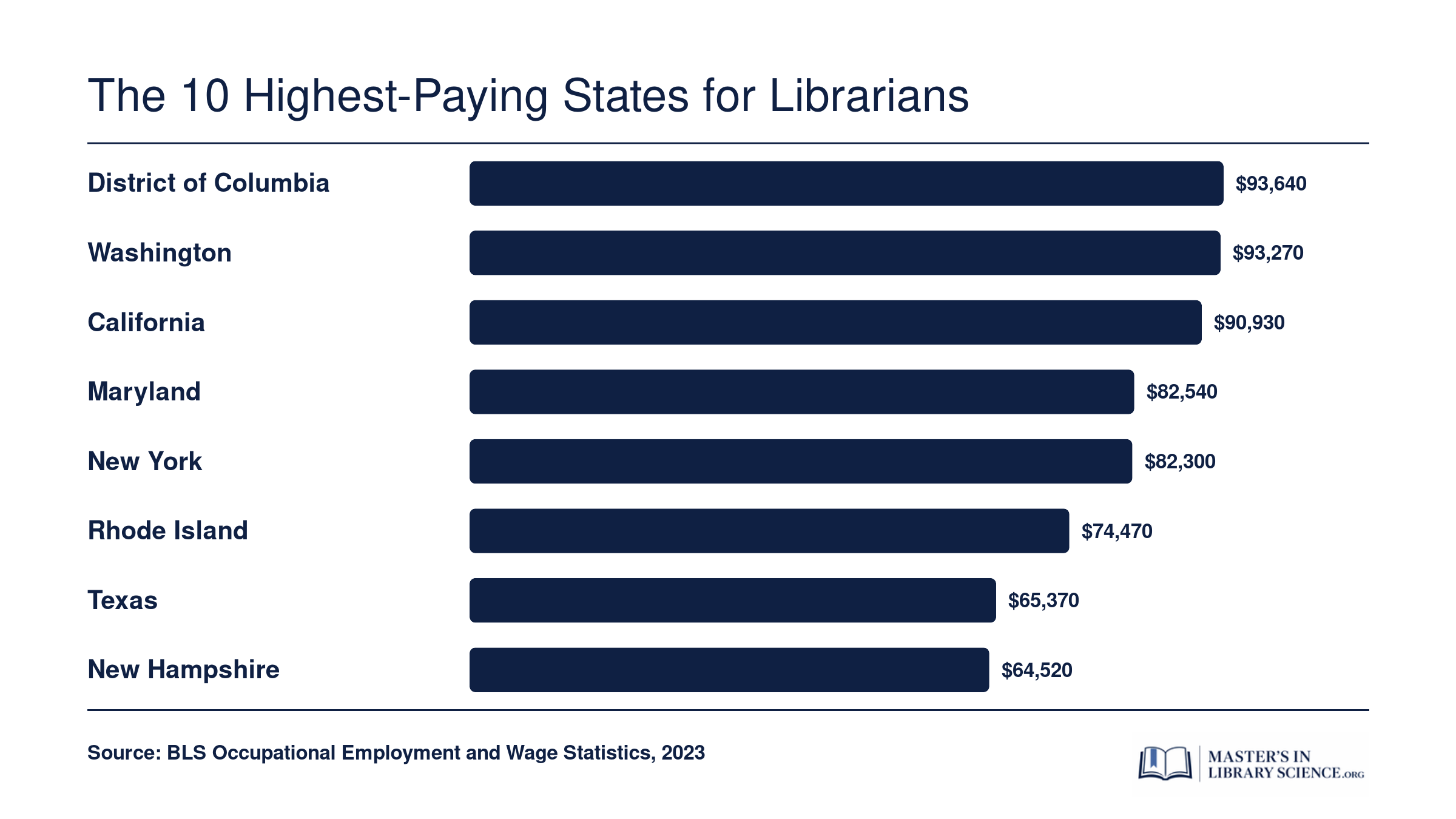
  • District of Columbia: $93,640 mean wage, 940 jobs1
  • Washington: $93,270 mean wage, 2,750 jobs
  • California: $90,930 mean wage, 8,680 jobs
  • Maryland: $82,540 mean wage, 3,180 jobs
  • New York: $82,300 mean wage, 11,010 jobs
  • Rhode Island: $74,470 mean wage, 780 jobs
  • Texas: $65,370 mean wage, 9,320 jobs
  • New Hampshire: $64,520 mean wage, 1,080 jobs
  • Florida: $63,400 mean wage, 5,940 jobs
  • Ohio: $60,430 mean wage, 6,090 jobs
  • Vermont: $60,030 mean wage, 600 jobs
  • Louisiana: $59,440 mean wage, 2,770 jobs
  • Wyoming: $49,420 mean wage, 430 jobs

For context, the national median annual wage for librarians was $64,370 in 2023.1 States like New York, Texas, California, Ohio, and Florida combine solid pay with the largest employment bases, making them statistically the most accessible job markets. Smaller states such as Vermont and Wyoming pay less and post fewer openings, though competition can also be lighter. Browsing current library science jobs in your target states can help you reality-check these averages against live postings.

A Note on Methodology

OES estimates exclude self-employed workers and reflect employer-reported wages, not advertised salaries. They do not adjust for cost of living, which we tackle in the next section. Treat these figures as a reliable starting baseline, not a guaranteed offer.

The 10 Highest-Paying States for Librarians

The top of the librarian pay curve is dominated by markets with dense urban populations, large university systems, and concentrated federal or state employers. Washington D.C. leads the country, with Washington state and California close behind. Note how steeply the curve drops: the gap between #1 and #8 is roughly $28,000 a year.

Eight highest-paying states for librarians led by D.C. at $93,640 and Washington at $93,270 in 2023, per BLS

Lowest-Paying States and Why Cost of Living Changes the Picture

Raw salary numbers tell only half the story. A librarian earning $58,000 in a low-cost state may take home more usable income than a peer earning $85,000 in a high-rent metro. Before you fixate on the top of the salary table, look at what those dollars actually buy.

States with the Lowest Nominal Librarian Wages

Based on BLS OEWS data, the states and nonmetropolitan areas reporting the lowest median annual wages for librarians tend to cluster in the South, the Plains, and parts of the rural Midwest. Reported figures include:

  • Kansas nonmetropolitan area: about $35,500 (2020)1
  • Western South Dakota nonmetropolitan area: about $36,200 (2020)1
  • Northern Northeastern Ohio nonmetropolitan area: about $38,160 (2022)2
  • Southeast Oklahoma nonmetropolitan area: about $46,950 (2022)2
  • Maine nonmetropolitan area: about $56,000 (2022)2
  • Louisiana statewide: about $57,300 (2022)2

Mississippi, Arkansas, West Virginia, and parts of Alabama also typically appear near the bottom of statewide medians. These figures are well below the national librarian median of $64,370 (2023)3, and at first glance they look discouraging.

How Cost of Living Reshuffles the Rankings

Once you adjust for housing, groceries, transportation, and state taxes, several low-wage states move up sharply. Mississippi, Arkansas, Oklahoma, Kentucky, and large stretches of the Midwest consistently post cost-of-living indices 10 to 20 percent below the national average. A librarian earning in the high $40Ks or low $50Ks in those areas can often match or exceed the real purchasing power of someone earning in the mid $60Ks in a coastal market. Prospective students weighing MLIS programs in Arkansas or MLIS programs in Mississippi should factor that cost-adjusted reality into their decision.

The flip side matters too. California's $90,930 median (2023) and the District of Columbia's $93,640 (2023) headline most rankings3, but both regions carry housing costs and tax burdens that can erase 25 to 40 percent of the apparent advantage.

Practical Takeaway for MLIS Students

When comparing job offers, run the numbers locally. A $58,000 public library role in Missouri or Tennessee can leave more in your pocket than a $72,000 position in San Francisco or Boston once rent, commuting, and state income tax are subtracted. Use the salary table as a starting point, then weigh it against the cost of actually living where the job is.

Salary by Library Science Specialization

Where you work matters as much as where you live. Specialization is one of the strongest predictors of MLIS earning potential, with law and medical librarians consistently topping national pay charts because their roles demand subject expertise that overlaps with regulated, high-stakes professional fields. The table below summarizes typical pay ranges across the major library science career paths.

SpecializationTypical Salary RangeMedianNotes
Academic / University Librarian$55,000 to $85,000$66,000Tenure-track or faculty-status roles at four-year institutions often pay higher; community college positions trend lower. Subject-specialist roles (STEM, business) can exceed the range.
Public Librarian$45,000 to $72,000$58,000Pay varies sharply by municipality budget and population served. Branch managers and directors earn above the upper end.
K-12 School Librarian / Media Specialist$48,000 to $78,000$61,000Salaries follow district teacher pay scales. Most states require both an MLIS (or equivalent) and a state teaching or school library media credential.
Law Librarian$70,000 to $130,000+$88,000Among the highest-paying specializations. Firm and academic law libraries often prefer or require a JD in addition to the MLIS, especially for senior or research roles.
Medical / Health Sciences Librarian$65,000 to $110,000$80,000Hospital, pharma, and academic medical center roles pay a premium. The Academy of Health Information Professionals (AHIP) credential from the Medical Library Association is widely valued.
Archivist$45,000 to $80,000$60,000BLS SOC 25-4011. Federal and corporate archives pay more than small historical societies. Digital archives skills push pay toward the top of the range.
Special / Corporate Librarian$60,000 to $105,000$78,000Includes competitive intelligence, taxonomy, and knowledge management roles in finance, consulting, and tech. Compensation often includes bonuses uncommon in public-sector library jobs.

Is an MLIS Worth the Investment?

The honest answer: it depends on which sector you target and where you can work. Here is the math.

The Cost vs. Earnings Premium

A typical MLIS program runs $25,000 to $65,000 in total tuition, depending on whether you choose an in-state public university or a private school. Against that cost, MLIS-required librarian roles generally pay $15,000 to $25,000 more per year than library technician or library assistant positions, which do not require a master's degree. Library assistants nationally earn roughly $35,000 to $40,000, while credentialed librarians average closer to $60,000. Over a 30-year career, that gap compounds into several hundred thousand dollars in additional lifetime earnings, even before factoring in better benefits and retirement contributions.

Sector and Experience Matter More Than the Degree Alone

Not all MLIS career paths pay equally. The hierarchy is fairly consistent:

  • Federal librarians (Library of Congress, NIH, agency roles): often $80,000 to $110,000+
  • Academic and special librarians (law firms, medical centers, corporate): $65,000 to $95,000
  • Public librarians: $50,000 to $70,000 in most states
  • School librarians/media specialists: tied to teacher salary scales, varies widely

Experience also drives big jumps. A year-one librarian earning $48,000 can reasonably expect $65,000 to $75,000 by year 10, with department head or director roles pushing higher.

Payback Math

If you finance $40,000 in tuition and capture even a $20,000 annual earnings premium over a non-MLIS alternative, you recoup the degree cost in roughly 4 to 6 years of post-tax earnings. Most graduates who land MLIS-required roles break even within 5 to 8 years.

Where the ROI Breaks Down

The investment math gets shaky in two scenarios. First, graduates who cannot relocate often face thin local job markets, especially outside metro areas, and may end up in part-time or paraprofessional work that does not require the degree. Second, public library generalist roles in low-wage states (Mississippi, Arkansas, West Virginia) may pay only $38,000 to $45,000, stretching payback past a decade. Cost-conscious applicants can offset this risk by targeting affordable library science degree online options to keep tuition debt low.

Bottom Line

An MLIS is a strong investment for graduates targeting academic, law, medical, corporate, or federal tracks, particularly in higher-paying states. It is a marginal investment for generalist public library work in low-wage regions, especially if you take on significant debt. Choose your specialization and geography deliberately, and the degree pays for itself.

Common Questions About MLIS Salaries

Below are direct answers to the questions prospective students ask most often before committing to an MLIS program. Figures cited reflect U.S. Bureau of Labor Statistics (BLS) data and American Library Association (ALA) guidance, and they vary by state, sector, and experience level.

What is the average salary for someone with a Master's in Library Science?
According to the BLS Occupational Employment and Wage Statistics, librarians and media collections specialists earn a median annual wage of roughly $64,000, with the top 10 percent earning more than $99,000. Actual pay depends on the employer type (academic, public, special, or school library), years of experience, and the cost of living in your state.
Which state pays librarians the most?
BLS wage data consistently places the District of Columbia, California, Washington, Maryland, and New York among the highest-paying locations, with mean librarian wages exceeding $80,000 in several of these markets. The District of Columbia typically tops the list because of its concentration of federal agencies, the Library of Congress, and large research institutions.
How much more do MLIS holders earn compared to library workers without the degree?
The ALA reports that most professional librarian roles require an ALA-accredited MLIS, and BLS figures show librarians earn substantially more than library technicians and assistants, who have a median wage near $38,000. That difference of roughly $25,000 per year reflects the credential's role as the gate to professional, supervisory, and specialist positions.
What is the highest-paying library science specialization?
Law librarianship, medical and health sciences librarianship, and data or digital asset management roles tend to pay the most, often in the $75,000 to $110,000 range for experienced professionals. These specializations reward an MLIS combined with a JD, a science background, or technical skills in metadata, taxonomy, and information systems.
What is a typical starting salary after earning an MLIS?
Entry-level librarians generally start between $45,000 and $55,000, though academic and federal positions can begin higher. ALA salary surveys suggest new graduates in public libraries average around $48,000, while special libraries in corporate or legal settings often offer starting pay above $60,000 for candidates with relevant subject expertise.
Is an MLIS degree worth the investment?
For students aiming at professional librarian roles, the answer is usually yes, because the MLIS is the standard credential required by most employers. Graduates who choose accredited, lower-cost programs and target higher-paying states or specializations typically recoup tuition within several years through stable salaries, benefits, and public-sector loan forgiveness eligibility.

Recent Articles