MLIS, MLS, MSLIS, and MS in Information degrees are treated as equivalent by employers when ALA-accredited.
Online MLIS tuition ranges roughly from $500 to $1,800 per credit, with most programs requiring 36 to 42 credits.
Core coursework covers metadata standards, digital preservation, and repository platforms alongside traditional library science foundations.
Digital librarian roles span academic libraries, federal agencies, museums, and corporate information teams, with pay varying sharply by sector.
Library collections have moved online faster than most catalogs can keep up. Born-digital archives, institutional repositories, and licensed databases now sit at the center of how patrons actually use libraries, and MLIS programs responded by building specializations in digital libraries and digital curation.
An MLIS in digital libraries is an ALA-accredited master's degree that pairs core library science skills with focused coursework in metadata, digital preservation, and information architecture.
This guide walks through how the degree compares to an MLS, which accredited online programs offer the track, what admissions and curriculum look like, realistic tuition and financial aid, and the digital librarian careers and salary ranges graduates can expect.
MLIS vs MLS vs MIS: What the Digital Libraries Track Really Is
If you have spent any time browsing graduate library programs, you have probably noticed the alphabet soup: MLIS, MLS, MIS, MSLS, MSI. The good news is that for hiring purposes, these titles are largely interchangeable. What matters to employers, and to you, is whether the degree is accredited by the American Library Association (ALA), not the specific letters on the diploma.
The Degree Names Are Mostly Cosmetic
The Master of Library Science (MLS) was the original credential. Most schools have since renamed it the Master of Library and Information Science (MLIS) to reflect the field's expansion into information technology, data, and digital systems. A handful of programs use Master of Information Science (MIS) or Master of Science in Information (MSI) to signal an even broader focus that includes user experience, data analytics, or informatics. The ALA accredits the program, not the name, so a graduate of an ALA accredited MIS program qualifies for the same librarian positions as a graduate of an ALA-accredited MLIS program. If you want a deeper breakdown of how these credentials compare, our guide on MLS vs MLIS walks through the distinctions.
Where Digital Libraries Fits In
A digital libraries concentration is a specialization layered on top of a general MLIS. While a generalist MLIS covers reference, cataloging, collection development, and library management broadly, a digital libraries track focuses on building and maintaining online collections: metadata standards, digital repositories, file format migration, and access systems.
There is meaningful overlap with digital curation and archives tracks, but the emphasis differs. Digital curation tends to stress long-term preservation and research data management. Archival studies tracks center on appraisal, arrangement, and description of unique materials. Digital libraries sits in between, with stronger attention to public-facing digital collections and discovery platforms.
Online vs On-Campus Accreditation
A common worry is whether an online MLIS carries the same weight as the on-campus version. When a school offers both formats, ALA accreditation applies to the degree itself, not the delivery mode. The transcript and credential are identical. Employers do not distinguish between online and in-person graduates of the same accredited program.
Ala-Accredited Online MLIS Programs With a Digital Libraries Focus
The table below compares 11 ALA-accredited master's programs that offer an online MLIS (or equivalent MSLIS / MS in Information) with a named track in digital libraries, digital curation, digital stewardship, or closely related digital information management. Use it as a shortlist starting point: confirm current concentration names, course availability, and any short on-campus residencies directly with each school before applying.
Why ALA Accreditation Matters
Most professional librarian positions, especially in academic libraries, large public library systems, and federal agencies like the Library of Congress, require a master's degree from a program accredited by the American Library Association (ALA). ALA accreditation signals that a program meets shared standards for curriculum, faculty, and student learning outcomes across the field. If a program is not on the ALA-Accredited Programs Directory, graduates may find their degree disqualified from many job postings, regardless of how strong the digital libraries coursework looks.1 Every program in the table below is currently ALA-accredited.
How to Read the Table
The concentration name is the school's own label for the digital libraries track. Names vary widely: some programs call it Digital Curation, others Digital Content Management or Digital Information Management. Despite the labeling differences, the core skill set (metadata, preservation, digital asset management, repository systems) is broadly similar. If you want a fuller picture of the competencies covered across these tracks, our guide to the top skills employers look for in library science degree graduates breaks them down by role. Delivery mode indicates whether coursework is fully online or whether occasional on-campus or synchronous sessions are required. Credits affects both total cost and time to completion: most programs land between 36 and 48 credits. Students still weighing concentration fit can also consult our walkthrough on how to choose a concentration for library science program needs.
Programs at a Glance
Syracuse University: Digital Curation and Services concentration, fully online, 36 credits.2
University of Alabama: Digital Libraries concentration, fully online, 36 credits.
University of North Texas: Digital Content Management concentration, fully online, 36 credits.
University of Arizona: Digital Information Management concentration, fully online, 36 credits.
University of Denver: Digital Libraries & Technology concentration, fully online, 39 credits.
Indiana University Bloomington: Digital Curation specialization, fully online, 39 credits.
San José State University: Digital Curation & Digital Services pathway, fully online, 39.5 credits.
University of Illinois Urbana-Champaign: Digital Libraries & Data Curation concentration, fully online, 40 credits.
Drexel University: Metadata and Digital Technologies concentration, fully online, 45 credits.3
University of North Carolina at Chapel Hill: Digital Libraries concentration, primarily online (some synchronous components), 48 credits.
The four 36-credit programs are the fastest and typically least expensive routes overall, while UNC Chapel Hill and Drexel offer deeper coursework at a higher credit load. Only UNC Chapel Hill is not described as fully asynchronous online; the other ten can be completed without relocating.
Admissions Requirements and Prerequisites
Admissions to online MLIS programs with a digital libraries focus are generally accessible compared to other graduate fields, but expectations have shifted in recent years. Here is what you can expect when applying.
GPA and Test Score Expectations
Most ALA-accredited programs set a minimum undergraduate GPA of 3.0 on a 4.0 scale, though some will consider applicants below that threshold with strong supporting materials or several years of relevant work experience. The GRE has largely faded from MLIS admissions. The majority of No-GRE Master's in Library Science Programs have dropped the requirement entirely, and many of those that still list it allow waivers for applicants who meet GPA cutoffs or hold prior graduate degrees. Always confirm the current testing policy on each program's admissions page, since these rules continue to change year to year.
Standard Application Materials
Expect to submit a fairly standard graduate package:
Official transcripts from every institution attended
A statement of purpose explaining why you want an MLIS and, ideally, why digital libraries specifically
Two or three letters of recommendation from professors or supervisors
A current resume or CV
An application fee (sometimes waived for veterans, alumni, or early applicants)
Background That Helps for Digital Libraries
No undergraduate major is required, and programs admit applicants from humanities, sciences, and professional fields alike. For the digital libraries track specifically, prior exposure to coding, databases, web development, metadata standards, or digital archives can strengthen your statement of purpose. Library paraprofessional experience also helps but is rarely required.
Deadlines and Start Dates
Program timelines vary. Some schools use fixed fall and spring deadlines, while many online programs operate on rolling admissions with multiple start dates per year. Rolling admissions can shorten the wait between applying and beginning coursework, which matters if you are trying to start within a specific semester.
Inside the Curriculum: Metadata, Preservation, and Digital Asset Management
An online MLIS with a digital libraries focus blends a traditional library science foundation with technical coursework in metadata, preservation, and repository systems. Expect roughly half the credits to come from the MLIS core and the rest from your specialization and electives.
The MLIS Core Foundation
Every ALA-accredited MLIS, whether it leans toward public librarianship or digital curation, anchors students in a shared core. You will typically take:
Reference and information services
Organization of information (cataloging, classification, controlled vocabularies)
Research methods in library and information science
Foundations of the profession, ethics, and information policy
Management of libraries and information organizations
This core is what makes an MLIS portable. Even if you specialize in digital libraries, you graduate qualified to work in many library settings, and the top skills employers look for in library science degree graduates still apply across roles.
Digital Track Electives
The specialization is where the digital libraries curriculum takes shape. Three clusters of coursework are nearly universal across programs like the University of Washington iSchool, UW-Milwaukee, Valdosta State, and the University of Arizona.
Metadata standards. Dedicated metadata courses (for example, LIS 539 at UW or INFOST 714 at UW-Milwaukee) teach Dublin Core, MODS, METS, and EAD, often alongside XML and schema design.12 You learn not just to apply standards but to choose between them for a given collection.
Digital preservation. Preservation courses such as UW's LIS 506 introduce frameworks like OAIS and the PREMIS data dictionary, file format risk, fixity checking, and tools such as BagIt.1 The goal is keeping digital objects usable across decades, not just backed up.
Institutional repositories and digital asset management. Systems-oriented courses (UW's LIS 587, Arizona's LIS 682, Valdosta State's MLIS 7580, UW-Milwaukee's INFOST 682) walk students through repository platforms including DSpace, Fedora, Samvera, and Islandora, plus information architecture topics covered in courses like INFOST 717.34
Emerging Topics and Hands-On Tools
Newer electives reflect where the field is moving. Linked data and semantic web courses introduce RDF, SPARQL, and BIBFRAME. Web archiving courses, prominent at programs like Valdosta State, give students practice with Archive-It and Webrecorder.4 AI in collections, computational approaches to cultural heritage, and data curation are also appearing in catalogs.
By graduation, you should have hands-on exposure to at least one repository platform, one metadata editor, and standard preservation tools, building a portfolio you can show employers.
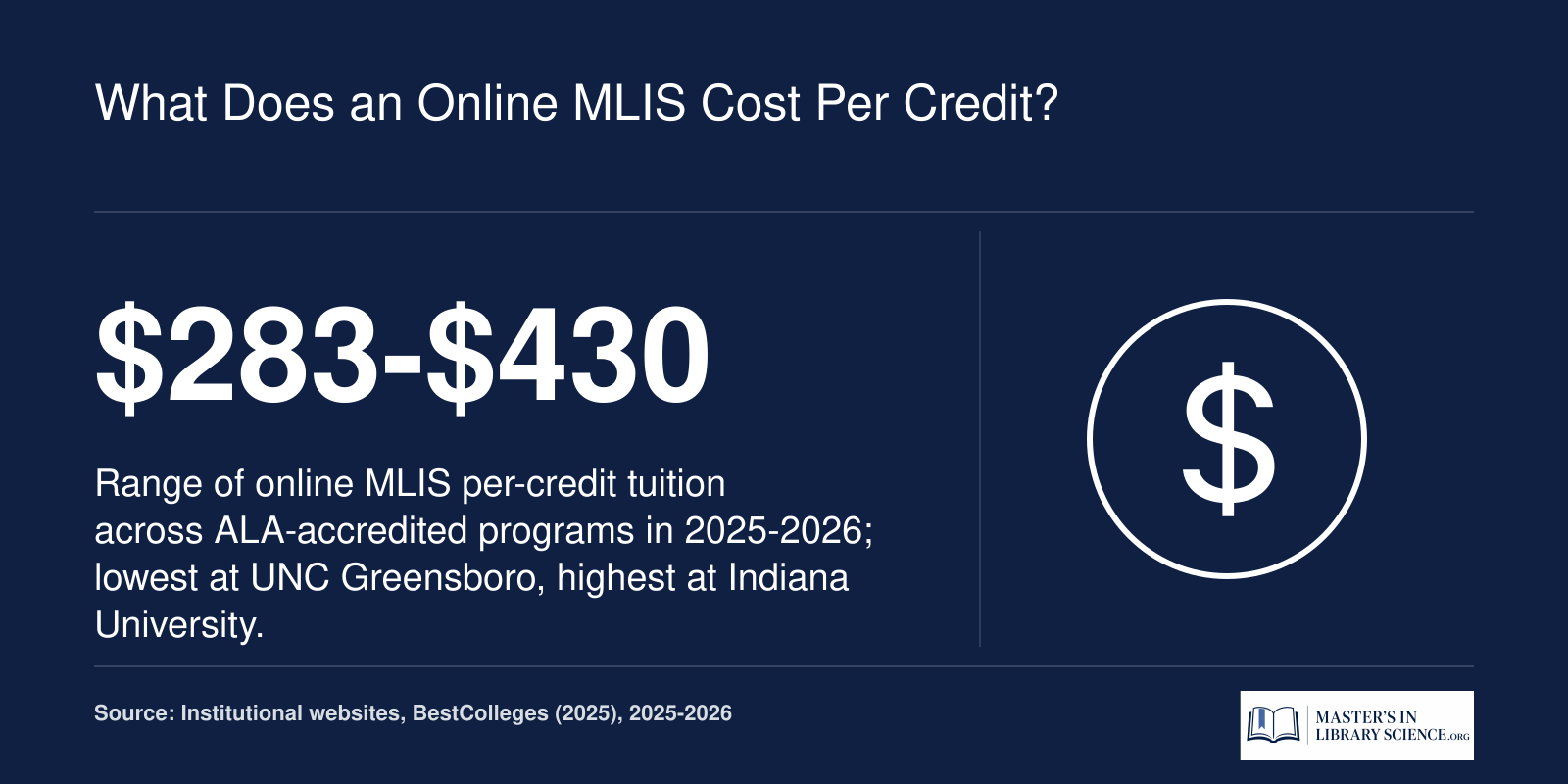
Tuition for online MLIS programs varies widely. Per-credit rates in 2025-2026 range from $283 at the University of North Carolina Greensboro to $430 at Indiana University; most programs charge the same online rate for all students, removing in-state/out-of-state distinctions. Total program cost depends on credit load, typically 36 to 48 credits, meaning a degree can range from about $10,000 to over $24,000. Financial aid, graduate assistantships, and IMLS-funded fellowships can significantly offset costs.
Digital Librarian Careers and Salary Ranges
An MLIS with a digital libraries focus opens doors well beyond the traditional reference desk. Graduates move into specialist roles across academic libraries, federal agencies, museums, publishers, and increasingly, corporate information teams. Pay varies widely by sector, so it is worth understanding where the numbers actually land.
What the Federal Data Shows
The Bureau of Labor Statistics groups most MLIS holders under Librarians and Media Collections Specialists (SOC 25-4022). As of 2023, the median annual wage for this group was $64,370, with a mean of $68,570 and total employment of about 133,760.1 Hourly wages across the field run roughly $18.60 to $49.03.1 Job growth is projected at about 6% through 2031, in line with the average across all occupations.2
Sector matters significantly. BLS industry breakdowns for 2023 show:
Colleges and universities: mean wage around $73,8901
Elementary and secondary schools: mean wage around $71,8001
Local government libraries (excluding schools): mean wage around $62,3601
Web search portals, libraries, and archives: mean wage around $60,7001
Federal, state, and local government (specialized roles): mean wage around $102,3201
Federal positions, including those at the Library of Congress, National Archives, and Smithsonian, consistently sit at the top of the range, though openings are limited.
Salary Ranges by Specialist Role
BLS does not publish separate medians for every digital track job title, so the figures below should be read as approximate ranges drawn from job postings, ALA salary survey data, and adjacent occupational categories. Treat them as orientation, not guarantees. For state-level context, our library science salary breakdown can help you calibrate these ranges to local markets.
Digital librarian (academic): roughly $55,000 to $80,000
Metadata librarian: roughly $55,000 to $85,000, higher in research libraries
Digital archivist: roughly $50,000 to $75,000, tracking the Archivists and Curators category (SOC 25-4011)
Digital preservation specialist: roughly $60,000 to $90,000, with federal roles often higher
Scholarly communications librarian: roughly $65,000 to $95,000 at research universities
Digital asset manager (corporate): roughly $70,000 to $110,000, with senior DAM leads in media, fashion, and tech firms exceeding that
Academic vs Corporate vs Federal
Corporate digital asset management roles often pay 20% to 40% above comparable academic positions, particularly in advertising, entertainment, and consumer brands where DAM directly supports revenue. Academic libraries offer stronger benefits, sabbaticals, and tuition remission, which can offset base pay. Federal roles tend to combine higher salaries with stable pensions but require navigating GS pay scales and security clearances. Students weighing careers in library science should consider which sector their coursework, internships, and capstone work best position them to enter.
How to Choose the Right Online MLIS Digital Libraries Program
Choosing an online MLIS with a digital libraries focus comes down to four filters applied in order. Skip the order and you risk paying for a credential that does not move your career.
A Four-Filter Decision Framework
Apply these in sequence, not all at once:
ALA accreditation first. If a program is not accredited by the American Library Association, most academic and public library jobs will screen you out before a human reads your resume. This is non-negotiable for traditional librarian roles.
Specialization depth second. Count the dedicated digital libraries electives. A real track has at least four or five courses covering metadata standards, digital preservation, repository systems, and digital asset management. One survey course is not a specialization.
Cost third. Once you have two or three accredited programs with genuine depth, then compare per-credit tuition, residency requirements, and total program cost.
Format fit last. Synchronous vs asynchronous, cohort vs self-paced, and required on-campus institutes all matter, but only after the first three filters narrow the list.
For a broader view of how to weigh these tradeoffs across any concentration, our guide on how to choose a library science program walks through the same logic at a higher level.
Red Flags to Watch For
Be skeptical when a program markets a digital libraries concentration but the catalog shows only one or two relevant courses. Other warning signs: faculty bios that do not list recent publications or projects in digital curation, no clear practicum coordinator, and vague language about how online students complete hands-on placements.
Match the Program to Your Career Target
Digital libraries work splits into three rough lanes, and programs lean different directions:
Academic repository and scholarly communication work rewards programs strong in institutional repositories, open access, and research data management.
Corporate digital asset management rewards programs with DAM software exposure, taxonomy work, and metadata for media assets.
Cultural heritage and archives rewards programs tied to museum studies, audiovisual preservation, and digitization of special collections.
If the third lane is your target, a dedicated cultural heritage MLIS online track may serve you better than a general digital libraries concentration.
A Practical Shortlist Step
Narrow your list to three programs, then email each department and request syllabi for the digital libraries electives before you apply. Real syllabi reveal tools taught, projects assigned, and currency of readings. Vague responses are themselves a data point. Cross-check your shortlist against ALA accredited MLIS programs to confirm each one clears the first filter.
Why the Practicum Matters Most
In an online program, the practicum or capstone is the strongest signal on your resume because it proves you did real work outside the LMS. Ask how placements are arranged for distance students, whether the school maintains partner sites, and whether you can propose your own host institution. A program that helps you land a practicum at a digital repository, archive, or DAM team is giving you a portfolio piece, professional references, and often a direct hiring pipeline.
Frequently Asked Questions About Online MLIS Digital Libraries Degrees
Prospective students often have similar questions when evaluating online library science programs with a digital libraries focus. The answers below clarify accreditation, cost, timeline, and career paths to help you compare options confidently.
Is an online MLIS in digital libraries ALA-accredited?
Yes, many online MLIS programs with a digital libraries concentration hold ALA accreditation. The American Library Association accredits entire programs, not individual tracks. Look for ALA-accredited status on the school's website or the ALA directory. An ALA-accredited degree is often required for professional librarian positions in public, academic, and school libraries.
What is the cheapest online MLIS degree?
The most affordable online MLIS degrees are typically found at public universities offering in-state tuition rates to all online students. Schools like Valdosta State University and the University of Alabama have been noted for lower per-credit costs. Total tuition varies, but you can find programs under $20,000. Always confirm total program fees, not just per-credit rates.
How long does an MLIS in digital libraries take to complete?
Most online MLIS programs require 36 credit hours and take two years of full-time study. Part-time students often finish in three to four years. Some programs offer accelerated options that can be completed in as little as 12 to 18 months. The digital libraries concentration typically adds no extra time beyond the standard MLIS curriculum requirements.
What is the difference between an MLIS and MLS?
MLIS (Master of Library and Information Science) and MLS (Master of Library Science) are functionally equivalent degrees. The MLIS name reflects the integration of information science into the curriculum. Both are ALA-accredited and qualify graduates for the same librarian roles. Employers treat them interchangeably; the program's curriculum matters more than the degree title.
What jobs can you get with an MLIS in digital libraries?
Graduates commonly work as digital librarians, digital archivists, metadata specialists, digital asset managers, or electronic resources librarians. These roles exist in academic libraries, museums, government agencies, and corporations. The specialization prepares you for positions managing digital collections, preservation systems, and online access platforms, often with above-average salaries in technical settings.
Do you need a tech background to enroll?
No, a formal technology background is not required. Programs welcome students from humanities, social sciences, and other fields. You will learn relevant technical skills like XML, metadata standards, and basic scripting during the program. A willingness to learn and comfort with digital tools are more important than prior coding experience. Some courses may offer introductory modules.