2026 Best Online MLIS Degrees in Arizona | Top Programs

2026 Best Online MLIS Degrees in Arizona | Top Programs

Compare ALA-accredited library science programs in Arizona by cost, earnings, and career outcomes

By Meredith SimmonsReviewed by MLIS Academic Advisory TeamUpdated May 6, 202618 min read
2026 Best Online MLIS Degrees in Arizona | Top Programs

Key Points

  • The University of Arizona is the only ALA accredited MLIS program in Arizona, offered fully online.
  • Total estimated program cost is roughly $953 per credit, combining tuition and fees at a uniform rate.
  • Arizona does not require a state license for librarians, but most employers expect an ALA accredited MLIS.
  • Specializations include archives, data science, and youth services, mapping directly to in demand career paths.

Arizona is home to just one ALA-accredited MLIS program, the University of Arizona's fully online Master of Arts in Library and Information Science, and that exclusivity makes it a high-stakes decision for aspiring librarians across the state and beyond. Because the 37-credit program is delivered entirely online, students can earn their MLIS from anywhere without relocating to Tucson.

In this guide, we break down everything you need to evaluate that decision with confidence: program costs and ROI, why ALA accreditation matters for Arizona librarians, available specializations, career outcomes and salaries, admission requirements, and the step-by-step path to becoming a librarian in Arizona. If you are still weighing programs in other states, our overview of how to choose the best Master's in Library Science program can help you compare options nationally.

Best Online MLIS Programs in Arizona for 2026

The University of Arizona is the sole ALA-accredited provider of a Master of Arts in Library and Information Science in the state, making it the definitive choice for Arizona residents and out-of-state learners alike. The fully online program offers multiple concentration pathways under one accredited umbrella, so the listings below break out each specialization track to help you compare focus areas. No other Arizona institution, including Arizona State University, currently offers an ALA-accredited MLIS degree.

Data sources: Program-level admissions and outcome data · U.S. Department of Education College Scorecard (collegescorecard.ed.gov) · National Center for Education Statistics (NCES-IPEDS) (nces.ed.gov)

University of Arizona

#1

Tucson, AZ · ~$17,000/yr (est.)

Best for: Working professionals seeking ALA-accredited flexibility

The University of Arizona delivers the only ALA-accredited online MLIS in the state through a 37-credit Master of Arts in Library and Information Science. Ranked among the top 10 globally for library science, the program prepares graduates for roles as librarians, archivists, data curators, and information specialists. With no entrance exam required, flexible scheduling, and multiple concentration tracks, it is designed to accommodate working professionals and career changers. The institution reports a 67.5% graduation rate (institution-wide) and graduate-level tuition of $14,856 in-state or $34,110 out-of-state, with a net price of $16,674.

  • ALA-accredited, 37-credit fully online master's program
  • Tuition set at $900 per credit for all students
  • No entrance exam required for admission
  • Concentrations in archival studies, librarianship, digital curation, and more
  • Curriculum covers foundations, research methods, and information organization
  • Flexible scheduling with multiple start dates for working professionals
  • Prepares graduates for librarian, archivist, and data curator careers
  • Dual JD/MA option available for legal information career paths
  • Digital information management and curation concentration
  • Focus on digital collections, data preservation, and information organization
  • Requires bachelor's degree with a minimum 3.0 GPA
  • Applicants submit transcripts and a statement of purpose; no entrance exam
  • Financial aid options available alongside competitive per-credit tuition
  • Prepares graduates for roles in libraries, archives, or corporate information
  • Digital information management and curation concentration
  • Focus on digital collections, data preservation, and information organization
  • Requires bachelor's degree with a minimum 3.0 GPA
  • Applicants submit transcripts and a statement of purpose; no entrance exam
  • Financial aid options available alongside competitive per-credit tuition
  • Prepares graduates for roles in libraries, archives, or corporate information
  • Digital information management and curation concentration
  • Focus on digital collections, data preservation, and information organization
  • Requires bachelor's degree with a minimum 3.0 GPA
  • Applicants submit transcripts and a statement of purpose; no entrance exam
  • Financial aid options available alongside competitive per-credit tuition
  • Prepares graduates for roles in libraries, archives, or corporate information

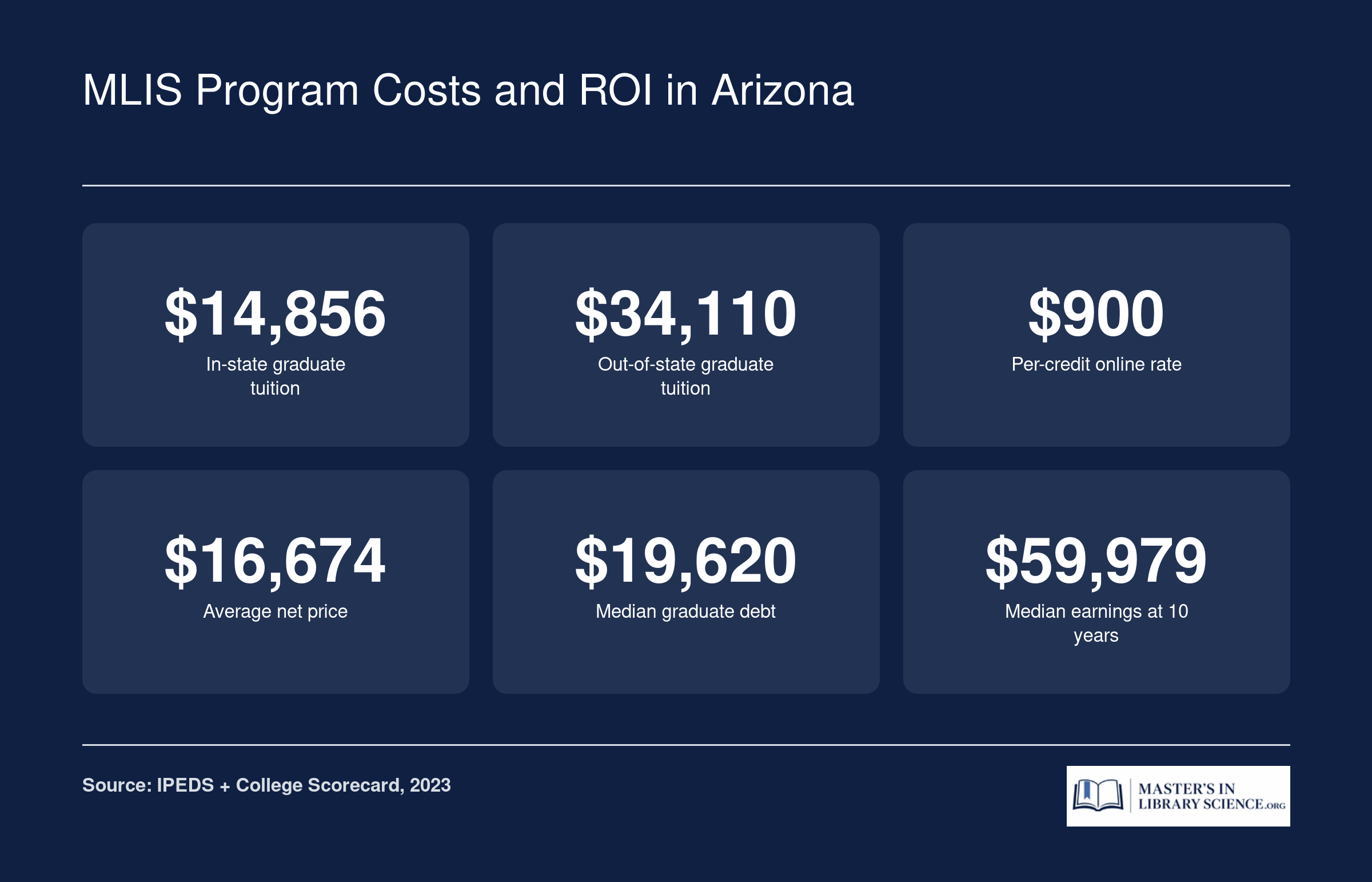
MLIS Program Costs and ROI in Arizona

Arizona's single ALA-accredited MLIS, at the University of Arizona, lists tuition at $900 per credit across its 37-credit curriculum. Comparing that sticker price against typical graduate debt and post-degree earnings reveals an ROI story most program directories overlook.

University of Arizona MLIS in-state tuition $14,856, out-of-state $34,110, net price $16,674, median earnings $59,979

ALA Accreditation: Why It Matters for Arizona Librarians

If you are researching library science programs in Arizona, one of the first questions you should ask is whether a program holds accreditation from the American Library Association (ALA). The short answer for Arizona: the University of Arizona's Master of Arts in Library and Information Science is the only ALA-accredited MLIS program in the state. Understanding what that distinction means can save you time, money, and career frustration down the road.

What ALA Accreditation Actually Means

ALA accreditation is a voluntary quality review process that evaluates a program's curriculum, faculty qualifications, student outcomes, and alignment with professional competencies defined by the library and information science field. Programs must undergo periodic reviews to maintain their accredited status. When a program carries the ALA seal, it signals to employers and licensing bodies that the degree meets nationally recognized professional standards. For a deeper look at the review process, see our guide on ALA accredited programs.

For students, this translates into practical advantages. Most public library systems, academic libraries, and federal librarian positions either require or strongly prefer candidates who hold an MLIS from an ALA-accredited program. Federal roles, such as those listed through the Library of Congress or other government agencies, typically list ALA accreditation as a non-negotiable qualification. Many state library associations and civil service classifications follow the same pattern.

Arizona's ALA-Accredited Option

The University of Arizona's MLIS, offered through the School of Information, is the sole program in Arizona that holds this accreditation. Students can complete the degree fully online, making it accessible regardless of where they live in the state. So to directly answer the common question: yes, the University of Arizona MLIS program is ALA accredited, and it is the only Arizona-based program that can make that claim.

Why ASU and Other Arizona Programs Are Different

Arizona State University offers graduate programs in information technology, knowledge management, and related fields, but ASU does not currently offer an ALA-accredited MLIS. Students sometimes confuse library-adjacent degrees in areas like information science, educational technology, or digital media with a professional library science credential. While these programs have their own value, they do not meet the ALA accreditation standard that most librarian positions demand.

This is an important distinction. If your career goal is to work as a librarian in a public, academic, school, or special library setting, enrolling in a non-accredited program could limit your eligibility for the very positions you are training for. Reviewing the full library science degree requirements before you apply can help you avoid that pitfall.

The Bottom Line for Arizona Students

Before committing to any graduate program, verify its accreditation status directly through the ALA's online directory of accredited programs. For Arizona residents or anyone interested in studying at an Arizona institution, the University of Arizona remains the clear choice for a professionally recognized library science degree. If you are considering an out-of-state online MLIS, applying the same accreditation check is equally important to protect your investment and career prospects.

According to the Bureau of Labor Statistics, librarian employment is projected to grow just 2 percent from 2024 to 2034. That slower than average growth rate means competition for open positions can be fierce, making credentials from an ALA accredited MLIS program especially valuable for candidates looking to stand out in Arizona's job market.

MLIS Specializations and Concentrations Available in Arizona

The University of Arizona's Master of Arts in Library and Information Science program offers a robust set of concentrations that map directly to career paths both within the state and nationally. As the only ALA-accredited MLIS program in Arizona, UArizona has designed its 37-credit curriculum to let students tailor their studies to specific professional goals.

Available Concentrations

Students can choose from several distinct specialization tracks:

  • Archival Studies focuses on preservation techniques, digital archiving, collection management, metadata standards, and ethical practices. Students develop skills in appraising, arranging, and describing historical materials, preparing them for careers in archives, museums, and cultural institutions.
  • Academic Librarianship prepares graduates for positions in college and university library systems, with coursework in information organization, digital resources, and research support.
  • Public Librarianship emphasizes community engagement and practical service delivery, balancing theory with real-world applications for public-facing library roles.
  • Digital Information Management and Curation trains students in digital collections, data preservation, and information organization for modern information careers in libraries, archives, or corporate settings.
  • Legal Information prepares graduates to work in law libraries, law firms, and court systems where specialized information retrieval and management skills are essential.
  • Medical and Health Information equips students for roles in hospital libraries, health sciences institutions, and medical research organizations.

Matching Specializations to Arizona's Job Market

Arizona's rapid population growth, particularly in the Phoenix and Tucson metro areas, is driving demand across multiple library sectors. The public librarianship concentration aligns well with expanding public library networks in Maricopa and Pima counties, where growing communities need skilled professionals to develop programs and manage collections.

The academic librarianship track connects to opportunities at Arizona's large university systems and community college networks. With three state universities and dozens of community colleges, the state supports a steady need for academic librarians skilled in research services and digital resource management.

The archival studies concentration holds particular relevance for Arizona's tribal libraries and cultural preservation efforts. The state is home to 22 federally recognized tribes, and institutions serving these communities need professionals trained in ethical archival practices and culturally sensitive collection management.

For students drawn to technology-forward roles, the digital libraries concentration in information management and curation opens doors to positions in corporate information management, government data curation, and digital repository administration. Arizona's growing tech sector in the Phoenix metro area creates additional demand for professionals who can organize, preserve, and provide access to digital assets.

What Can You Do With a Library Science Degree in Arizona?

The program's interdisciplinary approach means graduates are not limited to traditional library roles. Depending on concentration, career paths include school librarian positions in Arizona's expanding K-12 districts (after meeting state certification requirements), archivist roles at museums and historical societies, digital asset managers at corporations, health information specialists at medical centers, and reference librarians at academic or public institutions. The legal information specialization opens a less common but well-compensated path into law librarianship, serving Arizona's legal community in firms, courts, and government agencies.

Career Outcomes and Salaries for Arizona MLIS Graduates

One of the most practical questions prospective students ask is: what is the salary for a librarian in Arizona? The answer depends on experience, employer type, and specialization, but available data paints a clear picture of a career that offers financial stability and strong demand across the state.

Arizona Librarian Salary Overview

According to Bureau of Labor Statistics data for librarians and media collections specialists (SOC 25-4022), the national median annual wage sits at $64,370, with a full range spanning from about $38,690 at the 10th percentile to $101,970 at the 90th percentile.1 In Arizona specifically, salary estimates place the median annual wage for librarians at approximately $60,753, with mean annual wages reaching around $69,252.2 These figures suggest that while Arizona's median trails the national figure slightly, experienced librarians in the state can earn competitive wages, particularly in specialized or senior roles.

The national mean annual wage of $66,990 provides additional context.1 Librarians who pursue concentrations in high-demand areas such as health sciences librarianship, digital information management, or legal information may see earnings at the higher end of these ranges. For a broader look at how Arizona compares to other states, see our Master's in Library Science Expected Salary by State guide.

Program-Specific Earnings Data

The University of Arizona's MLIS program is the only ALA Accredited option in the state. While program-specific federal scorecard earnings data for short-term outcomes (one-year, two-year, and four-year post-graduation medians) is not currently reported for this particular credential, the institution-wide median earnings 10 years after enrollment sit at $59,979. This figure represents all University of Arizona graduates across programs, so MLIS-specific outcomes may differ. Readers should treat this as a general institutional benchmark rather than an MLIS-specific projection.

Employment Prospects and Major Employers

Arizona's library job market is supported by a range of large public and academic employers.3 Key hiring organizations include:

  • Maricopa County Library District, one of the largest public library systems in the state
  • Phoenix Public Library, serving the fifth-largest city in the United States
  • Arizona State University and University of Arizona library systems, which employ academic librarians across multiple campus locations
  • Smaller but notable employers such as Amphitheater Public Schools in Tucson, Diné College in Tsaile, and specialized settings like Chamberlain University in Phoenix for health sciences librarian roles

Most professional librarian positions at these institutions require a MLIS degree from an ALA-accredited program.4 This requirement is standard across public library systems, academic libraries, and many school districts in Arizona, making ALA accreditation a practical necessity rather than a nice-to-have credential.

What Graduates Can Expect

While program-specific employment share and poverty-threshold data are not currently available for the University of Arizona's MLIS program through federal reporting, the broader job outlook for librarians nationally remains steady. The BLS notes that a master's degree in library science, often from an ALA-accredited institution, is the standard prerequisite for entering the profession.4 Arizona graduates benefit from a state with growing population centers and expanding public library infrastructure, particularly in the Phoenix-Mesa-Chandler and Tucson metro areas, where demand for qualified librarians continues to align with community growth.

Admission Requirements and How to Apply to Arizona MLIS Programs

Applying to an online MLIS program in Arizona is straightforward once you understand what admissions committees expect. The University of Arizona School of Information, the state's flagship option, outlines clear requirements through its Graduate College admissions portal.1 Below is a breakdown of what you need, when to apply, and how to put together a competitive application.

Core Admission Requirements at the University of Arizona

To be considered for the UA MLIS program, applicants must hold a bachelor's degree from an accredited institution and have a minimum cumulative GPA of 3.0.1 The program does not currently require the GRE, as a waiver is available for the 2025-2026 admissions cycle.1 This makes the application process more accessible for working professionals and career changers who may not have recent standardized test scores.

The application package submitted through the University of Arizona Graduate College portal typically includes:

  • A personal statement outlining your interest in library and information science
  • Letters of recommendation (usually two or three) from academic or professional references
  • A current resume or CV highlighting relevant experience
  • Official transcripts from all post-secondary institutions attended

There is no specific prerequisite coursework beyond holding a bachelor's degree, and applicants come from a wide range of undergraduate backgrounds.

Application Deadlines and Admission Cycles

The primary application deadline for Fall 2026 admission is March 1.1 The UA MLIS program follows a fixed admissions cycle rather than rolling admissions, so submitting your materials well before the deadline is important. Late applications may be considered on a space-available basis, but this is not guaranteed. Planning ahead gives you the best chance of securing a spot and accessing any financial aid opportunities.

How Long Does It Take to Complete an MLIS Degree Online?

The UA MLIS requires 37 credit hours and is designed to be completed in approximately 24 months of full-time study.2 Part-time students can extend this timeline to fit work or personal commitments, though doing so will naturally push graduation further out. The online format offers flexibility in pacing while still maintaining a structured curriculum.

Tips for a Strong MLIS Application

Your personal statement is arguably the most important piece of your application. Admissions committees want to see a clear connection between your goals and the library and information science field. Rather than writing broadly about loving books or research, focus on specific experiences that sparked your interest, such as volunteering at a public library, managing digital collections, or working in an archival science setting.

If you lack direct library experience, consider gaining some before you apply. Many public and academic libraries welcome volunteers, and even informal roles like organizing a community reading program or managing records for a nonprofit can demonstrate relevant skills. Internships, even short-term ones, signal genuine commitment.

For your letters of recommendation, choose references who can speak to your analytical thinking, communication skills, or leadership potential. Academic references are valuable if you are a recent graduate, but supervisors or mentors from professional settings work just as well for career changers. Give your recommenders at least four to six weeks of lead time, and share a brief summary of your goals so they can tailor their letters accordingly.

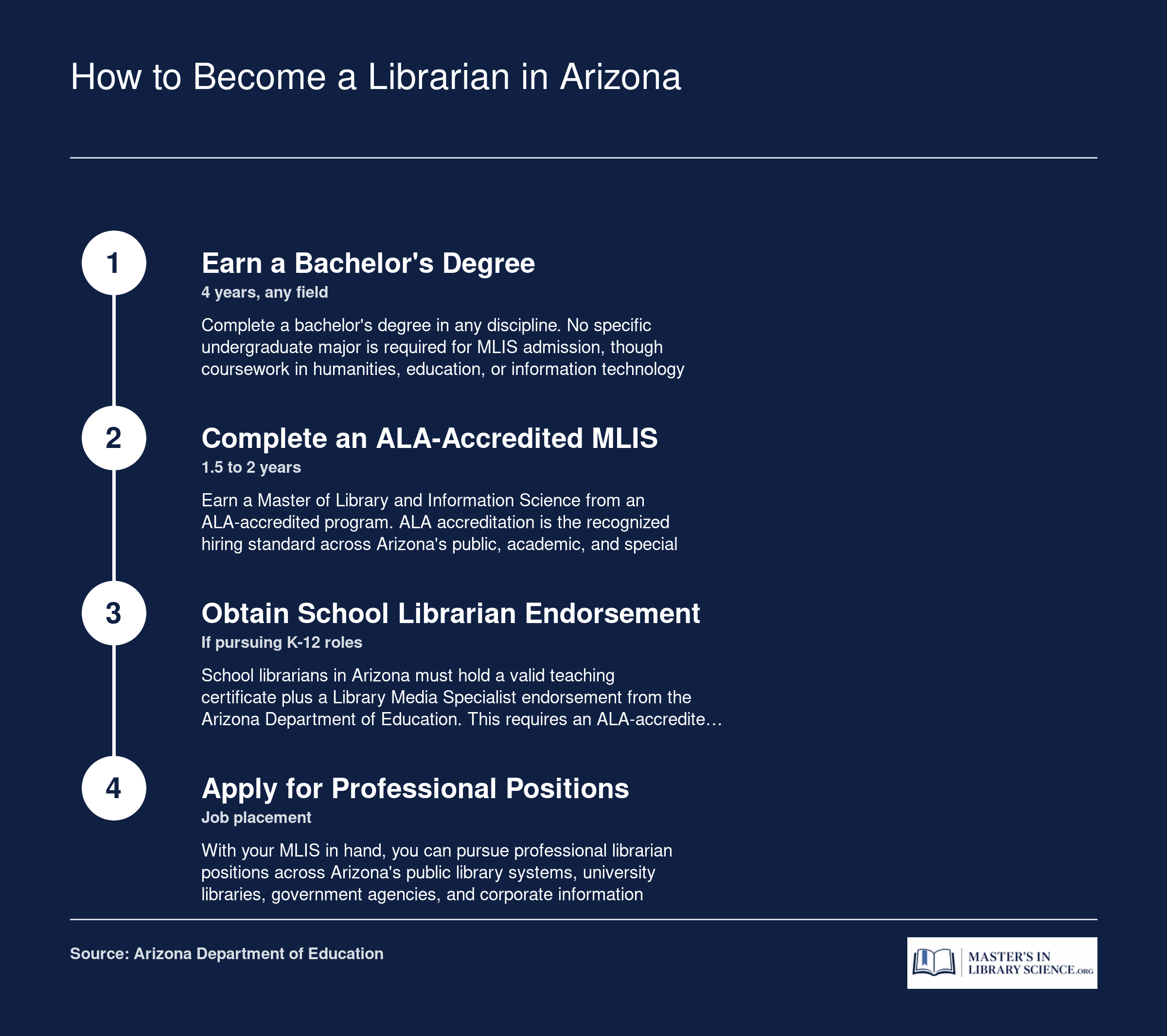
How to Become a Librarian in Arizona

Do you need a master's degree to be a librarian in Arizona? Yes. Most professional librarian positions in public, academic, and special libraries require an ALA-accredited MLIS degree as the baseline hiring standard. Arizona does not mandate a state license for public or academic librarians, but school librarians must obtain an Arizona Department of Education endorsement to work in K-12 settings.

Four step path to becoming a librarian in Arizona, from bachelor's degree through MLIS to optional school librarian endorsement and job placement

Frequently Asked Questions About Arizona MLIS Programs

Prospective students often have similar questions about pursuing a Master's in Library and Information Science in Arizona. Below are answers to the most common questions, drawing on program details, accreditation standards, and career data covered throughout this guide.

Is the University of Arizona MLIS program ALA accredited?
Yes, the University of Arizona's Master of Arts in Library and Information Science is accredited by the American Library Association. This accreditation is critical because most professional librarian positions at public libraries, academic institutions, and federal agencies require a degree from an ALA accredited program. The UA program has maintained this accreditation continuously and undergoes regular review to ensure it meets ALA standards.
How much does an online MLIS degree cost in Arizona?
Tuition for the University of Arizona's online MLIS program varies based on residency status. Arizona residents can expect to pay less per credit hour than out of state students, though the online format often narrows the gap. Total program costs typically range from approximately $20,000 to $35,000 depending on residency, fees, and course load. Financial aid, graduate assistantships, and scholarships can help offset expenses.
What can you do with a library science degree in Arizona?
An MLIS degree opens doors to careers as a public librarian, academic librarian, school library media specialist, archivist, digital asset manager, or information analyst. Arizona's growing population supports demand across public library systems, K through 12 schools, tribal libraries, university libraries, and private sector organizations. Graduates also pursue roles in data management, user experience research, and knowledge management in corporate settings.
How long does it take to complete an MLIS degree online?
Most students complete the University of Arizona's online MLIS in about two years of full time study, which typically involves 36 credit hours. Part time students can extend their timeline to three or even four years, making the program flexible for working professionals. Accelerated options may be available depending on course availability and individual scheduling, allowing some students to finish in as few as 18 months.
Do you need a master's degree to be a librarian in Arizona?
For most professional librarian positions in Arizona, yes, a master's degree in library and information science from an ALA accredited program is required. This applies to roles in public libraries, academic libraries, and many special libraries. Some paraprofessional or library technician positions may not require a master's degree, but advancement into supervisory or specialized librarian roles almost always does.
What is the salary for a librarian in Arizona?
According to the U.S. Bureau of Labor Statistics, librarians in Arizona earn a median annual salary that is competitive with national figures. Salaries vary by setting and experience, with academic and specialized librarians often earning more than those in public library systems. Entry level librarians in Arizona can expect starting salaries in the range of $45,000 to $55,000, while experienced professionals may earn $65,000 or more.
Can I work while completing the UA MLIS online?
Yes, the University of Arizona's online MLIS program is designed with working professionals in mind. Courses are delivered asynchronously, meaning students can access lectures and complete assignments on their own schedule. Many students maintain full time or part time employment throughout the program. Part time enrollment options further support work and life balance, making it feasible to gain practical experience while earning your degree.