Librarians earned a median wage of $64,370 in 2024, per the Bureau of Labor Statistics, with strong variation by setting and region.
ALA-accredited MLIS programs are the standard employers and state licensing boards expect, and accreditation status should be the first filter in any program search.
Net prices at top MLIS programs range from under $10,000 to the low six figures, with online and in-person formats often charging identical tuition.
Specializations like academic, public, school, and archival librarianship lead to distinct career paths, so concentration choice shapes coursework and hiring prospects.
A career in library science can mean shelving rare manuscripts, running a children's storytime, building a university's data archive, or designing digital systems for a hospital. The path almost always runs through the same credential: an ALA-accredited Master of Library and Information Science.
This hub pulls together what prospective students ask about most: which programs are worth a closer look, what an MLIS actually costs, what librarians earn, why ALA accreditation matters, how online formats compare to on-campus, and which specializations lead where. For a full catalog of online MLIS programs, start with our main degree directory.
Use the sections below to navigate by need, from the Best Master's in Library Science Programs rundown to a clear-eyed look at Tuition vs. Earnings ROI, plus a state-by-state view of masters in library science salary data.
How Much Does It Cost to Become a Librarian?
The total cost of becoming a librarian is more than just tuition. A realistic budget includes graduate tuition and fees, books and technology, and, for anyone planning to work in a K-12 school, state licensure costs on top of the degree.
Tuition and Net Price at Affordable MLIS Programs
Public universities anchor the affordable end of the MLIS market, especially for in-state residents. Among the lower-cost programs in our rankings, the University of South Florida reports an average net price of about $9,812 per year, Florida State University comes in around $11,297, and the University of North Carolina at Chapel Hill sits near $11,655. UCLA's average net price is roughly $12,548, and the University of Washington-Seattle is about $14,091. Net price reflects what students typically pay after grants and scholarships, so it is a more realistic planning number than sticker tuition alone. For a wider view of low-cost options, see our roundup of the cheapest library science degree online.
Beyond tuition, plan for required fees, textbooks and database access, a laptop that meets your program's specs, and travel costs if your program includes any in-person residencies or a practicum.
In-State vs. Out-of-State and the Online Advantage
The gap between in-state and out-of-state graduate tuition can be steep. UNC Chapel Hill, for example, lists in-state tuition near $8,994 against out-of-state tuition above $41,000. The University of Michigan shows a similar split, with in-state tuition around $17,736 and out-of-state above $60,000.
Online MLIS programs often flatten this gap. Many fully online options charge a single tuition rate regardless of residency, or offer reduced out-of-state rates, which can make a top-ranked program in another state competitive with your local school.
State Licensure Fees for School Librarians
If your goal is to work as a K-12 school librarian, factor in state certification costs on top of the MLIS. Total fees typically run $200 to $600, including an application fee ($50 to $200), an exam fee ($100 to $200), and fingerprinting ($40 to $100).1 Renewals later run roughly $20 to $50.
Costs vary widely by state. New Jersey runs about $250 to $450 once you add the provisional issuance fee, credential evaluation, and fingerprinting.1 Texas runs $200 to $400 and requires the TExES School Librarian EC-12 exam plus two years of work experience. Pennsylvania is cheaper, $100 to $300, and does not require a separate librarian exam.2 For exact requirements in your state, see our school librarian certification guide.
MLIS Salary Outlook: What Librarians Actually Earn
Librarian salaries cover a wider range than many prospective students expect. According to the Bureau of Labor Statistics, librarians and media collections specialists earned a median annual wage of $64,370 in 2024, with a mean wage of $68,570 (about $32.97 per hour).1 Roughly 142,100 people held these jobs nationally, and employment is projected to grow about 2% from 2024 to 2034.2
National Wage Percentiles
The spread from entry-level to experienced pay is significant. Looking at the full distribution gives a more honest picture than a single median:
10th percentile: $38,690
25th percentile: $50,930
Median (50th): $64,370
75th percentile: $80,980
90th percentile: $101,970
In other words, the top 10% of librarians earn roughly two and a half times what the bottom 10% earn. Where you land on that curve depends heavily on your employer type, geography, and years of experience. For a deeper breakdown, our Master's in Library Science Career Pay & Salary guide walks through the numbers role by role.
Where Librarians Earn the Most
Geography matters. California reported a mean annual wage of $78,990 for librarians in 2024, and New York followed closely at $77,140, both well above the national average.1 Metro areas with strong public funding and large academic systems tend to pay more. The Hartford, Connecticut metro area, for example, posted a median wage of $73,800 (about $35.91 per hour) for roughly 870 librarian positions.3
It is worth noting that high-wage states also tend to have higher costs of living, so a larger paycheck does not always translate to more take-home value. State-by-state differences are large enough that prospective students often consult a library science salary by state comparison before committing to a program.
Employer Type Makes a Big Difference
Not all librarian jobs pay the same. Public library positions, especially in smaller or rural systems, often cluster near the lower and middle percentiles. Academic librarians at universities and special librarians working in law firms, corporations, hospitals, or research institutions typically earn more, frequently landing in the 75th to 90th percentile range.
The federal government is the standout employer: librarians working for federal agencies earned a mean annual wage of $102,320 in 2024, the highest of any major employer category.1 Roles at the Library of Congress, national agencies, and federal research libraries account for much of that premium. If maximizing earnings is a priority, targeting academic, special, or federal MLIS career paths is worth considering early in your planning.
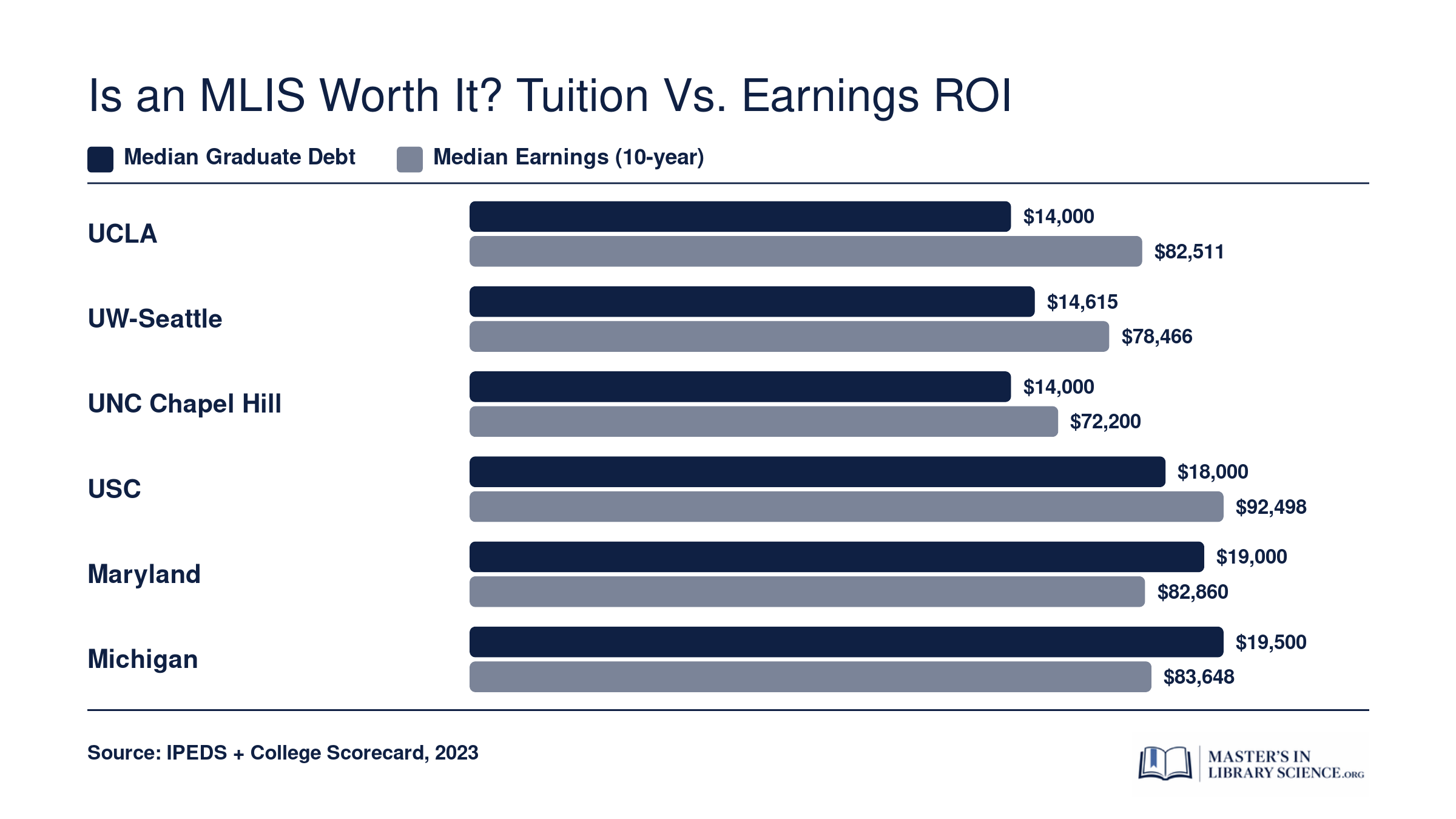
Is an MLIS Worth It? Tuition Vs. Earnings ROI
One way to gauge MLIS value: stack typical graduate debt against long-term earnings. At these six top-ranked programs, mid-career salaries dwarf debt loads, suggesting most graduates can recoup borrowing within just a year or two of full earnings.
ALA Accreditation: Why It Matters for Your MLIS
When you start comparing MLIS programs, one credential cuts through the noise: accreditation by the American Library Association (ALA). It is the benchmark that employers, hiring committees, and state licensing boards use to verify that a degree meets professional standards. Treat it as the first filter you apply, not the last.
The Standard Employers Expect
Most professional librarian roles, from public library directors to special collections archivists, list an ALA-accredited master's degree as a baseline requirement in the job posting. Skipping accreditation can quietly close doors you did not know were closing.
Two categories where this matters most:
Academic librarians: Colleges and universities almost universally require an ALA-accredited MLIS or MLS for tenure-track and full-time librarian positions.
School librarians: Many states tie their school library media specialist license or endorsement directly to completion of an ALA-accredited program, sometimes paired with a teaching credential.
If you are considering public, corporate, law, or medical librarianship, the same expectation generally holds, even when it is not written into law. For tenure-track roles, the academic librarianship degree pathway leans heavily on this credential.
How to Verify a Program
The ALA maintains a public Directory of Accredited Programs that lists every master's degree currently in good standing in the United States, Canada, and Puerto Rico. Before you apply anywhere, look the school up directly on the official list of ALA accredited MLIS programs. Be cautious of programs marketed as library science alternatives, certificates positioned as MLIS substitutes, or degrees from institutions whose accreditation has lapsed or is only at the regional (not programmatic) level. Regional accreditation of the university is not the same as ALA accreditation of the degree.
Accreditation Does Not Mean Expensive
A common misconception is that ALA-accredited programs cost more. They do not. Accreditation is a quality standard, not a price tier. Many of the most affordable online MLIS programs in the country, including several at public universities with in-state or flat online tuition, hold full ALA accreditation. You do not have to choose between credibility and budget. You can, and should, insist on both.
Online Vs. In-Person MLIS Programs
Most ALA-accredited MLIS degrees are now available in both online and on-campus formats, and many schools charge the same tuition either way. The right choice depends on how you learn, whether you can relocate, and what kind of library work you want to do after graduation.
Upsides
Downsides
Online MLIS programs offer schedule flexibility that lets you keep a full-time job or care for family while you study.
Online students get fewer casual networking moments with faculty and classmates, which can matter for job referrals later.
Studying online removes relocation costs and opens the door to ALA-accredited programs anywhere in the country.
Remote formats may offer fewer in-person practicum touchpoints, so you have to seek out local internships on your own.
Many schools charge online students the same tuition as in-person students, so the degree itself does not cost more.
Online learning demands strong self-discipline and time management, since you set most of your own pace.
In-person programs give you direct faculty mentorship, a peer cohort, and easier access to graduate assistantships and paid teaching roles.
In-person programs often require relocation, raising your total cost of attendance through housing, transportation, and lost wages.
On-campus students can work hands-on with university archives, rare books, and special collections that strengthen a resume.
On-campus schedules can be hard to combine with full-time work, especially if required courses meet during the day.
Specializations and Career Paths in Library Science
The MLIS is one degree, but it opens doors to very different jobs. Choosing a specialization shapes your coursework, your practicum placement, and the employers who will take your resume seriously. Most programs ask you to declare a concentration in your first or second semester, so it pays to think about direction before you apply.
Common MLIS Concentrations
Academic librarianship: Supports faculty research and undergraduate instruction at colleges and universities. Often requires a second master's for tenure-track roles.
School library media: Runs K-12 school libraries and teaches information literacy. Employers are public and private school districts.
Archives and preservation: Manages historical records, manuscripts, and rare materials for universities, museums, government agencies, and corporations.
Digital and data curation: Handles digital repositories, metadata, and research data management. A growing track tied to universities, federal agencies, and tech-adjacent employers.
Youth and children's services: Programs storytimes, summer reading, and teen services in public libraries.
Health sciences librarianship: Supports clinicians and researchers in hospitals, medical schools, and pharmaceutical companies. Often the highest-paid track.
Special librarians (legal, medical, corporate) and academic librarians typically sit at the higher end of the pay scale, since their employers are well-funded and the work overlaps with research and analytics. Public library and school library roles tend to pay less but offer stable benefits, pensions, and predictable schedules.
A Note on School Librarians
If you want to work in a K-12 school, the MLIS alone is usually not enough. Most states require an additional teaching license or school media certification, and some require classroom teaching experience first. Check your state's department of education rules before enrolling, because requirements vary widely.
Pick Before You Apply
Not every school offers every concentration. A program strong in archives may have nothing for health sciences, and vice versa. Narrowing your specialization first lets you target schools that actually offer the how to choose a concentration for library science program, faculty, and internship pipelines you need.
Common Questions About MLIS Degrees
Below are quick answers to the questions prospective students ask most often when researching MLIS programs. Each answer covers the essentials on cost, salary, format, accreditation, timeline, and admissions so you can move forward with a clearer plan.
How much does it cost to become a librarian?
Total MLIS tuition typically ranges from about $20,000 at in-state public programs to $60,000 or more at private universities. Add fees, books, and any required residencies or technology charges. Many students offset costs with graduate assistantships, employer tuition benefits, or by attending a public school in their home state. Online programs sometimes charge a flat tuition rate regardless of residency, which can simplify budgeting.
What is the average salary for a librarian with a master's degree?
According to the U.S. Bureau of Labor Statistics, librarians and media collections specialists earn a median annual wage of roughly $64,000, with the top 10 percent earning over $100,000. Pay varies by sector: academic and special librarians often earn more than public librarians, while school librarians follow district teacher pay scales. Location, years of experience, and management responsibilities also shape earnings.
Are online MLIS programs as good as in-person programs?
Yes, when the program is ALA accredited. Employers evaluate the accreditation and the degree itself, not the delivery format. Online MLIS programs use the same faculty, curriculum, and learning outcomes as on-campus tracks at most schools. The main trade-offs are practical: online students gain flexibility but need to be proactive about networking, internships, and building relationships with faculty and classmates.
Which MLIS programs are ALA accredited?
The American Library Association currently accredits more than 60 master's programs across the United States, Canada, and Puerto Rico. Well-known accredited programs include those at the University of Illinois, the University of Washington, Rutgers, Syracuse, San Jose State, and the University of North Carolina. The ALA maintains an official directory of accredited programs, which is the authoritative source to confirm a school's status.
How long does it take to earn a master's in library science?
Most full-time MLIS students finish in about two years, completing 36 to 48 credit hours. Accelerated tracks can compress this to 12 to 18 months, while part-time students often take three to four years. Online programs frequently allow flexible pacing, letting working professionals balance coursework with their jobs. A few schools offer dual degrees that take longer but combine an MLIS with a second specialization.
Do you need a GRE to apply to MLIS programs?
Usually not. The vast majority of MLIS programs have dropped the GRE requirement, and most ALA-accredited schools now admit students based on undergraduate GPA, a personal statement, letters of recommendation, and relevant work or volunteer experience. A handful of competitive research universities still request scores or accept them optionally. Always verify current admissions requirements directly on each program's website before applying.