Music librarians manage scores, recordings, and performance parts using specialized metadata standards like RDA, MARC, and music thesauri.
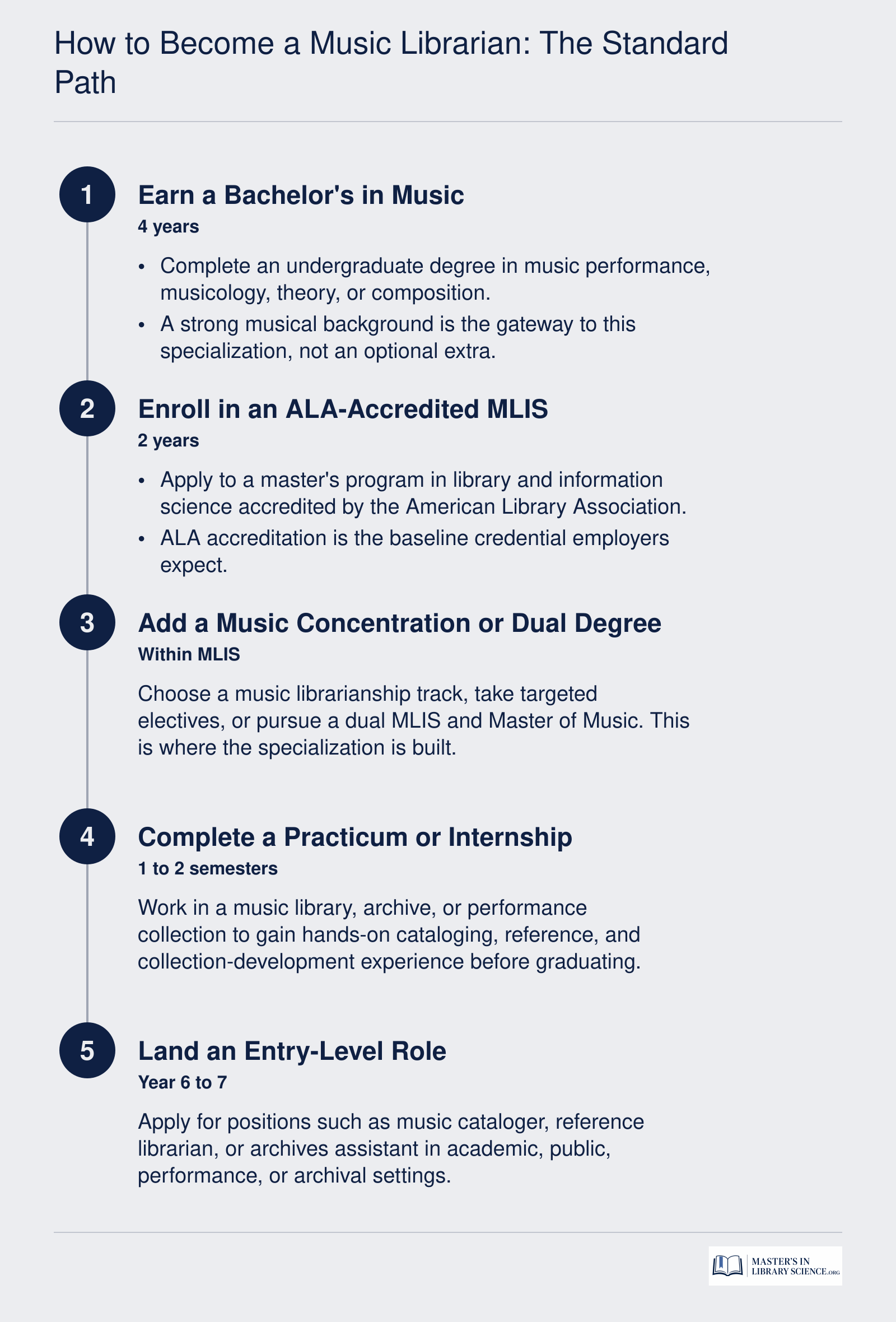
The standard path takes six to seven years: a music bachelor's, then an ALA-accredited MLIS with a music track.
ALA accreditation is required for most academic and conservatory jobs, so verify it before enrolling in any program.
Expect coursework in music cataloging, reading knowledge of German, French, or Italian, and a supervised practicum.
Music librarianship is a small field with surprisingly steady demand. University music libraries, symphony orchestras, opera companies, public radio archives, and conservatories all need specialists who can catalog scores, manage performance parts, and steward audio collections that general librarians are not trained to handle.
The catch: fully online MLIS programs with a true music concentration are rare, and most require at least some on-campus or hybrid coursework once you reach the music-specific electives. For candidates weighing adjacent specializations, an academic librarianship degree often shares much of the same MLIS core.
This guide walks through the programs that exist, what the coursework and practicum hours look like, realistic salary ranges by setting, and the four main career paths, from academic libraries to broadcast archives.
What Is a Music Librarian?
A music librarian is a specialized information professional who manages collections of scores, sheet music, audio and video recordings, performance parts, and music-specific reference materials. Unlike a general academic librarian, a music librarian works with formats and metadata that demand subject fluency: identifying a piece by opus and catalog number, distinguishing a critical edition from a performance edition, cataloging a recording by performer and conductor as well as composer, and applying specialized standards like the MARC music format and thematic catalog numbering systems.
Subject Expertise Sets the Role Apart
Music librarians typically hold an undergraduate degree in music (often performance, theory, history, or composition) in addition to their MLIS. That background matters because the job involves answering questions a generalist cannot easily field: locating a specific edition for a doctoral recital, verifying instrumentation for an orchestra rental, or advising a researcher on primary sources in a composer's manuscript collection. Reading musical notation, recognizing repertoire, and understanding music theory and history are working tools, not optional extras. These library science skills sit alongside the cataloging and reference fundamentals taught in any MLIS program.
Where Music Librarians Work
The role appears in several settings, each with a slightly different emphasis:
University music libraries and schools of music, supporting faculty research and student performance
Conservatories, where collections lean heavily toward performance materials and parts
Orchestra and opera company libraries, focused on preparing parts, marking bowings, and managing rentals
Public libraries with significant music collections or circulating instrument programs
Broadcast and media archives, including radio stations and film studios
Across these settings, careers in library science tied to music tend to reward candidates who can move fluently between public service and behind-the-scenes technical work.
Overlap With the Music Archivist Role
Many music librarians also function as music archivists, preserving fragile recordings, composer manuscripts, concert programs, photographs, and other ephemera. In smaller institutions a single person often handles both circulating collections and archival holdings, making preservation and digitization core parts of the job. For students drawn to that side of the work, an online archival studies masters can complement music-focused coursework.
How to Become a Music Librarian: The Standard Path
Music librarianship sits at the intersection of two disciplines, so the path requires depth in both. Most music librarians follow a five-stage progression that takes roughly six to seven years from the start of a bachelor's degree.
Online and Hybrid Master's Programs With a Music Librarianship Track
A handful of ALA-accredited schools currently offer a music librarianship concentration, specialization, or substantive music coursework inside an MLIS or MS in Library Science. Delivery formats vary widely, and "online" rarely means 100% online once specialized music courses enter the picture. Below is a practical comparison of programs active for the 2025-2026 academic year, drawn from the ALA Accredited Programs Directory and each school's published program pages.1
Fully Online Options
These programs deliver the MLIS coursework, including the music track or electives, through distance learning:
University of North Texas, MS in Library Science with a Music Librarianship Concentration. 36 credits at roughly $407 per credit. Among the most affordable fully online routes.
Kent State University, MLIS with substantial music coursework available as electives. Around $570 per credit.
Simmons University, MS in Library and Information Science with a Music Librarianship Track. Tuition runs about $1,020 per credit, the highest of the online cohort.
University of Illinois Urbana-Champaign, MS in Library and Information Science with a Music Librarianship Specialization. About $751 per credit.
San Jose State University, MLIS with Music Librarianship electives. Approximately $835 per credit.
Programs with the deepest music librarianship curricula tend to require campus time, often because they draw on a partner school of music for graduate-level music history, theory, or bibliography courses.
Indiana University Bloomington, MIS (Master of Information Science) with a Music Librarianship Track, hybrid format, about $620 per credit. Indiana's Cook Music Library is one of the largest academic music libraries in North America, and on-site coursework is part of the appeal.
Catholic University of America, MSLS with a Music Librarianship Concentration, on-campus only, roughly $1,000 to $1,100 per credit.
What "Online" Really Means Here
Prospective students should read each program's residency requirements carefully. Even at a fully online school, the music side of the curriculum (music bibliography, score cataloging, or a graduate music history seminar) may require synchronous attendance, a partner institution course, or a short on-campus residency. A practicum in a music library or archive is also standard, and that has to happen in person somewhere.
If you need a 100% remote pathway, UNT, Kent State, Illinois, Simmons, and San Jose State are the most flexible. If you want the strongest music library training and can relocate, Indiana and Catholic remain the traditional anchors of the field.
Why ALA Accreditation Is Non-Negotiable
When you compare music librarianship programs, the single most important credential to verify is whether the degree is accredited by the American Library Association (ALA). For most academic, research, and conservatory positions, an ALA accredited MLIS or MLS is treated as the baseline professional qualification, not a bonus.
The ALA Standard for Music Librarian Jobs
Browse job postings at university libraries, members of the Association of Research Libraries (ARL), or major conservatories like Juilliard, Eastman, or the New England Conservatory, and you will see the same line repeatedly: "ALA-accredited master's degree required." That language is not a suggestion. Hiring committees use it as a hard filter, and applications without it are often screened out before review. Public library systems and large performing arts archives apply the same rule for their professional librarian and archivist openings.
Where the Music Library Association Fits In
A common point of confusion: the Music Library Association (MLA) does not run its own accreditation process. There is no separate "MLA-accredited" list of music librarianship programs. Instead, MLA endorses the ALA framework and points prospective students toward ALA accredited programs that offer music-focused coursework, dual degrees with music, or strong practicum placements in music collections.
Watch Out for Non-Accredited Look-Alikes
Some online programs market themselves as "library science" or "information studies" degrees without holding ALA accreditation. These can leave graduates ineligible for the academic and conservatory roles they were aiming at.
Before enrolling, verify the program's current status directly through the ALA Office for Accreditation's online directory of accredited MLIS degree programs. Confirm the status is active, not on probation or conditional, for the year you plan to graduate.
Coursework, Languages, and Practicum Hours
A music librarianship track layers specialized music coursework on top of the standard MLIS core. Expect a familiar foundation in cataloging, reference services, and collection development, then build outward into the formats and metadata standards unique to music materials.
Core MLIS Plus Music-Specific Coursework
The MLIS backbone usually includes introduction to library science, organization of information (cataloging), reference and information services, collection development, and a research methods or capstone course. Music tracks add courses such as:
Music bibliography and reference sources
Score cataloging using MARC and RDA, including uniform titles for musical works
Audiovisual and sound recording archiving, including preservation of analog and born-digital formats
History of music printing and publishing
Music information retrieval or digital music libraries
The Music Library Association's Core Competencies for Music Librarianship serves as the de facto benchmark that programs and hiring committees use to gauge whether a graduate is prepared for specialized work. For a broader look at the top skills employers look for in library science degree graduates, the competencies map closely to general MLIS outcomes with added subject depth.
Language Requirements
Academic music librarian positions, especially tenure-track roles at research universities, almost always expect reading proficiency in German plus one Romance language, typically French or Italian. German covers the bulk of musicology scholarship, while French and Italian are essential for opera, early music, and historical performance research. Some programs build language study into the curriculum; others expect you to demonstrate proficiency through coursework or a translation exam before graduation.
Practicum and Internship Hours
Hands-on experience is non-negotiable. Most programs require a practicum or internship of roughly 100 to 300 hours in a music library, performing arts archive, or recording collection. This is where you learn to handle rare scores, process donor collections, run reference desks during recital season, and apply cataloging standards to real materials.
Dual-Degree MLIS Plus Master's in Music
For candidates targeting tenure-track academic music librarian roles, a dual degree is often the strongest credential. Examples currently active include:
Indiana University Bloomington: MA in Folklore/Ethnomusicology plus MLS, 51 total credits with 9 shared, ALA-accredited1
University at Buffalo: MA in Music History or Music Theory plus MS in Information and Library Science, 68 total credits with 6 shared, ALA-accredited and recognized by the MLA2
University of Wisconsin-Milwaukee: MM in Music plus MLIS, 57 total credits with 12 shared, with German, French, and Italian language preparation built in3
These pathways take longer than a standalone MLIS, but the combined subject expertise pays off in a competitive academic job market.
Music librarian salaries vary widely by employer type, geographic region, and whether the role is unionized. Because the Bureau of Labor Statistics does not break out music librarians as a separate occupation, prospective students should start with the broader librarian baseline and then adjust expectations based on setting.
The BLS Baseline for Librarians
The Bureau of Labor Statistics groups music librarians under Librarians and Media Collections Specialists (SOC 25-4022). As of 2024, the median annual wage for this occupation was $64,320, with a 2023 mean of $68,570.1 Entry-level workers earned around $38,690, while the most experienced 10 percent earned $101,970 or more.2 Total employment sits near 142,100, with roughly 13,500 annual openings projected through 2034 and a modest 2 percent growth rate.1
Setting matters. The BLS reports a 2023 mean wage of $73,890 in colleges and universities, $78,530 at junior colleges, $71,800 in elementary and secondary schools, and $62,360 in local government (which includes most public libraries).2 Union-represented librarians earn roughly 41 percent more than non-union peers, and the gender pay ratio in the field sits between 91 and 97 percent.3
How Music Librarian Roles Compare
Layering setting-specific information from Music Library Association salary discussions and active job postings, expected ranges look roughly like this:
Academic music librarians (university music libraries, conservatories): typically $55,000 to $80,000 for entry and mid-career roles, with department heads at large research institutions reaching $90,000 to $110,000.
Public library music or media specialists: generally $48,000 to $70,000, tracking close to the local government mean.
Orchestra and performance librarians (symphonies, opera companies, ballet): often $60,000 to $95,000, with major orchestras (Big Five and large regional ensembles) reporting principal librarian salaries above $100,000 under collective bargaining agreements.
Broadcast and media archive librarians (public radio, film studios, streaming archives): roughly $55,000 to $85,000, with higher pay in major media markets.
For a broader look at library science salary benchmarks across regions, state-level data can help calibrate these ranges.
Trade-Offs to Weigh
Orchestra performance librarians often out-earn entry-level academic music librarians, especially at unionized ensembles. The trade-off is scarcity: only a few dozen full-time orchestra librarian positions exist nationwide, and turnover is low. Academic and public library tracks offer more openings and clearer entry points, while archive roles fall in between. Treat these ranges as planning estimates rather than guarantees, and verify current postings before committing to a specialization.
Career Paths: Academic, Public, Performance, and Archives
Music librarians work across four main employment settings, each with distinct hiring rhythms, expectations, and pay scales. Because the field is small and specialized, national datasets rarely break out music librarian roles separately from the broader librarian category. The most reliable approach is to triangulate: use federal labor data for the big picture, niche job boards for current openings, and individual employer sites for the actual postings you will apply to.
Where to Find Reliable Job Outlook Data
For the broadest projections, go directly to the U.S. Bureau of Labor Statistics at BLS.gov and look up the Occupational Outlook Handbook entry for Librarians and Media Collections Specialists. The BLS publishes 2024-2034 employment projections, median wages, and estimated annual openings for the parent occupation. While these figures cover all librarians, they give you a defensible baseline for growth trends and replacement demand.
For state-level variation, search phrases like 'librarian salary 2024 [your state]' or 'archives job outlook BLS' to surface state labor department summaries and academic workforce reports. These often reveal regional patterns that national averages obscure.
Tracking Active Music Librarian Openings
The Music Library Association (MLA) maintains a job board that is the single best source for music-specific postings. Watch it over a few months to see how postings cluster: academic positions tend to surface heavily in late winter and spring for fall starts, while public library and archives roles appear more evenly year-round. Note the mix of employer types, required degrees, and any language or instrumental requirements as you scroll, since the spread of library science jobs in this niche is wider than most candidates expect.
For adjacent roles, the American Library Association (ALA) JobLIST and the Society of American Archivists (SAA) career center post openings in cataloging, special collections, and digital archives that frequently call for music subject expertise.
Checking Employers Directly
Real-time openings often appear on employer career pages before, or instead of, hitting aggregator boards. Build a watchlist that includes:
University HR sites for institutions with conservatories or strong music programs
Large public library systems with notable music collections
Performance organizations such as symphonies, opera companies, and broadcast archives
Independent music archives, historical societies, and label or publisher archives
Set up saved searches or email alerts where possible. Job titles vary widely (music cataloger, performing arts librarian, audio archivist, media collections specialist), so search broadly and read the full description rather than filtering only on 'music librarian.' If you are still mapping the wider landscape of MLIS career options, scanning these adjacent titles will sharpen your sense of where music expertise actually gets hired.
Frequently Asked Questions
Music librarianship sits at the intersection of two graduate-level fields: library science and music. The questions below pull together the practical details prospective students ask most often about training, salary, and career fit.
What degree do you need to be a music librarian?
Most music librarian positions require an ALA-accredited Master of Library Science (or MLIS) degree. For academic and specialized roles, employers strongly prefer candidates who also hold a bachelor's or master's degree in music. Some librarians earn dual master's degrees, while others complete a music undergraduate degree followed by an MLS with a music librarianship concentration or coursework.
Are there fully online master's programs in music librarianship?
Yes, but options are limited. Several ALA-accredited schools offer their MLS fully online and let students build a music librarianship focus through electives, independent studies, and remote practicums. Truly specialized music librarianship tracks are rarer and often hybrid, requiring some on-campus residencies. Always confirm with the program that music-focused coursework and practicum placements can be completed at a distance.
How much do music librarians make?
Music librarian salaries generally track with broader librarian pay and depend heavily on setting. Academic music librarians at universities tend to earn the most, followed by performance organizations and large public library systems. Entry-level roles often start in the mid five figures, while senior positions at research universities or major orchestras can reach well into the six figures, especially with administrative duties.
Do I need to know a foreign language to be a music librarian?
For academic and research-oriented positions, yes. Reading knowledge of at least one language beyond English, commonly German, Italian, French, or Latin, is often expected because so much music scholarship, scores, and historical materials are non-English. Public library and performance library roles are usually more flexible, but language skills still strengthen your candidacy and broaden the collections you can manage.
Is music librarianship a good career in 2026?
It remains a small but stable field. Job postings are limited compared to general librarianship, so candidates should expect a national search. That said, demand stays steady at universities with music programs, conservatories, orchestras, and major archives. Students who combine an ALA-accredited MLS, a music background, and digital or metadata skills are well positioned for the openings that do appear.
What's the difference between a music librarian and a music archivist?
A music librarian manages active collections that patrons use daily, including scores, recordings, reference help, and instruction. A music archivist focuses on preserving rare or historical materials such as composer manuscripts, performance ephemera, and institutional records. The roles overlap, share similar graduate training, and sometimes live in the same job description, particularly at smaller institutions where one person handles both.