ALA accreditation is the single most important credential to verify when comparing online MLIS programs in youth services.
Most MLIS degrees run 36 to 42 credits, with per-credit tuition driving wide differences in total cost.
BLS data shows librarian pay varies sharply by setting, geography, and years of experience.
A youth-focused practicum plus ALSC or YALSA aligned coursework positions graduates for entry-level children's or teen librarian roles.
Few library careers offer the daily reward of a youth services librarian: handing the right book to a reluctant reader, running a storytime that becomes a child's first taste of literature, or guiding a teen through a research project that shapes their future.
ALA-accredited online MLIS programs now make this career accessible from anywhere in the country, with flexible coursework designed for working adults.
This guide walks through what to expect, from accredited program options and curriculum details to tuition, salary outlook, and the step-by-step path to becoming a children's or young adult librarian.
What Is an MLIS in Children & Young Adult Services?
An MLIS in Children & Young Adult Services is a Master of Library and Information Science degree with a concentration focused on serving readers from birth through age 18. Students complete the same foundational coursework as any MLIS candidate (reference, cataloging, information ethics, management) and then layer on specialized classes in youth literature, programming, and developmental learning. The goal is to prepare librarians who can guide young patrons from board books through college-prep reading.
Children's Services vs. Young Adult Services
The specialization actually covers two related but distinct practice areas. Understanding the difference helps you pick electives and plan a career path.
Children's services typically covers birth through age 12. Coursework emphasizes early literacy, storytime planning, picture book evaluation, summer reading programs, and partnerships with caregivers and elementary schools.
Young adult services covers roughly ages 12 through 18. Classes focus on YA collection development, teen advisory boards, programming for adolescents, intellectual freedom issues unique to teen materials, and reaching reluctant readers.
Combined Tracks vs. Separate Concentrations
Program structure varies. Some schools bundle both age ranges into a single youth services track, while others let students specialize in one or the other. For example, the University of South Carolina offers a combined Youth Services concentration that spans birth through age 18, while San Jose State University's iSchool lets students choose courses targeted specifically at children or specifically at young adults within its broader pathway. If you're still weighing options, our guide on how to choose a concentration for library science program walks through the trade-offs.
Where Graduates Work
This specialization is not limited to one setting. Graduates typically move into:
Public library children's and teen departments, running storytimes, summer reading, and after-school programming
K-12 school libraries (often paired with a separate school librarian certification, depending on the state)
Academic libraries that maintain children's literature collections used by education and English faculty
Nonprofits, museums, and literacy organizations that serve youth audiences
In short, the concentration is broad enough to support several careers in library science while still giving you the focused expertise hiring managers look for in youth-facing roles.
Ala-Accredited Online MLIS Programs in Youth Services
For aspiring children's and young adult librarians, choosing an ala accredited mlis programs is the most important first step. Accreditation from the American Library Association signals that the degree meets professional standards recognized by public libraries, school districts, and academic employers nationwide.1 Below is a snapshot of accredited online MLIS programs that offer a defined specialization, concentration, or certificate in youth services, children's services, or young adult services.
Programs With Dedicated Youth Services Concentrations
Several ALA-accredited schools build their entire youth services pathway around fully online coursework, making them strong fits for working adults and out-of-state applicants:
Rutgers University (New Jersey): Youth Services concentration, fully online.
San José State University (California): students choose between Children's Librarianship or Young Adult Librarianship, fully online.
St. John's University (New York): Youth Services Specialization, fully online.2
Syracuse University (New York): Children and Youth Services concentration, fully online.
University of Alabama (Alabama): Children's Services or Youth Services pathway, fully online.
University of Denver (Colorado): Youth Services concentration, fully online.
University of Missouri-Columbia (Missouri): Youth Services concentration, fully online.3
These programs typically combine a core MLIS curriculum with electives in literature for children and teens, programming, intellectual freedom, and services for diverse youth populations.
Programs With Specialized or Hybrid Pathways
A few programs frame youth services within a broader thematic track or include limited in-person components:
University of Illinois at Urbana-Champaign (Illinois): Digital Age Librarian concentration with a Youth Experience specialization, fully online.
University of Washington (Washington): Youth and Family Services concentration, primarily online with some hybrid elements.
Texas Woman's University (Texas): School Librarian Certification with a youth and children's services focus, fully online, well suited for candidates targeting K-12 library positions.
How to Compare These Options
When narrowing your shortlist, look beyond the concentration name. Useful comparison points include:
Whether the youth specialization is a formal transcript notation, an informal advising track, or a stackable certificate.
The number of required youth-focused electives versus general MLIS coursework.
Whether the program supports school librarian licensure in your state, which matters if you plan to work in a K-12 setting.
Practicum or fieldwork flexibility, especially for online students placing themselves in a local public or school library.
All programs listed above hold ALA accreditation, so the deciding factors usually come down to cost, residency requirements, specialization depth, and how each curriculum aligns with your specific career goals in children's or young adult librarianship. For a broader view of options across the country, you can browse accredited MLIS degree programs by state and specialization.
Admissions Requirements and GRE Policies
Admissions requirements for online MLIS programs in children and young adult services are generally consistent across ALA-accredited schools, though specific thresholds and the role of the GRE vary. Most programs evaluate undergraduate GPA, letters of recommendation, a statement of purpose, and a resume rather than standardized test scores.
Common Requirements at Major Programs
The University of Alabama's online MLIS asks for a minimum 3.0 GPA, calculated on the last 60 hours of undergraduate coursework. Applicants must submit two letters of recommendation, a statement of purpose, and a resume.1
Louisiana State University's online MLIS also sets a 3.0 minimum GPA. LSU does not require letters of recommendation, but it does require a statement of purpose (about 1,000 words) and a current resume.2
The University of Wisconsin-Milwaukee's online MLIS uses a slightly lower 2.75 minimum GPA threshold, making it a practical option for applicants whose undergraduate record falls below the more common 3.0 cutoff.3
GRE Policies
Most ALA-accredited online MLIS programs have moved away from requiring the GRE, and many now waive it entirely or offer waivers based on prior graduate study, undergraduate GPA, or relevant professional experience. For a current overview of test-optional options, see this guide to No-GRE Master's in Library Science Programs. Because policies change from cycle to cycle, do not assume: confirm the current rule for the year you plan to apply.
How to Verify Requirements Before You Apply
Visit the official admissions or requirements page for each program you are considering, and look specifically for the current GRE statement and any waiver criteria.
Use the American Library Association's Directory of ALA-Accredited Programs to confirm a school's accreditation status, then cross-check the graduate catalog or admissions bulletin for the most authoritative requirements.
Review the U.S. Bureau of Labor Statistics occupational profile for librarians to understand general entry expectations for the field, but recognize that program-level GRE rules are not covered there.
Email or call the admissions office directly if anything is ambiguous, and ask explicitly whether work experience, a prior graduate degree, or a strong GPA qualifies you for a GRE waiver.
Curriculum: Core Courses and Youth Services Electives
An online MLIS in children and young adult services blends the foundational coursework every librarian needs with a focused track of youth-specific electives. Strong programs map their curriculum to the professional competencies published by ALSC (Association for Library Service to Children) and YALSA (Young Adult Library Services Association), giving graduates a credential that aligns with what hiring managers in public libraries and schools actually look for.
MLIS Core Courses
Regardless of specialization, MLIS students complete a shared foundation. Typical required courses include:
Foundations of library and information science
Reference and information services
Cataloging and classification
Information organization and metadata
Research methods for library practice
Management of libraries and information agencies
These courses build the technical and theoretical base: how information is described, retrieved, evaluated, and ethically delivered to users of any age. For a broader look at the skills you learn in mls program, the competencies extend well beyond youth services.
Youth Services Electives
The specialization comes through electives concentrated on serving children (roughly birth to age 14) and teens. Common offerings include:
Children's literature and history of the picture book
Young adult literature and reading interests of teens
Storytime planning and early literacy
Programming for tweens and teens, including makerspaces and digital media
Materials and services for diverse youth
School library media and curriculum collaboration
Information literacy instruction for K through 12
Many programs also offer a supervised practicum in a public library youth department or school library, which is where coursework gets translated into reference interviews, booktalks, and program design.
Intellectual Freedom and Book Challenges
Given the current climate of organized book challenges in school and public libraries, intellectual freedom has moved from a single lecture to a full course at many schools. Expect coursework on the ALA Library Bill of Rights, the ALA Code of Ethics, collection development policies, reconsideration procedures, and how to respond to challenges from patrons, parents, and elected officials. This is now considered essential training for anyone entering youth services.
Mapping to ALSC and YALSA Competencies
The ALSC Competencies for Librarians Serving Children in Public Libraries, revised in 2020, are organized into seven domains: commitment to client group, reference and user services, programming skills, knowledge and curation of materials, outreach and advocacy, administrative and management skills, and professionalism and professional development.1 YALSA's Teen Services Competencies cover a parallel set of domains for ages 12 to 18. The best programs explicitly tie syllabi and learning outcomes to these frameworks, so students graduate able to demonstrate competency rather than just course completion.
Online Format, Program Length, and Practicum Requirements
Online MLIS programs in youth services vary in how they deliver coursework, how quickly you can finish, and what hands-on experience they require. Understanding these structural details helps you pick a program that fits your schedule and learning style.
Asynchronous vs. Synchronous Delivery
Most online MLIS programs use an asynchronous format, where weekly modules, recorded lectures, readings, and discussion boards can be accessed on your own schedule. This is the most flexible option and dominates the field because it accommodates working adults across time zones.
A smaller number of programs use synchronous delivery, with live Zoom sessions held at fixed times each week. These can feel closer to a traditional classroom and offer real-time discussion, but they require you to be available on specific evenings. Many programs blend the two: asynchronous coursework supplemented by occasional live sessions, virtual office hours, or optional cohort meetings.
Typical Program Length
MLIS programs generally require 36 to 42 credit hours. Common timelines include:
Full-time: about 2 years to complete
Part-time: 3 to 4 years, often the default pace for working students
Accelerated: 12 to 18 months at programs that offer year-round enrollment or condensed terms
Part-time pacing is popular among online students who keep working in libraries, schools, or unrelated jobs while they study. If finishing quickly is a priority, it's worth comparing the fastest library science degree options that run year-round.
Practicum and Internship Requirements
Nearly every ALA-accredited MLIS program includes a supervised practicum, internship, or field experience. For students concentrating in children and young adult services, that usually means 100 to 150 hours in a youth services setting: a public library children's room, a school library, a teen space, or a literacy nonprofit.
A major advantage for online learners is that placements are typically arranged locally. You work with a faculty supervisor and a site mentor in your own community, which means the practicum doubles as networking. Many students report that their internship site becomes their first professional reference, or even a stepping stone toward library science jobs after graduation.
Tuition and Per-Credit Costs Across Online MLIS Programs
Tuition is often the deciding factor when comparing online MLIS programs in youth services. Per-credit rates for ALA accredited mlis programs vary widely, and because most degrees require between 36 and 42 credits, even a small difference per credit can shift total program cost by several thousand dollars.
Sample Per-Credit and Total Program Costs
Below are two ALA-accredited online MLIS programs with a youth services focus, using published 2025-2026 figures:
Louisiana State University (Youth Services emphasis area): $555 per credit, 36 credits, roughly $19,980 total.2
St. John's University (Youth Services specialization): $1,235 per credit, 36 credits, roughly $44,460 total.1
These two programs illustrate the broad range that prospective students will encounter. Public universities, especially those that charge a single online rate regardless of residency, tend to fall on the lower end. Programs frequently cited as affordable library science degrees online in this space include the University of North Texas, Valdosta State, Texas Woman's University, the University of South Florida, and the University of Alabama. Published rates change yearly, so confirm current figures directly with each school before applying.
In-State vs. Out-of-State Considerations
Some public universities charge online students an in-state rate no matter where they live, which can make a residency-blind program more affordable than a local option. Others apply standard out-of-state surcharges to distance learners. When comparing schools, look for the specific online tuition rate rather than the general graduate rate, and check whether fees (technology, library, registration) are bundled into the per-credit figure.
Funding to Offset Costs
Scholarship aid can meaningfully reduce out-of-pocket cost. The American Library Association distributes roughly $300,000 in scholarships annually across its member units, with several awards designated specifically for students pursuing youth services or school librarianship.3 Graduate assistantships, employer tuition benefits, and state library agency grants are additional avenues worth exploring before enrollment.
Salary and Career Outlook for Youth Services Librarians
Pay for youth services librarians varies widely by employer setting, geography, and experience. The figures below come from the most recent Bureau of Labor Statistics data for Librarians and Media Collections Specialists (SOC 25-4022). Six-figure salaries exist but are concentrated at the top of the wage distribution, typically in well-funded urban systems, large school districts with administrative roles, or senior academic library positions.
Setting / Percentile
Median Annual Wage
Notes
National median (all librarians)
$64,370
Across all employer types and experience levels.
10th percentile
$37,140
Entry-level, part-time, or rural settings.
25th percentile
$48,860
Early-career librarians and lower-cost regions.
75th percentile
$82,490
Mid-to-senior roles, often in larger systems or specialized positions.
90th percentile
$100,800
Top earners, typically library directors, large urban systems, or senior academic posts.
Elementary and secondary schools
$66,680
School librarians and media specialists; often follow district teacher salary schedules.
Local government (public libraries)
$59,560
Most public library youth services roles; pay varies sharply by municipal budget.
Colleges, universities, and professional schools
$66,610
Academic librarians; less common path for youth services specialists.
Projected job growth, 2024 to 2034
About 3 percent
Roughly as fast as the average for all occupations, with steady demand for children's and teen programming.
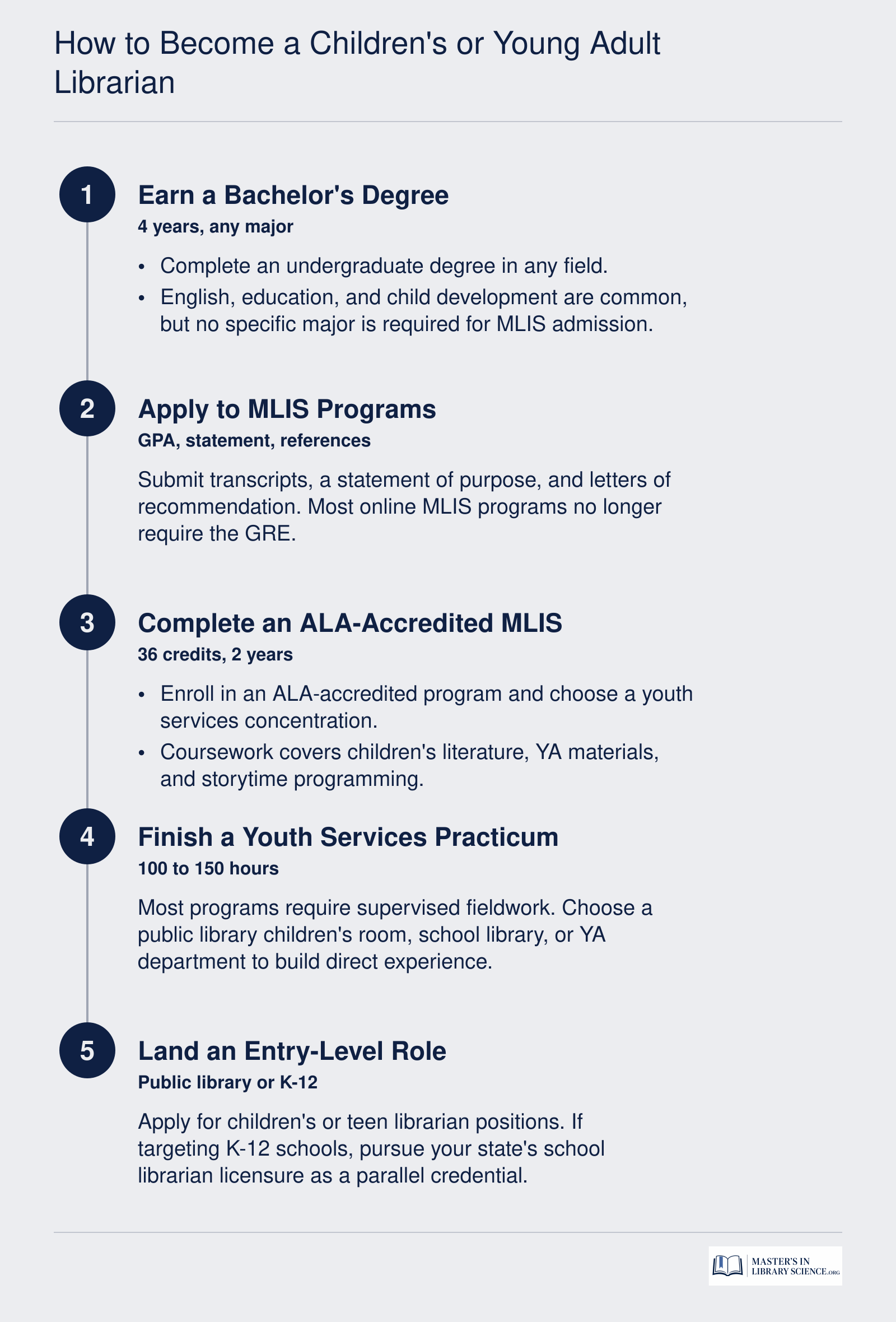
How to Become a Children's or Young Adult Librarian
Becoming a youth services librarian is competitive but achievable. The path is well-defined, and most candidates who complete an ALA-accredited MLIS with a youth concentration and gain hands-on practicum experience are positioned to land an entry-level role.
Frequently Asked Questions
Below are answers to common questions about earning an online MLIS in youth services and building a career working with children and teens in libraries.
Can you make 6 figures as a librarian?
It is possible but uncommon. The Bureau of Labor Statistics reports a median annual wage of around $64,000 for librarians and media collections specialists, with the top 10 percent earning over $100,000. Six-figure salaries typically go to library directors, academic library administrators, or specialists in large urban systems, federal agencies, or law and corporate libraries, not entry-level youth services roles.
How hard is it to become a children's librarian?
The path is structured but achievable. Most positions require a bachelor's degree followed by an ALA-accredited master's in library science, which typically takes two years online. Competition for full-time youth services roles can be strong in desirable metro areas, so practicum experience, storytime practice, and volunteer or paraprofessional work in a library while in school significantly improve hiring odds.
How do you become a youth services librarian?
Start with a bachelor's degree in any field, then complete an ALA-accredited MLIS or MLS program with a concentration or electives in children's and young adult services. Coursework usually covers youth literature, programming, and reference for minors. Most students also complete a practicum in a public or school library. Some states additionally require school librarians to hold teacher certification.
What is the difference between children's and young adult library services?
Children's services generally cover ages birth through about 12 and emphasize early literacy, storytimes, picture books, and family programming. Young adult services focus on roughly ages 12 to 18, with collections and programs centered on teen fiction, identity development, homework support, college and career readiness, and creating safe social spaces. Many MLIS programs cover both within a single youth services track.
Is an online MLIS in youth services ALA accredited?
Many are, but not all. Accreditation is granted to the overall MLIS or MLS degree by the American Library Association's Committee on Accreditation, not to individual specializations. Before enrolling, verify the program's status on the official ALA directory of accredited programs. Most public library and school library positions require a degree from an ALA-accredited institution.