An ALA-accredited online MLIS is the baseline credential for academic librarian roles at U.S. colleges and universities.
Research universities and tenure-track positions often prefer a second master's in a subject discipline alongside the MLIS.
Most online MLIS programs have dropped the GRE requirement, simplifying admissions for working applicants in 2026.
BLS reports a 2023 median wage of $64,370 for librarians, with academic roles clustering near that midpoint.
Open almost any academic librarian job posting and you will see the same line near the top: ALA-accredited master's degree required. That single credential, the MLIS degree, is the gatekeeper for nearly every reference, instruction, cataloging, and subject liaison role inside a college or university library.
Online delivery has become the dominant way working adults earn it. Programs are asynchronous, regionally accredited, and priced across a wide range, which makes side-by-side comparison the most useful first step.
This guide covers the programs worth shortlisting, what daily academic library work looks like, admissions and the GRE waiver picture, curriculum, total cost, and the salary outlook by role.
Best Online MLIS Programs With an Academic Librarianship Track
The programs profiled below are online-first, ALA accredited programs MLIS degrees that either offer a formal academic librarianship concentration or support the path through a focused cluster of electives. Our ordering reflects a mixed quality composite: accreditation in good standing with the American Library Association2, the availability and depth of an academic-library track, and program-quality signals like faculty research alignment with higher-education libraries, practicum partnerships with university libraries, and breadth of relevant electives. We do not rank by sticker price or by reported graduate salaries, both of which can mislead when comparing online MLIS programs.
How We Frame the Ranking
Every program here is fully online or primarily online, with limited or no campus residency requirements. Each holds current ALA accreditation, which is the credential most academic library employers expect. "Track" can mean different things across schools: some institutions publish a named academic librarianship concentration with a defined course sequence, while others guide students through a recommended elective cluster paired with an academic-library practicum. Both routes can prepare you for academic work, but the named concentration is easier to communicate to hiring committees. If you are still weighing concentrations more broadly, our guide on how to choose a concentration for library science program walks through the tradeoffs.
Programs to Compare
The following programs are commonly cited by prospective students researching academic-library careers. Specific concentration names, credit totals, and elective lists change from year to year, so confirm details directly with each program before applying.
University of Kentucky offers an online MLIS through its School of Information Science. Students interested in academic work typically build a course plan around scholarly communication, information literacy instruction, and collection development.
University of Arizona delivers its MA in Library and Information Science fully online and is known for strong coverage of academic and research library topics, including digital collections and instruction.
University of North Texas runs one of the larger online MLIS programs in the country, with elective depth in academic libraries, instruction, and information organization.
University of Maryland offers an online MLIS through its iSchool, with electives that connect to academic libraries, archives, and digital curation, areas that overlap heavily with research-university work.
University of Pittsburgh offers an online MLIS through the School of Computing and Information, with coursework supporting academic, research, and special-collections paths.
Syracuse University delivers its MS in Library and Information Science online, with elective options relevant to academic instruction, reference, and scholarly communication.
A Fully Online Option Worth Knowing
Louisiana State University's online Master of Library and Information Science is a 36-credit, fully online, ALA-accredited program.1 It does not market a named academic librarianship concentration, but students aiming at higher-education libraries can assemble a focused electives cluster around instruction, collection development, and information organization. For applicants who want a flexible, fully online format with established ALA accreditation, LSU is a credible option to weigh alongside the named-concentration programs above.
What to Verify Before You Apply
Before committing, confirm three things with any program: that ALA accreditation is current, that the academic-library coursework you want is actually offered in your intended start term, and that practicum or capstone placements can be arranged at an academic library near you if remote placement is not available.
What Academic Librarianship Actually Looks Like Day-To-Day
Academic librarianship is library work performed inside colleges and universities, supporting the research, teaching, and learning missions of the institution. The user base is narrower than a public library's: undergraduates writing their first research papers, graduate students wrestling with literature reviews, and faculty conducting original scholarship. Because the work is tied to the academic calendar and the curriculum, it has a different rhythm and culture than other branches of the profession.
How It Differs From Other Library Tracks
Public librarians serve a general community across all ages and interests, with heavy programming and readers' advisory. School librarians (often called school media specialists) work with K-12 students and require state teaching credentials in many states; the specifics vary, and prospective candidates often consult school librarian licensure requirements before committing to a program. Special librarians work in corporate, legal, medical, or government settings with very narrow subject domains.
Academic librarianship sits apart on three dimensions:
User base: students and faculty within a single institution, not the general public.
Instruction load: most academic librarians teach, whether one-shot research sessions for a composition class or credit-bearing information literacy courses.
Employment status: at many four-year institutions, librarians hold faculty rank and may be on a tenure or continuing-appointment track, with expectations to publish and serve on governance committees.
Common Functional Roles
Academic libraries are organized around a handful of recurring positions, and you will see most of these on any university job board or in broader library science career listings:
Reference and research services: helping patrons navigate databases, citations, and search strategies.
Instruction: designing and delivering information literacy sessions, often co-taught with disciplinary faculty.
Subject or liaison librarian: serving as the dedicated contact for one or more academic departments, building collections and relationships in that field.
Scholarly communication: supporting open access, institutional repositories, copyright questions, and research data management.
Collections and acquisitions: selecting materials, managing licensing, and stewarding budgets.
The Cultural Shift
Working inside a faculty and research environment changes the job in subtle ways. Meetings happen on academic time. Colleagues expect evidence-based arguments and citations. Career advancement often rewards publishing, presenting at conferences, and contributing to professional service, not just operational performance. Many of these expectations align with the top skills employers look for in library science degree graduates, from research fluency to written communication. For students who enjoy the campus environment, this culture is the appeal.
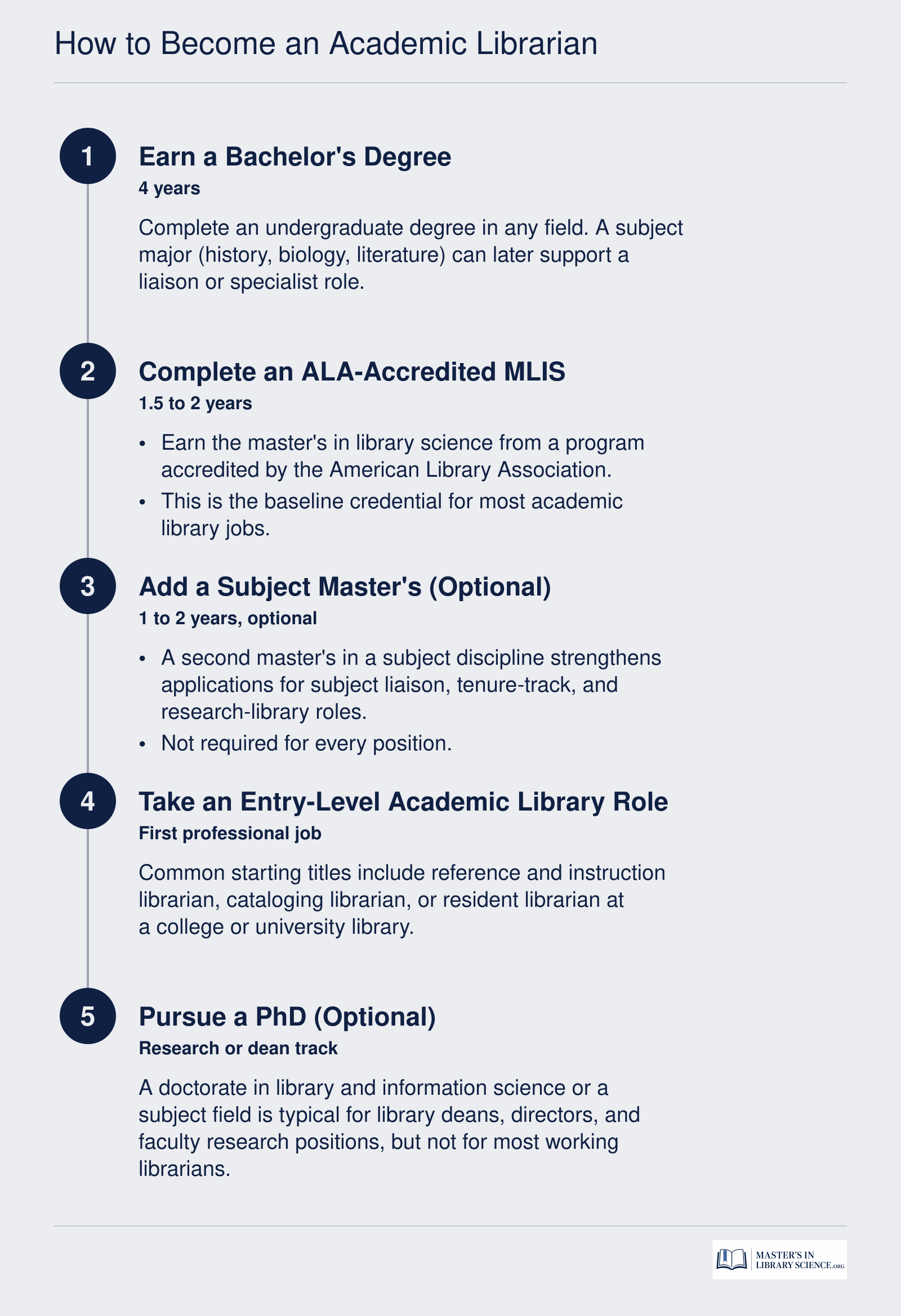
How to Become an Academic Librarian
Most academic librarians follow a recognizable credentialing ladder. The core requirement is an ALA-accredited MLIS, but research universities and tenure-track lines often expect additional subject expertise. A second master's is commonly preferred for subject liaison, tenure-track, or research-library positions, though many entry-level academic library roles do not strictly require it.
Admissions Requirements and the GRE Waiver Picture in 2026
Applying to an online MLIS program is more straightforward than applying to most other graduate degrees. The American Library Association does not require the GRE for accreditation1, so individual schools set their own rules, and most have moved away from standardized testing entirely.
The Standard MLIS Application Checklist
Across ALA-accredited online programs, you can expect to submit a similar package:
A bachelor's degree from a regionally accredited institution (any major is fine)
Official transcripts from every college you've attended
A minimum undergraduate GPA, often 3.0 on a 4.0 scale, with conditional admission sometimes available below that
A statement of purpose explaining why you want to enter the library field
Two or three letters of recommendation, ideally mixing academic and professional sources
A current resume or CV
A few schools add their own twists. Some request a writing sample, some conduct a short interview, and some give preference to applicants who already have paid or volunteer library experience. None of these are universal, so read each program's page carefully before drafting your materials.
The 2026 GRE Picture
The GRE has largely disappeared from MLIS admissions, and a quick look at MLS no-GRE options confirms how widespread waivers have become. Syracuse, the University of Denver, the University of Hawaii at Manoa, and Florida State all offer GRE waivers or have eliminated the test outright for 2026 entry.2 Syracuse, for example, holds to a 3.0 GPA minimum and waives the GRE.
LSU Online is a notable exception: it still requires the GRE, with a minimum total score of 300 and a 3.5 on analytical writing, and scores must be less than five years old.3 If LSU is on your list, plan testing time into your application calendar.
Application-Stage vs. On-the-Job Qualifications
At the application stage, you are essentially proving you can do graduate-level work: a solid GPA, clear writing, and references will carry you in. The deeper qualifications that academic librarians actually use day-to-day, including reference interviewing, instruction design, collection development, and subject expertise, are built during the MLIS itself and through practicums, not demonstrated upfront.
Curriculum: Core MLIS Plus Academic-Library Electives That Matter
Almost every ALA-accredited MLIS curriculum is built on the same five-course spine. Knowing what that spine looks like, and which electives bend it toward academic work, is how you turn a generalist degree into an academic librarian resume.
The Core You Will See Everywhere
Expect roughly 15 to 18 credits of required coursework covering the same ground at nearly any program:
Foundations of library and information science (history, ethics, professional values)
Organization of information (cataloging, metadata, classification systems like LCSH and RDA)
Reference and information services
Research methods in LIS
Management of libraries and information organizations
These courses are non-negotiable because they map to the ALA Core Competences. They also tend to be where programs assess basic professional readiness before letting you specialize.
Electives That Signal Academic Focus
Hiring committees at colleges and universities scan transcripts for coursework that mirrors the job. The electives that matter most:
Information literacy and instructional design (for teaching librarian and first-year experience roles)
Scholarly communication, open access, and copyright (for scholcomm and repository work)
Academic collection development and acquisitions
Archives, special collections, and digital preservation
Research data management and data services
Subject librarianship or discipline-specific resources (sciences, humanities, business)
A student aiming at a liaison role should stack instruction plus a subject elective. Someone targeting scholcomm should pair copyright with data management. If special collections pull at you instead, an archival studies degree track within the same MLIS can layer cleanly on top of these academic electives.
Practicum and Capstone
Most programs require a practicum, internship, or capstone of 120 to 200 hours. For academic librarianship, where you do it matters as much as the grade. A practicum hosted by a college or university library, ideally in instruction, reference, or technical services, gives you a supervisor who can speak to academic-library competencies in a reference letter. Remote practica at academic libraries are now common and acceptable to most search committees.
Tuition, Total Cost, and Financial Aid for Online MLIS Programs
Total cost is one of the most useful filters when comparing online MLIS programs, because tuition varies widely and most academic librarian roles pay similar starting wages regardless of where you earned the degree. Two structural factors drive the final number: the per-credit rate and the total credits required (typically 36 to 48 for ALA-accredited programs).
Sample 2026 Tuition for Online ALA-Accredited Programs
Published 2026 rates show how much spread exists even among well-regarded public university programs:
University of Alabama: $480 per credit, 36 credits, roughly $17,280 total. Tuition is a flat online rate, so out-of-state students pay the same as in-state students.1
LSU Online: $560 per credit, 36 credits, roughly $20,160 total, also at a flat online rate.2
Other programs commonly compared in this tier include the University of Kentucky, University of Arizona, University of North Texas, University of Maryland, University of Pittsburgh, Syracuse, San Jose State, University of Illinois, and Indiana University. Some use a flat online rate; others charge differentiated in-state and out-of-state tuition, which can swing total cost by several thousand dollars. Always confirm the current per-credit figure and credit count on the program's official tuition page before modeling your budget. If price is your top filter, a curated list of the cheapest library science degree online options can help narrow the field quickly.
How to Verify Costs and Accreditation
A reliable workflow:
Start with the ALA's directory of accredited programs to confirm a school is ALA-accredited and to reach the program's cost page directly.
Open each program's official tuition page and note whether the rate is flat for online students or split by residency.
Multiply per-credit tuition by required credits, then add fees, technology charges, and any required in-person residency travel.
Cross-check librarian salary data from the Bureau of Labor Statistics so total cost is weighed against realistic earnings in academic library roles.
Email the admissions or financial aid office to confirm current rates, scholarship deadlines, and assistantship availability.
Financial Aid Worth Pursuing
Federal aid (FAFSA) covers most students, but profession-specific awards matter too. The American Library Association distributes at least $300,000 in scholarship funds annually across its member divisions, with awards specifically earmarked for students pursuing academic and research librarianship.3 A broader roundup of scholarships for MLIS students is worth reviewing alongside FAFSA results. Many universities also offer graduate assistantships that reduce or waive tuition in exchange for part-time work in a campus library.
Academic Librarian Salary by Role
Salary is one of the clearest ways to test whether an MLIS pencils out for academic library work. The Bureau of Labor Statistics reports a 2023 median annual wage of $64,370 for librarians and media collections specialists, with the middle 50% earning between $50,930 and $80,980.1 The top 10% cleared $101,970. Academic settings tend to sit on the higher end of that range: librarians working in colleges, universities, and professional schools earned a mean wage of $73,890 in 2023, compared with $62,360 in local government libraries.1
Typical Pay by Academic Library Role
National occupational data does not break out every academic title, and figures vary by institution size, region, and union status. The following ranges are commonly cited in ALA-APA and ARL salary surveys and should be read as approximate rather than guaranteed:
Reference and instruction librarian (entry-level): roughly $50,000 to $65,000
Subject specialist or liaison librarian: roughly $60,000 to $80,000
Scholarly communication, data, or digital scholarship librarian: roughly $65,000 to $90,000, with higher figures at research universities
Department head (e.g., head of access services, head of collections): roughly $80,000 to $110,000
Dean or director of libraries: typically $130,000 and up at large research institutions, occasionally exceeding $250,000 at flagship universities
Tenure-track faculty librarian positions, common at research universities, often follow a separate academic pay scale and may include summer research stipends. For a broader view of how compensation shifts across regions, our library science salary by state breakdown adds useful context.
Is the MLIS Worth It for Academic Librarianship?
The MLIS is essentially the price of admission: nearly all academic librarian postings require an ALA-accredited master's degree. Set against the tuition figures from the prior section, an in-state or moderately priced program (roughly $20,000 to $35,000 total) is generally recoverable within a few years at the academic mean wage of about $73,890. Higher-cost private programs lengthen the payback window and warrant a closer look at scholarships and assistantships.
Program length also shapes the return. Most students finish full-time in about two years, while part-time learners juggling work typically take three to four years. Working in a library during the degree, common in academic settings, often shortens the time to a first professional role and can move new graduates past the entry-level MLIS degree salary band faster.
Frequently Asked Questions About the Academic Librarianship Path
Below are the questions prospective students ask most often when weighing an online MLIS for academic library work. The answers reflect the program landscape, costs, and career patterns covered earlier in this guide.
Do librarians need a master's degree?
For nearly all professional academic librarian positions, yes. College and university job postings almost universally require an ALA-accredited master's degree in library science (typically the MLIS) as a baseline qualification. Paraprofessional and library assistant roles do not require the degree, but reference, instruction, cataloging, and faculty librarian positions at four-year institutions consistently list the MLIS as the minimum credential.
How do you become an academic librarian?
The standard path is to earn a bachelor's degree in any field, complete an ALA-accredited MLIS (often online), and gain practical experience through a graduate assistantship, internship, or practicum in an academic library. Many new graduates start in a residency program, a circulation or instruction role, or a subject liaison position, then build toward tenure-track or specialized faculty librarian jobs.
What is the cheapest online MLIS degree?
Public universities that offer in-state online tuition tend to be the most affordable, with several ALA-accredited programs running well under $25,000 in total tuition. Schools like Valdosta State, the University of Southern Mississippi, and East Carolina University regularly appear among the lowest-cost options. Always compare per-credit tuition, fees, and whether the program charges out-of-state rates for online students.
Is an MLIS degree worth it for academic librarianship?
If your goal is a permanent professional role at a college or university library, the MLIS is effectively required, so the return on investment depends on keeping costs reasonable. Graduates who target affordable ALA-accredited programs and build experience during the degree typically recoup tuition within a few years of full-time work, especially at four-year institutions and research universities.
Do academic librarians need a second master's degree in a subject area?
Not for most positions, but a second master's helps for subject-specialist and research-library roles. Liaison librarian jobs at large research universities, particularly in the sciences, law, and health, sometimes prefer or require a second graduate degree. For instruction, reference, technical services, and most teaching-college positions, the MLIS alone is sufficient.
Are online MLIS programs ALA-accredited?
Many are. The American Library Association accredits programs based on curriculum and outcomes, not delivery format, so fully online MLIS degrees can hold the same accreditation as on-campus versions. Before enrolling, confirm the program appears on the ALA's official directory of accredited programs, since hiring committees at academic libraries typically screen for that credential.