An ALA-accredited MLIS is the standard credential for law librarianship; a JD is required only for academic and some senior firm roles.
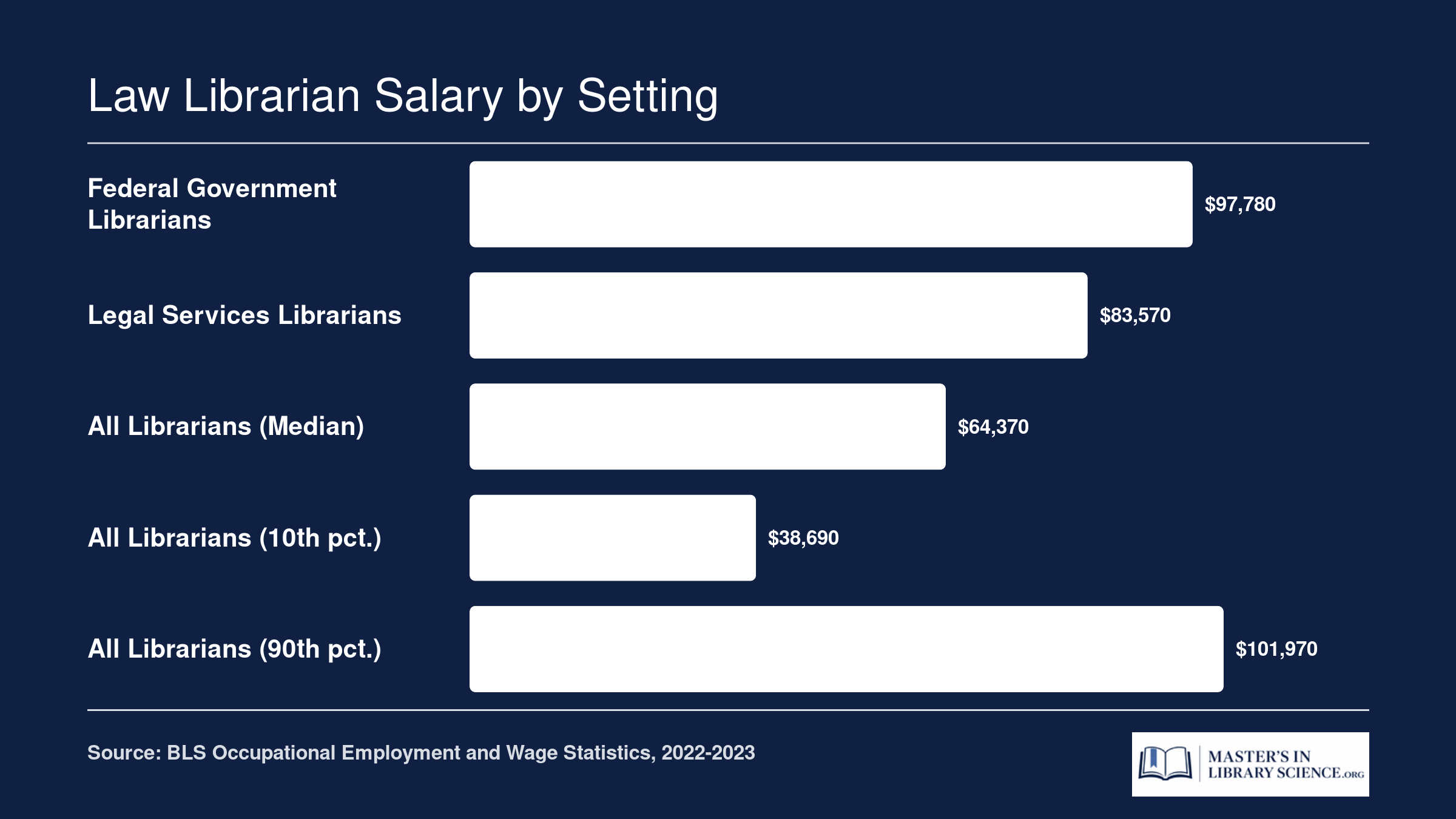
Law librarians earn a median of $64,370 nationally, with federal and academic law library positions typically paying well above that baseline.
Most online MLIS programs run 36 to 48 credits, take roughly two years part-time, and offer formal law librarianship concentrations or electives.
Law librarians and paralegals are not interchangeable: different credentials, different daily work, and different career trajectories.
You may already work the reference desk, support attorneys as a paralegal, or hold a JD and want off the billable-hour treadmill. A specialized online degree can move you into law librarianship without uprooting your life.
An MLIS in law librarianship is an ALA-accredited Master of Library and Information Science with a concentration in legal information: think advanced legal research, government documents, and law library administration layered onto the standard library science core.
Below, we map the full pathway, compare accredited online mlis programs, break down admissions, curriculum, and cost, and tackle the question candidates ask most: do you actually need a JD?
How to Become a Law Librarian: The JD vs Non-JD Pathway
The path into law librarianship is more flexible than many candidates assume. The standard route looks like this:
Earn a bachelor's degree in any field (history, political science, English, and pre-law are common, but no specific major is required).
Complete an ALA-accredited MLIS or MSLS, ideally with a law librarianship concentration or relevant electives in legal research, government documents, and information policy.
Optionally add a JD, either before, after, or concurrently with the MLIS.
Move into a first role through internships, library assistant positions, or post-MLIS reference and research jobs.
When a JD Is Genuinely Required
The JD requirement is concentrated in academic law libraries. According to American Association of Law Libraries guidance, law school library director positions and law school reference librarian positions typically require both the MLIS and a JD.1 These roles often carry faculty status, teach legal research to law students, and sit inside an ABA-accredited law school, which is why the second degree matters.
That said, only about 33% of working law librarians actually hold a JD, and AALL data indicates that just 0 to 19% of law librarian job postings require both degrees.1 In other words, the dual-credential profile is the exception, not the rule.
When MLIS-Only Is Enough
For most non-academic settings, an ALA-accredited MLIS is the core credential and a JD is not required. This includes:
Law firm libraries and knowledge management roles
Corporate and in-house counsel libraries
County law libraries serving the bar and the public
Court libraries supporting judges and clerks
Other government law libraries (federal agencies, state legislatures, executive branch)
These employers prioritize legal research skill, database fluency (Westlaw, Lexis, Bloomberg Law), and client service over a law degree. If you're still mapping out options, our guide on how to choose a library science program can help you weigh concentrations against career targets.
Dual Programs vs Sequential vs MLIS-Only
Several universities offer joint JD/MLIS programs that compress both degrees into roughly four years. They make sense if you already know you want an academic librarianship degree track. Sequential paths (MLIS first, JD later, or vice versa) are also common, and an MLIS-only path is increasingly viable given how few postings actually require the JD.
Quick Self-Assessment
Targeting a law school library, especially a director or reference faculty role: plan for both degrees.
Targeting a law firm, court, county, corporate, or government library: an ALA-accredited MLIS with a law concentration is generally sufficient.
Undecided: start with the MLIS, gain experience, and add a JD later only if a specific role demands it.
What a Law Librarian Actually Does Day-To-Day
A law librarian's day is built around one core function: connecting attorneys, faculty, students, judges, or agency staff with the right legal information at the right moment. The specifics, though, look very different depending on where you work.
Core Duties Across All Settings
No matter the employer, most law librarians spend their time on a recurring set of tasks:
Answering legal research questions, from quick citation checks to multi-jurisdictional statutory surveys
Managing subscriptions and access to legal databases like Westlaw, Lexis, Bloomberg Law, HeinOnline, and Fastcase
Teaching research skills, whether to first-year law students, summer associates, or new judicial clerks
Developing the collection: deciding what treatises, looseleafs, and digital resources to buy, renew, or cancel
Cataloging and maintaining records so materials are actually findable
How the Setting Changes the Work
In an academic law library, a Tuesday might mean co-teaching a 1L Legal Research and Writing session in the morning, meeting with a faculty member about a law review article in the afternoon, and answering reference questions at the desk in between. These are some of the top skills employers look for in library science degree graduates, applied to a legal context.
In a law firm library, the rhythm is faster and tied to billable hours. You might pull legislative history for a litigation team, run a competitive intelligence report on a prospective client, and triage Westlaw alerts for partners, all before lunch.
In a court library, the audience is judges and clerks, and the work skews toward fast, accurate research support on active cases plus maintaining a usable collection for self-represented litigants.
In a government or agency library, expect a mix of policy research, regulatory tracking, and supporting agency attorneys.
Emerging Responsibilities
The role is shifting. Knowledge management (capturing and organizing what attorneys at a firm already know) is now a major function in many private libraries. Competitive intelligence, profiling clients and opposing counsel, has become its own subfield. And with generative AI tools entering legal research, librarians are increasingly the people who vet outputs, train staff on responsible use, and evaluate which AI products are worth licensing. It's one of the more dynamic careers in library science right now.
Accredited Online MLIS Law Librarianship Programs Compared
The programs below are grouped because they all offer online or substantially online delivery and have appeared on prospective students' shortlists for law librarianship. They are ordered by reputation and depth of legal-information coursework, not by price or salary outcomes. Tuition and credit figures shift each academic year, so confirm current numbers with each school before applying. Above all, verify ALA accredited programs directly on the ALA's published list, because that is the credential law-library employers actually check.1
University of Washington iSchool
The UW iSchool offers an MLIS with a formal Law Librarianship Specialization, one of the few programs in the country with a dedicated track rather than a loose elective cluster.2 The MLIS requires 36 to 43 quarter credits and can be completed fully online or on the Seattle campus. At roughly $961 per credit, total program tuition lands near $39,401 for 2026-2027.3 The program is ALA-accredited, with its next scheduled review in 2027.1 UW is unusual in that the Law Librarianship Specialization requires a JD (earned or in progress) for admission to that track, which positions graduates for academic law library and faculty-track roles.
UNT, Arizona, Syracuse, and Denver
The other commonly compared options take a more flexible approach:
University of North Texas offers an ALA-accredited MS in Information Science with a law librarianship interest area. It is delivered online and is frequently cited for lower tuition than coastal peers, but the legal coursework is built from electives rather than a named track.
University of Arizona runs an ALA-accredited MA in Library and Information Science with a legal information pathway. Delivery is fully online, and students typically combine core LIS coursework with legal research electives offered through the iSchool and law college.
Syracuse University iSchool offers an ALA-accredited MS in Library and Information Science online. It does not maintain a dedicated law track; students interested in law librarianship build a focus through electives and internships.
University of Denver offers an ALA-accredited MLIS online, with course options that touch legal information and academic librarianship. Like Syracuse, it functions as an elective cluster rather than a named concentration.
How to read this comparison
If you want a named, employer-recognizable concentration on your transcript, UW is the clearest fit (with the JD prerequisite). If you want flexibility, lower published tuition, or a non-JD path into court, firm, or corporate law libraries, UNT, Arizona, Syracuse, and Denver are reasonable starting points. For applicants weighing testing requirements alongside accreditation, it can help to scan MLS no GRE options before committing. In every case, confirm ALA accreditation and current tuition on the program's own admissions page.
Admissions Requirements and Prerequisites
Admission to an ALA-accredited online MLIS with a law librarianship concentration is generally less competitive than law school or many graduate programs, but you still need to assemble a solid file. Schools want evidence that you can handle graduate-level reading and research, communicate in writing, and articulate why you want this specific career.
The Standard Application File
Most programs ask for the same core materials:
A bachelor's degree from a regionally accredited U.S. institution (or recognized international equivalent), in any major
Undergraduate GPA of roughly 3.0 on a 4.0 scale, though some programs admit below that with a strong overall file
Official transcripts from every college attended
A statement of purpose, usually 500 to 1,000 words, explaining your interest in librarianship and ideally in legal information work
Two or three letters of recommendation from professors, supervisors, or librarians
A current resume or CV
An application fee, often waivable for veterans, alumni, or recruitment events
GRE and Standardized Tests
The GRE has largely disappeared from MLIS admissions. Most ALA-accredited online programs have either permanently dropped the requirement or waive it for applicants who meet a GPA threshold, and our roundup of No-GRE Master's in Library Science Programs is a useful starting point. Verify the current policy on each program's admissions page before paying for a test you may not need.
What a JD Is, and Is Not
A law degree is not required to apply. MLIS law tracks are designed for both JD holders and non-JD candidates, and admissions committees evaluate them on the same MLIS criteria. Some programs do appreciate, but rarely require, prior exposure to legal research: paralegal experience, work in a law firm or court, undergraduate coursework in legal studies or political science, or time spent in any library setting. If you have none of that, a clear statement of purpose explaining how you plan to build legal knowledge during the program goes a long way.
International Applicants
If English is not your first language, or your degree was taught in another language, expect to submit TOEFL, IELTS, or Duolingo English Test scores. Programs typically look for a TOEFL iBT around 80 to 100 or an IELTS band of 6.5 to 7.0. International transcripts usually need a course-by-course evaluation from a service such as WES or ECE.
Curriculum, Program Length, and Cost
An MLIS in law librarianship layers legal specialization onto the standard library science core. Expect a familiar foundation in cataloging, reference services, information organization, collection development, and research methods, then a set of law-focused electives or a formal concentration that prepares you for legal information work.
The Law-Specific Course Layer
Most programs build the specialization around four anchor courses:
Advanced Legal Research: the core skill of the profession, covering primary and secondary sources, citators, regulatory tracking, and legislative history
Law Library Administration: budgeting, vendor negotiation, staffing, and collection planning specific to firm, court, and academic law libraries
Legal Bibliography: the structure of legal literature, treatises, looseleaf services, and how legal information is published and updated
Government Documents: federal and state document systems, depository libraries, and administrative materials
Hands-on database fluency is non-negotiable. Quality programs build training in Westlaw, LexisNexis, Bloomberg Law, and HeinOnline directly into coursework, often through vendor-provided academic access. You should graduate comfortable running complex Boolean searches, KeyCite/Shepard's validation, and docket retrieval without thinking about it.
Credits, Timeline, and Tuition
MLIS programs typically require 36 to 48 credits. Pacing options:
Full-time: roughly 2 years
Part-time: 3 to 4 years, which is how most working students complete the degree
Tuition varies widely. Public in-state programs can run around $15,000 total, while private universities and out-of-state rates often reach $45,000 or more. The comparison table earlier in this guide breaks down specific schools, but the rule of thumb holds: ALA accreditation matters far more than prestige, so cost-conscious students should weight affordable library science degree online options heavily.
Practicum and Internship Requirements
Most programs require a supervised field experience of 100 to 150 hours. Online students are not exempt: you arrange a local placement, usually at a law firm library, county law library, court library, or academic law library, with faculty approval. This is often where job offers originate, so treat the practicum as a hiring audition rather than a checkbox.
Paying for It
Three funding streams are worth pursuing:
AALL scholarships: the American Association of Law Libraries offers awards specifically for MLIS students pursuing law librarianship, including some restricted to those without a JD
Employer tuition reimbursement: if you already work at a firm or court, ask before enrolling; many legal employers will fund relevant graduate work
Graduate assistantships: on-campus GA positions can offset tuition, though they are harder to access in fully online formats
Beyond AALL, broader library science scholarships and federal aid can close remaining gaps for students who plan ahead.
Pay for law librarians varies sharply by employer. The Bureau of Labor Statistics reports a median annual wage of $64,370 for librarians and media collections specialists overall, but legal and federal settings sit well above that baseline. Use these figures as directional benchmarks, not guarantees.
Law Librarian vs Paralegal: Different Jobs, Different Credentials
Law librarians and paralegals both work alongside attorneys, but they hold different credentials, perform different tasks, and follow different career arcs. The roles overlap in some firm settings, particularly around legal research, but one rarely substitutes for the other. Here is how the two compare on the factors that matter most to prospective students.
Factor
Law Librarian
Paralegal
Typical credential
ALA-accredited MLIS or MSLS, often paired with a JD for academic and firm roles
Paralegal certificate, associate degree, or bachelor's in paralegal studies; ABA-approved programs preferred
Primary focus of the work
Manages legal information systems, builds research collections, trains attorneys and students on databases, and answers reference questions
Supports specific cases by drafting documents, organizing discovery, filing pleadings, and conducting case-bound research under attorney direction
Relationship to attorneys
Operates as an information professional and instructor; often peer-level in academic and government settings
Works under direct attorney supervision; cannot give legal advice or sign off on filings
Typical salary range
Roughly $60,000 to $110,000, with academic directors and large firm librarians earning more
Roughly $50,000 to $80,000 in most markets, with senior litigation paralegals at large firms earning more
Career ceiling
Library director, head of research services, associate dean for information services, or chief knowledge officer
Senior paralegal, paralegal manager, or transition into law school followed by attorney roles
Where the roles overlap
Conducts deep legal research, teaches research skills, and curates secondary sources used by attorneys
Conducts case-specific legal research and may use the same databases, but tied to active matters rather than collections
Frequently Asked Questions
Below are quick answers to the questions prospective students most often ask about pursuing a law librarian career through an online MLIS program. Each answer focuses on practical decision points: credentials, earnings, daily work, and whether the degree pays off.
Do you need a JD to be a law librarian?
Not always. Public services, technical services, and many government and firm roles accept an ALA-accredited MLIS alone. However, most academic law library faculty positions, head of reference roles at law schools, and senior firm research positions prefer or require both a JD and an MLIS. If you are aiming at academic law librarianship, plan for the dual credential.
How much does a law librarian make?
Earnings vary widely by setting. Entry-level public law library and court library roles often start in the mid-five figures, while experienced firm and academic law librarians frequently earn well into six figures, especially those holding a JD plus MLIS. Geography, employer type (firm, academic, government), and supervisory responsibility drive most of the pay differences.
What does a law librarian do?
Law librarians manage legal information across print and digital platforms. Daily tasks include conducting case and statutory research for attorneys or judges, training users on Westlaw and Lexis, managing subscription budgets, cataloging legal materials, supporting law student instruction, and increasingly handling competitive intelligence, knowledge management, and AI tool evaluation inside firms and courts.
What is the difference between a law librarian and a paralegal?
Paralegals work under attorney supervision on specific cases, drafting documents and assisting with filings. Law librarians serve many users, manage information collections, teach research, and operate across cases rather than within one. Paralegals typically hold a certificate or associate degree, while law librarians usually need an ALA-accredited master's degree, and sometimes a JD.
Is an MLIS in law librarianship worth it?
It is worth it if you are targeting law libraries specifically, since most postings require an ALA-accredited master's. The degree opens firm, academic, court, and government roles that are otherwise closed. If you are unsure between general librarianship and law, a flexible MLIS with a law concentration preserves options without locking you in.
Does ABA or ALA accreditation matter more for law librarian careers?
For the librarian credential itself, ALA accreditation of your MLIS program is what employers check. ABA accreditation applies to the law school, which matters only if you are also pursuing a JD. For a pure MLIS path into law librarianship, prioritize ALA-accredited programs and verify the school's law librarianship coursework or specialization.