Library science is institution centered while information science is system centered and spans any digital or physical environment.
Most ALA accredited master's programs now include information in their degree title, reflecting the fields' growing convergence.
Tech oriented information science roles consistently pay $15,000 to $30,000 more per year than traditional librarian positions.
AI and big data are creating entirely new roles and accelerating the merger of both disciplines.
MLS, MLIS, MSLIS, MSIM. If the alphabet soup of graduate library and information science degrees has left you wondering whether you are choosing between two genuinely different career paths or just two labels for the same thing, you are not alone.
The overlap is real, but so are the differences. The distinction between library science and information science shapes which courses you take, which industries recruit you, and how much you can expect to earn. Graduates who move into tech-focused information science roles consistently out-earn peers in traditional library positions by a significant margin. Understanding the MLS vs. MLIS landscape is the first step toward making a confident decision.
Below, we break down definitions, compare MLS vs. MLIS programs side by side, map out career paths and salaries, and walk you through a decision framework so you can choose the right path with confidence.
What Is Library Science?
Library science is the study of how information is organized, preserved, and made accessible within library institutions. Its intellectual roots stretch back centuries, but the modern discipline took shape in the late 19th and early 20th centuries as public libraries expanded across the United States and formalized their practices around cataloging, collection development, and patron services.
If you picture library science as simply learning how to shelve books, think bigger. The field is grounded in a philosophical commitment to equitable access to information and meaningful community engagement. Library science professionals serve as bridges between people and the resources they need, whether those resources are physical books, digital databases, government documents, or local programming. A Master's in Library Science program builds expertise across all of these areas.
Core Competency Areas
Library science education typically covers four major competency areas:
Cataloging and classification: Applying standardized systems (such as the Dewey Decimal Classification or Library of Congress Subject Headings) to organize materials so they can be discovered and retrieved efficiently.
Reference services: Helping patrons locate, evaluate, and use information through direct consultation, readers' advisory, and research instruction.
Archival preservation: Safeguarding physical and digital collections for long-term access, including conservation techniques and metadata standards for rare or historically significant materials.
Community programming: Designing outreach initiatives, literacy programs, maker spaces, and cultural events that serve the diverse needs of a library's user base.
Where Library Scientists Work
Library science professionals overwhelmingly work in physical institutional settings. The most common environments include:
Public libraries serving local communities
Academic libraries at colleges and universities
School libraries (often called media centers) in K through 12 settings
Special libraries housed within hospitals, law firms, museums, government agencies, and corporations
Across all of these settings, the unifying thread is a service orientation. Library science positions tend to be deeply embedded in a specific institution and its community, with day-to-day work shaped by patron needs, collection priorities, and public service goals rather than by abstract data problems or technology platforms. For a closer look at what coursework develops these competencies, explore our guide to skills you learn in an MLS program.
What Is Information Science?
Information science is the broad, interdisciplinary study of how information is created, structured, stored, retrieved, and used across any system, whether digital or physical. While library science centers on curating collections and serving patrons in library settings, information science zooms out to examine the lifecycle of information itself, regardless of where it lives or who needs it.
A Tech-Forward Discipline
Information science leans heavily into technology. Core areas of study and practice include:
Information architecture and metadata design
User experience (UX) research and usability testing
Database design and management
Data analytics and visualization
Human-computer interaction
Knowledge management systems
These competencies prepare graduates to design the frameworks that help people find, interpret, and act on information efficiently. If library science asks "How do we connect a community with the right resources?" information science asks "How do we organize and surface information so that any user, in any context, can make the best possible decision?"
An Interdisciplinary Foundation
One of the defining features of information science is that it draws from several academic traditions at once. Computer science contributes the technical backbone, from algorithms to systems design. Cognitive science informs how people process, retain, and search for information. Communication theory shapes the study of how meaning moves between individuals, organizations, and machines. This blend of perspectives makes the field uniquely adaptable to new challenges, which is one reason many mlis programs online now give students the flexibility to emphasize information science coursework.
Where Information Scientists Work
Unlike library science, which is closely associated with public, academic, and special libraries, information science professionals work across a wide range of sectors. You will find them at tech companies designing search interfaces, in healthcare organizations managing electronic health records, in government agencies building data governance policies, and in consulting and finance firms developing business intelligence tools. The common thread is not a particular institution but a shared focus on making information accessible, usable, and secure. Graduates interested in the overlap between the two fields may also explore specializations such as a Master's in Library Science in Digital Libraries Degree Online.
For prospective students weighing their options, information science offers a path that extends well beyond the library walls while still honoring the same foundational commitment to connecting people with information.
Key Differences Between Library Science and Information Science
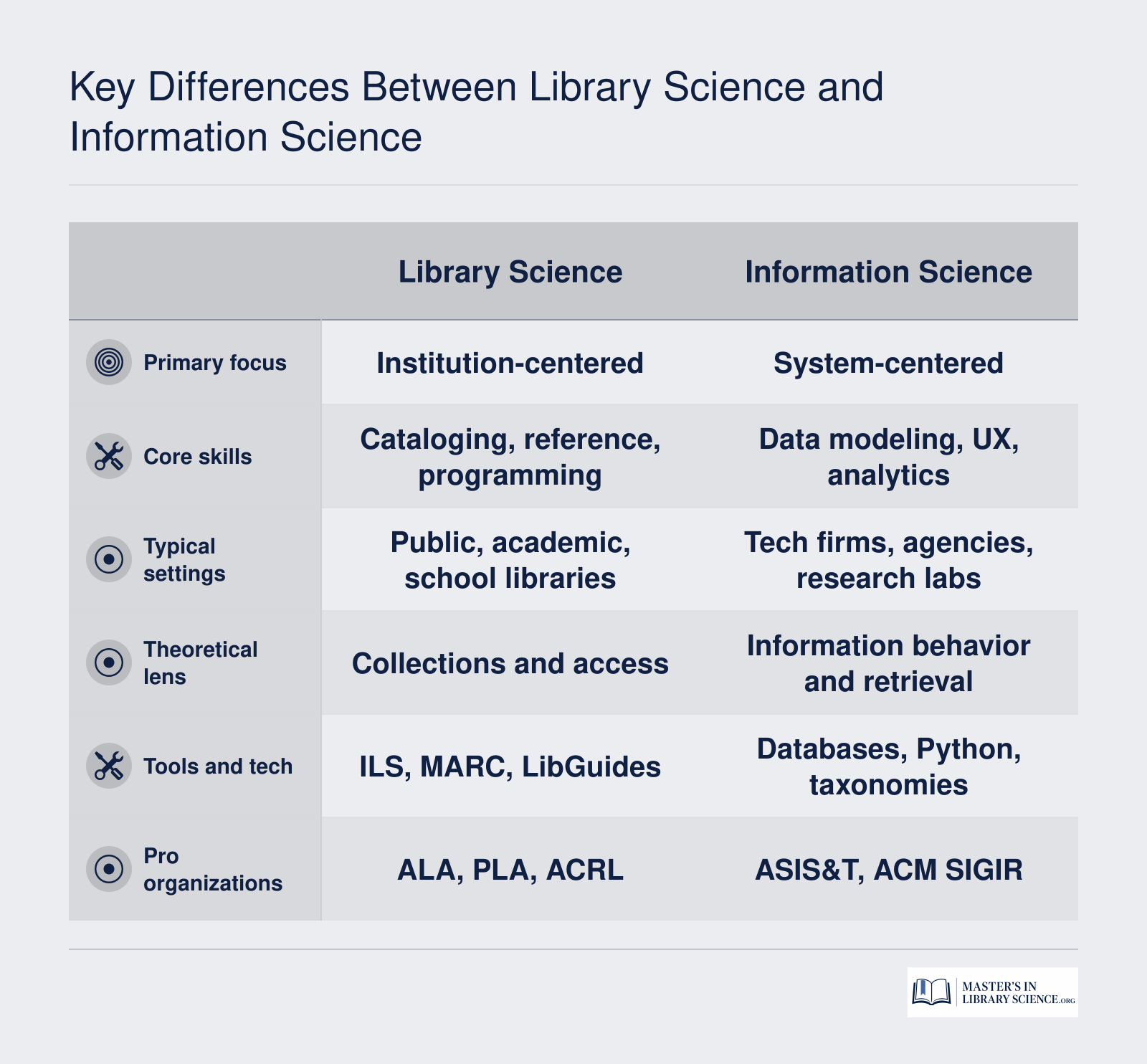
A clean way to hold these fields apart: library science is institution-centered (it builds and stewards the library as a place), while information science is system-centered (it designs how information flows through any system). The table below contrasts the two across six attributes prospective MLIS students ask about most.
MLS Vs. MLIS: How the Degree Programs Actually Differ
If you have spent any time browsing graduate programs, you have probably noticed that some schools award a Master of Library Science (MLS) while others grant a Master of Library and Information Science (MLIS), and still others use variations like MS in Library and Information Science. The alphabet soup can be confusing, but the differences are more meaningful than a simple name change.
What Each Degree Emphasizes
The traditional MLS curriculum centers on the core competencies of librarianship.1 Think cataloging and classification, collection development, reference services, and user services. These courses prepare graduates to manage physical and digital collections, assist patrons, and run library programs. Developing these competencies is central to earning a Master's in Library Science, and they remain foundational regardless of which degree title a program uses.
The MLIS builds on that same foundation but layers in information science electives and, in many programs, required coursework in areas like data management, UX design, digital systems, and information architecture.1 The result is a degree that prepares you for roles inside libraries and well beyond them.
A Generational Rebrand, Not a Revolution
Many ALA-accredited programs that once conferred an MLS have rebranded to reflect a broader curriculum.2 A few examples illustrate the shift:
The University of Illinois Urbana-Champaign now awards an MS in Library and Information Science with specializations in user services, archives, and digital curation.2
The University of Pittsburgh offers an MLIS that was re-accredited through 2028, blending traditional representation and organization courses with technology-focused electives.3
The University of Southern California awards an MMLIS (Master of Management in Library and Information Science) with an explicit focus on data analysis, technology, and librarianship, plus an optional management certificate.1
In each case, the American Library Association accredits the program under the same standards it applies to legacy MLS degrees.2 Accreditation does not distinguish between the two labels, so both carry equal weight with employers who require an MLIS degree.4
Credit Hours and Delivery Formats
Most ALA-accredited programs require between 36 and 48 credit hours, though some fall outside that range. The University of Southern California's MMLIS, for instance, requires 31 credits and can be completed in about 20 months.1 Syracuse University's MS in Library and Information Science can be finished in roughly 18 months online, with specialization tracks in digital curation and children/youth services.1 The University of Denver offers a fully online MLIS completable in 21 months, featuring flexible pacing, mentorship, and built-in internship opportunities.1 The University of Missouri also delivers its MLIS entirely online, with a focus on research application and leadership.1
These hybrid and fully online options have dramatically expanded access, making it possible to earn an ALA-accredited degree without relocating.
The Bottom Line for Job Seekers
Here is the practical reality: for most public, academic, and school library positions, an MLS and an MLIS satisfy the same hiring requirements as long as the program holds ALA accreditation.4 Employers posting for a "librarian" typically list an "ALA-accredited master's degree" rather than specifying MLS or MLIS by name.
Where the MLIS gains an edge is outside traditional library walls. Graduates who completed coursework in data management, UX, or digital systems are better positioned for roles in corporate information management, data curation, digital asset management, and technology consulting. If you already know you want to work in a public library, either degree will serve you well. If you want to keep your options open, or you are drawn to the technology side, an MLIS program with strong information science electives is the more versatile choice.
A growing number of ALA-accredited master's programs now include the word 'information' in their degree title, reflecting a broad shift across the field. While exact counts vary year to year, the trend is clear: most accredited programs have moved away from a standalone 'library science' label in favor of titles like Master of Library and Information Science. You can verify current program names through the ALA Accredited Programs Directory.
Career Paths and Salary: Library Science Vs. Information Science Jobs
Both library science and information science graduates enter rewarding careers, but the salary landscape differs significantly depending on which side of the field you land on. Professionals who move into tech-oriented or private-sector information science roles consistently earn $15,000 to $30,000 more per year than their counterparts in traditional library settings. That gap largely reflects employer type: public institutions and school districts operate on tighter budgets than corporations, consulting firms, and tech companies.
Library Science Career Paths
Graduates with an MLS or MLIS who focus on library science coursework typically pursue roles in public, academic, or school settings. The Bureau of Labor Statistics reports a median annual wage of $64,370 for librarians and media collections specialists (SOC 25-4022) as of 2024, though library science salary varies by institution and geography.1
Common library-side roles include:
Public Librarian: Works in community libraries managing collections, programming, and patron services. Median salary falls near the BLS librarian figure. Typical employers are city and county library systems.
Academic Librarian: Supports research and instruction at colleges and universities. Salaries often run slightly above the national librarian median, especially at large research institutions.
School Librarian: Serves K-12 students and teachers. Compensation typically follows local teacher pay scales, and some states require a separate teaching credential alongside the MLS or MLIS.
Archivist: Preserves and organizes historical records for museums, government agencies, and universities. The BLS groups archivists under SOC 25-4011, with a median salary generally in the mid-$60,000s.
Cataloger or Metadata Librarian: Applies classification systems and metadata standards to organize materials. Found in academic libraries, large public systems, and special libraries.
Information Science Career Paths
Information science graduates tend to move into private-sector and technology-driven roles where salaries climb higher. These positions emphasize data management, user experience, and systems design rather than traditional collection stewardship. For a broader look at options on both sides of the field, explore careers in library science.
Common information-science-side roles include:
UX Researcher: Studies how users interact with digital products and recommends design improvements. Employers range from tech companies to financial institutions, with median salaries often reaching the $80,000 to $100,000 range depending on location and experience.
Data Analyst: Interprets datasets to inform organizational decisions. Found across healthcare, finance, government, and tech. Salaries commonly land in the $75,000 to $95,000 range.
Information Architect: Designs the structure and navigation of websites, intranets, and digital platforms. This role blends library-science classification principles with digital design, and compensation frequently exceeds $90,000.
Knowledge Manager: Develops internal systems that capture, organize, and share institutional knowledge. Common in consulting firms, large corporations, and government agencies, with salaries typically in the $80,000 to $100,000 range.
Database Administrator: Manages and secures organizational databases. The BLS lists database administrators under SOC 15-1245, with a median annual salary well above $90,000.
What Drives the Salary Gap
The difference is not about one field being more valuable than the other. It reflects the economics of employer sectors. Public libraries, school districts, and nonprofit archives operate within fixed budgets, while tech companies and corporate employers compete for talent in a market that rewards data fluency and technical skills. Many MLIS graduates strategically bridge both worlds by combining library science foundations with information science electives, positioning themselves for roles on either side of the masters in library science salary spectrum.
Job Outlook: Where Demand Is Growing Fastest
The job market for library science and information science graduates is far from monolithic. Depending on which side of the spectrum you lean toward, your employment prospects can look very different over the next decade.
Traditional Library and Archival Roles: Steady but Slow
According to the Bureau of Labor Statistics, librarians (SOC 25-4022) are projected to see about 2% job growth from 2024 to 2034, which is slower than the average for all occupations.1 With roughly 142,100 positions nationally and an estimated 13,500 annual openings (driven largely by retirements and turnover rather than new positions), the traditional library job market is best described as stable but flat.1 Archivists, curators, and related occupations (SOC 25-4011) follow a broadly similar trajectory, with modest growth tied primarily to cultural institutions and government agencies.2
Public-sector library hiring remains consistent, but budget constraints in municipal and county systems mean that net new positions are rare. Most openings come from replacing professionals who leave the field or retire.
Information Science Roles: Where the Growth Is
On the information science side, the outlook is considerably more dynamic. Computer and information research scientists (SOC 15-1221) and database administrators and architects (SOC 15-1245) typically see projected growth rates that outpace the national average by a significant margin, driven by rising demand in artificial intelligence, data governance, cloud computing, and digital transformation. While exact BLS projections for the 2024 to 2034 window should be confirmed directly through the Occupational Outlook Handbook, these roles have historically grown at rates several times faster than traditional library positions.
Private-sector employers in healthcare, finance, technology, and consulting are actively recruiting professionals who can organize, protect, and extract value from large data sets, and that skillset overlaps meaningfully with what MLIS career programs teach.
Hybrid Roles Blurring the Line
Some of the most exciting opportunities sit at the intersection of both fields. Keep an eye on these emerging titles:
Data librarian, managing research data repositories at universities and research institutions
Digital archivist, preserving born-digital materials and migrating legacy collections
Health informatics specialist, organizing clinical data for hospitals and public health agencies
UX researcher in academic settings, improving how patrons interact with digital library systems and scholarly databases
These hybrid positions typically command higher salaries than traditional library roles and benefit from dual competencies in information organization and technology.
Is an MLIS Worth It in 2026?
The short answer is yes, but with an important caveat. If you plan to pursue a generalist public librarian track without additional specialization, you will face a competitive market with limited growth. However, if you target the information science side of the degree or specialize in a high-demand niche like data librarianship, digital curation, or health informatics, your career prospects improve substantially. The MLIS remains a versatile credential, and understanding the full range of library science degree requirements can help you plan strategically. Its return on investment in 2026 depends largely on how you tailor your coursework, practicums, and technical skills to match where demand is accelerating.
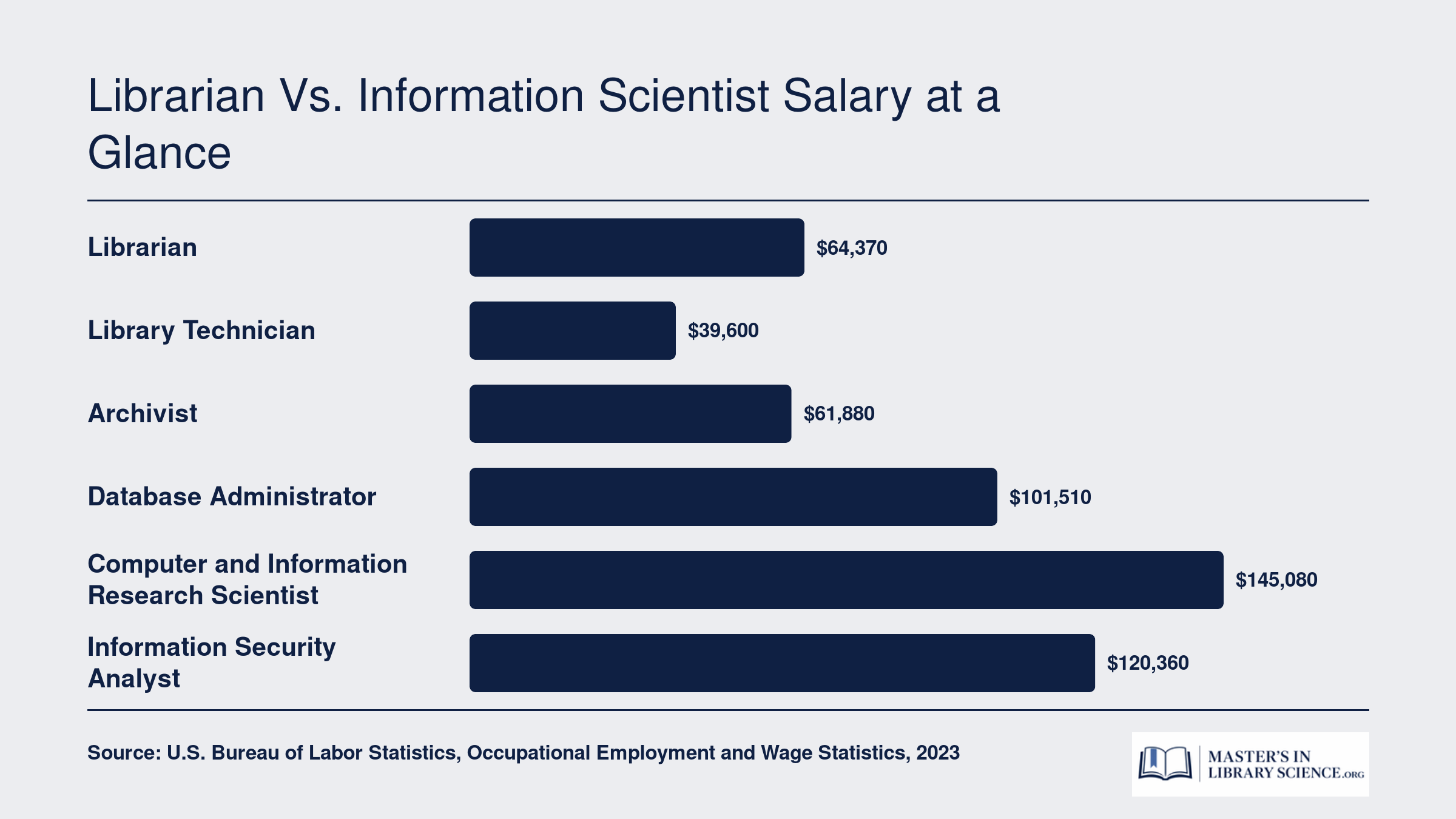
Librarian Vs. Information Scientist Salary at a Glance
Traditional library roles and information science positions can differ significantly in median pay. The chart below compares annual median salaries for six representative job titles across both fields, using federal labor data.
How AI and Big Data Are Reshaping Both Fields
Artificial intelligence and big data are not just buzzwords for library science and information science professionals. They are actively rewriting job descriptions, creating entirely new roles, and accelerating the convergence between these two disciplines.
AI in Library Science: Automation and New Opportunities
AI is already automating tasks that once consumed a large share of a librarian's day. Automated cataloging tools can assign subject headings and classification numbers with increasing accuracy, and AI-powered chatbots now handle routine reference queries at academic and public libraries around the clock.
Rather than eliminating librarian roles, however, these tools are shifting the work. Libraries now need professionals who can:
Manage and audit the metadata that feeds AI systems
Curate high-quality training data for machine learning models
Teach patrons and students about algorithmic literacy, helping them understand how search results are ranked and filtered
AI-powered discovery layers in academic libraries offer a concrete example. These systems use natural language processing to help researchers surface relevant materials across millions of records, but they require skilled librarians to evaluate output quality, correct bias in results, and refine the underlying data.
Big Data and the Expansion of Information Science
On the information science side, big data and machine learning have pushed the field squarely into data science territory. Many MLIS graduates now compete for library science jobs that barely existed five years ago, including knowledge engineer, data governance analyst, and taxonomy architect.
Information scientists at major tech firms, for instance, build knowledge graphs that organize vast networks of entities and relationships, powering everything from search engines to virtual assistants. These positions demand a blend of information organization theory and technical fluency with tools like Python, SPARQL, and graph databases.
A Growing Convergence
The most significant trend may be how much these two fields are overlapping. Libraries are adopting more sophisticated technology platforms, while tech companies increasingly recognize that they need professionals trained in information governance, ethical data stewardship, and user-centered design.
This convergence means that a graduate who enters library science may end up working alongside data engineers, and an information science specialist may find their skills in high demand at a public library system rolling out AI-driven services. For prospective students, the takeaway is clear: whichever path you choose, building comfort with emerging technologies will only expand your MLIS career options in either field.
Questions to Ask Yourself
Do you picture yourself working directly with people, such as library patrons and students, or designing the systems and databases they rely on behind the scenes?
Are you drawn to public service roles in libraries, schools, and nonprofits, or do you see yourself in the private sector at a tech company, consulting firm, or healthcare organization?
Would you rather curate and manage physical or digital collections, or would you prefer building information architectures and data models from scratch?
When you think about your long-term career, is salary ceiling your top priority, or does mission alignment with community education, literacy, and access matter more to you?
Frequently Asked Questions About Library Science and Information Science
Prospective students often have overlapping questions about library science vs information science, especially when comparing degree options. Below, we answer the most common questions to help you navigate the differences, career prospects, and practical considerations of each path.
Is library science the same as information science?
No. While library science and information science share common ground in organizing and providing access to knowledge, they differ in focus. Library science centers on curating collections, community programming, and public services within library settings. Information science takes a broader approach, emphasizing data systems, information architecture, and technology-driven solutions across industries. Many modern programs in library and information science blend elements of both.
What is the difference between an MLS and an MLIS?
An MLS (Master of Library Science) typically focuses on traditional librarianship, including cataloging, reference services, and collection development. An MLIS (Master of Library and Information Science) broadens that foundation to include coursework in data management, UX design, and information systems. In practice, the MLS vs MLIS distinction often depends on the program's curriculum emphasis, and both are accepted for most librarian positions.
Which field pays more, library science or information science?
Information science roles generally offer higher median salaries because many positions sit within the technology and corporate sectors. Roles like data analyst, UX researcher, or information architect often command salaries well above the median for traditional librarian positions. However, experienced librarians in specialized or administrative roles can also earn competitive wages, and public-sector benefits often add significant value.
What jobs can you get with a library science or information science degree?
A library science degree prepares you for roles such as public librarian, school media specialist, archivist, or academic librarian. An information science degree opens doors to positions like information architect, data analyst, knowledge manager, or digital asset manager. Graduates of combined library and information science programs can pursue opportunities across both tracks.
Is an MLIS worth it in 2026?
For many students, yes. The MLIS remains the standard credential for librarian positions and is increasingly valued in corporate information management, data governance, and digital services. Growing demand for professionals who can organize, curate, and ethically manage information keeps the degree relevant. The key is choosing an ALA-accredited program with coursework aligned to your career goals.
Can you switch between library science and information science careers?
Yes. The two fields share enough foundational knowledge that transitioning is common. A librarian might move into corporate knowledge management, while an information scientist could shift into academic librarianship. Additional certifications or targeted coursework can smooth the transition, but many employers value the core competencies that both disciplines develop.
What are the transferable skills between library science and information science?
Both fields develop strong skills in information organization, metadata standards, research methodology, and user-centered service. Critical thinking, database management, and the ability to evaluate and synthesize large volumes of information are equally valued. These transferable skills make professionals in library information science adaptable across public, academic, nonprofit, and corporate environments.