MLIS Degree Jobs & Careers: Your Complete 2026 Guide

MLIS Degree Jobs & Careers: Your Complete 2026 Guide

Explore Every Career Path Open to Master's in Library & Information Science Graduates

By Meredith SimmonsReviewed by MLIS Academic Advisory TeamUpdated May 7, 202619 min read
MLIS Degree Jobs & Careers: Your Complete 2026 Guide

Key Points

  • About 22 percent of MLIS graduates work outside traditional library settings in fields like tech and corporate knowledge services.
  • MLIS program costs range from roughly $20,000 to $60,000, with in-state public universities typically on the lower end.
  • The BLS projects steady librarian demand through 2034, boosted by a significant wave of retirements in the profession.
  • Non-traditional MLIS roles in UX research, data management, and information architecture often command higher salaries than library positions.

A Master's in Library and Information Science opens doors well beyond the shelves of a public library. MLIS graduates work in tech companies, healthcare systems, government agencies, law firms, and nonprofits, applying skills in data management, information architecture, and user research across a surprising range of industries.

This guide breaks down the full landscape of MLIS career possibilities. You will find traditional library roles alongside emerging and non-traditional MLIS career paths, detailed library science salary data by role, a ten-year job outlook, and a clear look at whether the degree delivers a strong return on investment. Whether you are drawn to academic librarianship or considering a pivot into UX research or digital asset management, the sections ahead will help you map your next move.

Traditional Library Careers for MLIS Graduates

An MLIS degree opens the door to several well-established career tracks in library and information science. While each role shares a foundation in organizing, preserving, and providing access to information, the day-to-day responsibilities and work environments differ significantly. Most public and school librarian positions require a degree from an ALA-accredited MLIS program, and some roles carry additional certification or licensure requirements. For a closer look at what's involved, see our guide on MLIS degree requirements.

Public Librarian

Public librarians serve communities of all ages and backgrounds through municipal or county library systems. Typical duties include managing collections, leading programming such as story times and literacy workshops, assisting patrons with reference questions, and increasingly supporting digital literacy initiatives. Public librarian roles almost universally require an ALA-accredited MLIS, and some states or municipalities require additional civil service examinations or local certifications.

Academic Librarian

Academic librarians work in college and university settings, where they support faculty and student research, manage specialized databases, teach information literacy courses, and oversee subject-specific collections. Entry-level positions typically require an ALA-accredited MLIS, but advancement into senior or tenure-track roles often calls for a second master's degree in a subject area or even a PhD. Academic librarians may also be expected to publish research and participate in faculty governance.

School Librarian

School librarians, sometimes called library media specialists, work in K-12 settings to cultivate reading habits, teach research skills, and collaborate with teachers on curriculum integration. Certification and licensure requirements for school librarians vary considerably by state. Some states require both a teaching credential and an MLIS or equivalent library media certification, while others accept a standalone library endorsement. Prospective school librarians should verify the specific requirements in the state where they plan to work by reviewing current School Librarian Certifications.

Special Librarian

Special librarians operate in corporate, legal, medical, government, or nonprofit settings, managing highly specialized collections and conducting targeted research for their organizations. A law firm librarian, for example, maintains legal databases and performs case research, while a medical librarian supports clinical teams with evidence-based resources. These roles demand deep subject expertise alongside MLIS training, and they often carry competitive salaries compared to other library positions.

Archivists and Records Managers

Two adjacent traditional careers also draw heavily on MLIS education: archivist and records manager. Archivists appraise, process, and preserve historical documents, photographs, and digital records for institutions such as museums, universities, and government agencies. Records managers focus on the lifecycle of organizational records, ensuring compliance with legal retention schedules and developing efficient retrieval systems. Both roles benefit from MLIS coursework in cataloging, metadata, and preservation, and some archivists pursue additional credentials such as the Certified Archivist designation to strengthen their professional standing.

Emerging and Non-Traditional MLIS Career Paths

The skills you'll gain with a Master's in Library Science degree, including information organization, metadata design, user research, and taxonomy development, translate directly into several fast-growing fields outside traditional librarianship. While published career outcome data from iSchools and ALA placement surveys specific to these non-traditional roles remains limited as of 2025, job postings and industry trends strongly suggest that MLIS competencies are valued in a range of corporate and tech-sector positions.1

UX Research and Information Architecture

UX research and information architecture are among the most frequently cited non-traditional career paths for MLIS graduates. However, prospective students should approach this pathway with realistic expectations. The UX research job market in 2025 is competitive, with entry-level positions especially scarce.2 Hiring trends have flattened or declined compared to the rapid growth seen in earlier years.3 According to Nielsen Norman Group's State of UX 2026 report and other industry analyses, the field is shifting toward generalist roles where designers and product managers absorb research responsibilities. Roughly 70% of designers and 42% of product managers now participate in user research activities, and self-service UX platforms like Loop11 and Maze are making it easier for non-specialists to conduct basic studies.3 AI tools are also automating tasks such as transcript summarization, further reshaping what dedicated UX researchers are expected to do.1

That said, MLIS graduates bring distinctive strengths to this space, particularly in qualitative research methods, information organization, and content strategy. Searching current postings on LinkedIn, Indeed, and ALA JobLIST can help you gauge real-time demand and identify which specific skills employers prioritize.

Digital Asset Management and Data Governance

Organizations across media, healthcare, finance, and technology need professionals who can design and maintain systems for managing digital files, records, and datasets. Digital asset management (DAM) and data governance analyst roles draw on core MLIS training in metadata schemas, controlled vocabularies, and information lifecycle management. Students interested in this area may also want to explore Master's in Library Science in Records Management Degree Online options that offer specialized coursework. Professional associations like ARMA International (focused on records management) publish industry reports and offer networking opportunities that can help MLIS students understand employer expectations in these areas. The Bureau of Labor Statistics groups some of these roles under broader occupational categories, so checking BLS.gov for related job outlook data is a useful starting point for library science salary and growth projections.

Corporate Knowledge Management

Large enterprises, consulting firms, and government agencies hire knowledge management specialists to organize internal information, build intranets, and ensure that institutional knowledge is accessible and well-structured. This role leverages an MLIS graduate's expertise in classification systems, search optimization, and information retrieval. The Special Libraries Association (SLA) is a particularly valuable resource for MLIS students interested in corporate knowledge work, offering career guides, salary surveys, and a professional network connecting information professionals in non-library settings.

Positioning Yourself for Non-Traditional Roles

If you are considering one of these emerging pathways, a few practical steps can help clarify your direction:

  • Review job postings regularly on LinkedIn, Indeed, and ALA JobLIST to identify in-demand skills such as SQL, taxonomy design, or specific DAM platforms.
  • Explore professional associations like UXPA, ARMA, and SLA for industry reports, certification programs, and networking events.
  • Look for MLIS programs or elective tracks that offer coursework in UX design, data curation, or digital asset management.
  • Seek internships or project-based experience in corporate or tech environments during your degree program.

Because comprehensive career outcome data for MLIS graduates in these fields is not yet widely published, conducting your own research through job boards, informational interviews, and professional organizations is especially important when evaluating these career paths.1

According to data reported by American Libraries Magazine, roughly 22 percent of MLIS graduates work outside traditional library settings. These professionals apply their expertise in information architecture, data management, user experience research, and corporate knowledge services across industries like tech, healthcare, and finance, demonstrating the remarkable versatility of the degree.

MLIS Career Salary Expectations by Role

Salary potential with an MLIS degree varies widely depending on role, employer type, and industry. Traditional library positions anchor to well-documented federal data, while non-traditional roles in technology and corporate settings often command higher compensation. The table below offers a consolidated view to help you benchmark realistic earning expectations.

Salary Comparison Across MLIS Career Titles

The following figures draw on Bureau of Labor Statistics (BLS) 2024 median wage data for traditional roles.1 Salary ranges for non-traditional titles are approximate and based on aggregated figures from employer-reported salary platforms. Treat non-BLS figures as general guides rather than definitive benchmarks, since compensation for these roles can shift significantly by region, company size, and years of experience.

  • Librarian (Public Library): Median around $64,370 per year. Typical employers include municipal and county library systems.1
  • School Librarian/Media Specialist: Median around $71,800 per year. Typically employed by elementary and secondary school districts.1
  • Academic Librarian: Median around $73,890 per year. Colleges and universities are the primary employers.1
  • Archivist or Curator: BLS groups these professionals together, with median wages generally in the $58,000 to $62,000 range. Common employers include museums, government agencies, and historical societies.
  • UX Researcher: Reported salary ranges commonly fall between $85,000 and $120,000 per year. Technology companies, consulting firms, and large enterprises are typical employers.
  • Information Architect: Ranges often cited between $80,000 and $115,000 per year. Digital agencies, software companies, and e-commerce firms hire for this role.
  • Data Governance Analyst: Frequently reported in the $75,000 to $105,000 range. Financial services, healthcare organizations, and large corporations represent common employer types.
  • Digital Asset Manager: Ranges generally fall between $60,000 and $90,000 per year. Media companies, publishing houses, and marketing agencies are typical employers.
  • Knowledge Manager: Reported ranges often span $75,000 to $110,000 per year. Consulting firms, government contractors, and multinational corporations tend to hire for this position.
  • Taxonomist or Metadata Specialist: Commonly cited between $65,000 and $95,000 per year. Technology companies, libraries, and content-heavy organizations are frequent employers.

Key Factors That Influence MLIS Salaries

Geography plays a significant role. For example, librarians in California earn a mean annual wage of approximately $90,960, with the top end reaching above $130,000, compared to the national median of $64,370.1 The overall national salary range for librarians stretches from roughly $38,690 at the lower end to about $101,970 at the upper end.1 For a deeper breakdown of compensation data across library science roles, explore our mlis degree salary page.

What This Means for Your Career Planning

If maximizing salary is a priority, non-traditional roles in UX research, information architecture, and data governance offer the highest reported ranges. However, traditional library roles provide strong job stability, predictable advancement through established pay scales, and mission-driven work environments. Specializing during your MLIS program, whether in digital curation, user experience, or data management, can position you to compete for higher-paying roles while still maintaining the flexibility to pursue traditional paths if your goals evolve.

Job Outlook for Library Science Professionals (2024-2034)

The Bureau of Labor Statistics projects steady, modest growth for librarians and archivists through 2034. Even where headline growth rates look small, an aging workforce drives meaningful replacement demand, opening thousands of positions each year as current professionals retire or shift roles.

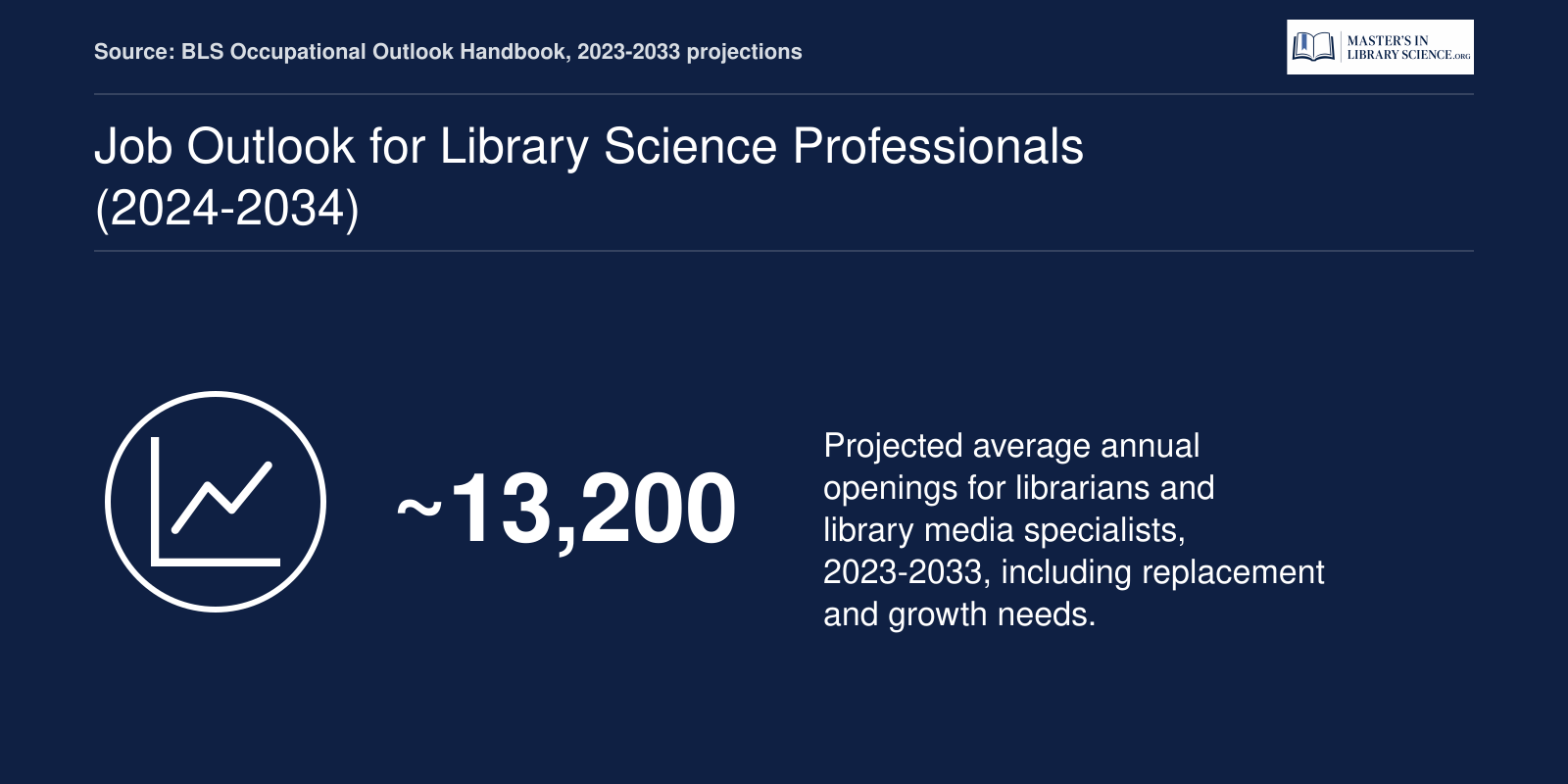
BLS projects roughly 13,200 annual openings for librarians and media specialists through 2034, driven largely by retirements.

Industries That Hire MLIS Graduates

Public libraries represent just one slice of the job market for MLIS holders. Graduates find rewarding careers in library science across a wide range of industries, each with distinct roles, employer types, and compensation structures.

Higher Education

Colleges and universities employ academic librarians who manage research collections, teach information literacy, and support faculty scholarship. Large research institutions like the University of Michigan and Harvard University maintain extensive library systems with specialized positions in digital scholarship, metadata services, and archives.

K-12 Schools

School librarians (sometimes called library media specialists) integrate information literacy into curricula and manage school library collections. Districts across the country hire MLIS graduates, though some states also require a teaching credential. Major school districts such as Chicago Public Schools and Los Angeles Unified employ dedicated library media specialists.

Healthcare and Hospital Libraries

Medical librarians work in hospitals, medical schools, and health systems to support clinical decision-making and research. Employers like the Mayo Clinic and Kaiser Permanente hire MLIS graduates for these roles. Healthcare library positions often come with strong benefits packages, including pension plans, tuition reimbursement, and comprehensive health coverage.

Law Firms and Legal Organizations

Law librarians conduct legal research, manage case databases, and maintain reference collections. Large firms such as Baker McKenzie and organizations like the American Bar Association employ MLIS professionals with legal research expertise.

Tech Companies

Information architects, taxonomy specialists, and UX researchers with MLIS backgrounds work at companies like Google, Amazon, and IBM. These roles tend to offer the highest base salaries among MLIS career paths, reflecting the premium tech firms place on information organization and retrieval skills. For a closer look at compensation benchmarks, see our mlis degree salary breakdown.

Government and Federal Agencies

Federal agencies are significant employers of MLIS graduates. The Library of Congress, the National Archives and Records Administration (NARA), and agencies across the intelligence community hire librarians and archivists. Federal librarian positions fall under the GS-1410 occupational series, which specifically requires a degree from an ALA accredited MLIS program. Government roles typically include generous benefits such as pension plans through the Federal Employees Retirement System, paid leave, and job stability.

Museums and Cultural Institutions

Museum librarians and archivists manage research collections, catalog artifacts, and preserve historical records. Institutions like the Smithsonian and the Metropolitan Museum of Art employ MLIS holders in curatorial support and digital preservation roles.

Nonprofits and Advocacy Organizations

Nonprofits such as the Bill and Melinda Gates Foundation and the Internet Archive hire MLIS graduates for roles in knowledge management, digital access, and information policy. These positions often combine library science skills with mission-driven work in areas like open access and community education.

As you evaluate your options, keep in mind that healthcare and government positions often provide the most robust benefits and retirement packages, while tech industry roles generally lead in base salary. Federal positions carry the added requirement of ALA accreditation, making your choice of MLIS program an important strategic decision.


How to Choose an MLIS Specialization for Your Career Goals

Choosing the right MLIS specialization is one of the most consequential decisions you will make during your program. The specialization you select shapes your coursework, your practicum placements, and ultimately the career paths available to you after graduation. Rather than defaulting to the broadest option, take time to align your concentration with a clear professional goal.

Common MLIS Specializations and Their Career Outcomes

Most ALA-accredited programs offer several concentration areas, each leading to distinct roles:

  • Archives and Preservation prepares graduates for careers as archivists, records managers, or digital preservation specialists in museums, government agencies, and historical societies.
  • Digital Libraries focuses on metadata, digital asset management, and repository design, positioning graduates for roles at academic institutions and technology organizations.
  • School Librarianship trains graduates to serve as school library media specialists who integrate information literacy into K-12 curricula.
  • Health Informatics equips professionals to manage clinical data systems, medical libraries, and health information exchanges within hospitals and research institutions.
  • Data Science and Analytics blends library science principles with quantitative methods, opening doors to data governance, business intelligence, and research data management roles.
  • Youth Services prepares librarians for public-facing positions designing children's and young adult programming in public library systems.

Matching Your Specialization to Your Career Goals

Start by identifying whether you gravitate toward community-centered work or higher-earning technical roles. If you want a public-facing position rooted in community engagement, youth services or Master's in Library Science in Public Librarianship Degree Online concentrations are strong fits. These paths lead to roles where you interact directly with patrons and shape local programming.

If your priority is a higher salary ceiling or private-sector employment, consider specializing in data governance, UX research, or health informatics. These concentrations translate well into corporate, healthcare, and technology environments where information management expertise commands premium compensation. To explore how specialization choices affect earning potential, review the latest masters in library science salary data.

Certification and Licensing Considerations

Some specializations carry requirements beyond the MLIS itself. Master's in Library Science in School Librarianship Degree Online programs, for example, typically require state-specific certification or licensure to work in public school systems. Requirements vary significantly from state to state, so prospective school librarians should research their target state's credentialing process early in their program. Failing to plan for additional certification can delay your entry into the workforce.

The Value of Practicum and Fieldwork Experience

Regardless of your chosen specialization, look for MLIS programs that include practicum or fieldwork components aligned to your target industry. A student pursuing archival work benefits enormously from a practicum placement in a university special collections department, while someone interested in health informatics should seek fieldwork in a hospital or clinical library setting. These hands-on experiences build professional networks, strengthen your resume, and help you confirm that your chosen specialization is the right fit before you enter the job market. Programs that embed real-world experience into the curriculum consistently produce graduates who transition more smoothly into their first professional roles.

Is an MLIS Degree Worth It? ROI and Career Advancement

MLIS programs typically cost between $20,000 and $60,000 depending on whether you attend online or on campus, with in-state public university programs often landing on the lower end. Weighing that investment against the salary premium over a bachelor's-only career in fields like education, communications, or humanities helps clarify whether the degree pays off for you. ROI improves significantly when graduates pursue non-traditional career paths with higher salary ceilings or when employer tuition reimbursement offsets program costs.

Pros

  • The MLIS is a required credential for most professional librarian positions, giving it strong gatekeeping value that protects your career investment.
  • Career versatility is exceptional: graduates work in libraries, tech companies, healthcare, government, and corporate information management.
  • Public sector library roles offer strong job security, predictable salary scales, pension eligibility, and comprehensive benefits packages.
  • Growing demand in non-traditional fields like UX research, data governance, and digital asset management expands your earning potential well beyond traditional roles.
  • Many employers in education and government offer tuition reimbursement, significantly reducing your out of pocket cost and improving long-term ROI.
  • Online and part-time MLIS options allow you to continue working during the program, reducing the income lost during your studies.

Cons

  • Starting salaries in traditional library roles are relatively modest, often ranging from $45,000 to $55,000, which can make repaying student loans challenging.
  • The 1.5 to 2 year time commitment carries a real opportunity cost, especially for career changers who forgo full-time income during study.
  • Attending a high-cost private program without scholarships or funding can result in student debt that takes years to recover through library sector salaries.
  • Some entry-level library positions, particularly part-time or paraprofessional roles, may not require or financially reward the MLIS credential.
  • Geographic limitations can affect ROI, as library job availability and pay scales vary significantly by state and metro area.

Frequently Asked Questions About MLIS Careers

Prospective MLIS students often have practical questions about accreditation requirements, salary expectations, and how the degree translates into different career paths. Below, we answer the most common questions to help you make an informed decision about pursuing a Master's in Library and Information Science.

Do you need an ALA-accredited MLIS to become a librarian?
For most public library, academic library, and federal library positions, yes. Employers in these sectors typically require a master's degree from a program accredited by the American Library Association (ALA). However, corporate roles, non-traditional positions in information management, and some special library jobs may not strictly require ALA accreditation. If you plan to work in a public or academic setting, choosing an ALA-accredited program is strongly recommended.
What is the average salary for someone with an MLIS degree?
According to the Bureau of Labor Statistics, the median annual wage for librarians and library media specialists was approximately $64,370 as of recent data. However, salaries vary significantly by role and industry. Archivists and digital asset managers may earn differently than academic librarians, and professionals who move into tech-adjacent roles such as UX research or information architecture often command higher salaries. The full range across MLIS career paths can span from roughly $50,000 to over $100,000, depending on specialization, location, and experience.
Can you work in tech with a library science degree?
Absolutely. MLIS graduates are increasingly sought after in the technology sector. Skills in information organization, metadata standards, and user-centered research translate directly into roles such as UX researcher, information architect, taxonomy specialist, and content strategist. Many tech companies and digital product teams value the systematic approach to information that library science training provides.
How long does it take to earn an MLIS?
A full-time MLIS program typically takes 1.5 to 2 years to complete. Many schools now offer online or hybrid formats that provide flexibility for working professionals. Some programs also offer accelerated options that can shorten the timeline, particularly for students who can devote themselves to coursework on a more intensive schedule. Part-time enrollment is common and may extend the program to 3 years or more.
Is a master's in library science worth it in 2026?
The value of an MLIS depends largely on your career goals and how you fund the degree. For those pursuing traditional library roles, the degree is often a non-negotiable requirement, making it essential for career entry. For those targeting non-traditional paths in data management, UX, or information governance, the degree can be a strong differentiator. To maximize ROI, consider factors like program cost, availability of assistantships or scholarships, and whether the specialization you choose aligns with growing job markets. Students who minimize debt and target high-demand niches tend to see the strongest return.
What is the difference between an MLS and an MLIS?
In practice, the MLS (Master of Library Science) and the MLIS (Master of Library and Information Science) are essentially the same credential. The difference in naming reflects each school's branding and curricular emphasis rather than a substantive distinction in degree value. Some programs use MLIS to signal a broader focus on information science alongside traditional library studies, while others retain the MLS title. Both are recognized equally by employers, and both can carry ALA accreditation. You may also encounter variations like the MSLIS or MSLS, which are likewise equivalent.