An ALA-accredited online MLIS with a school librarianship track is the standard credential for K-12 library roles.
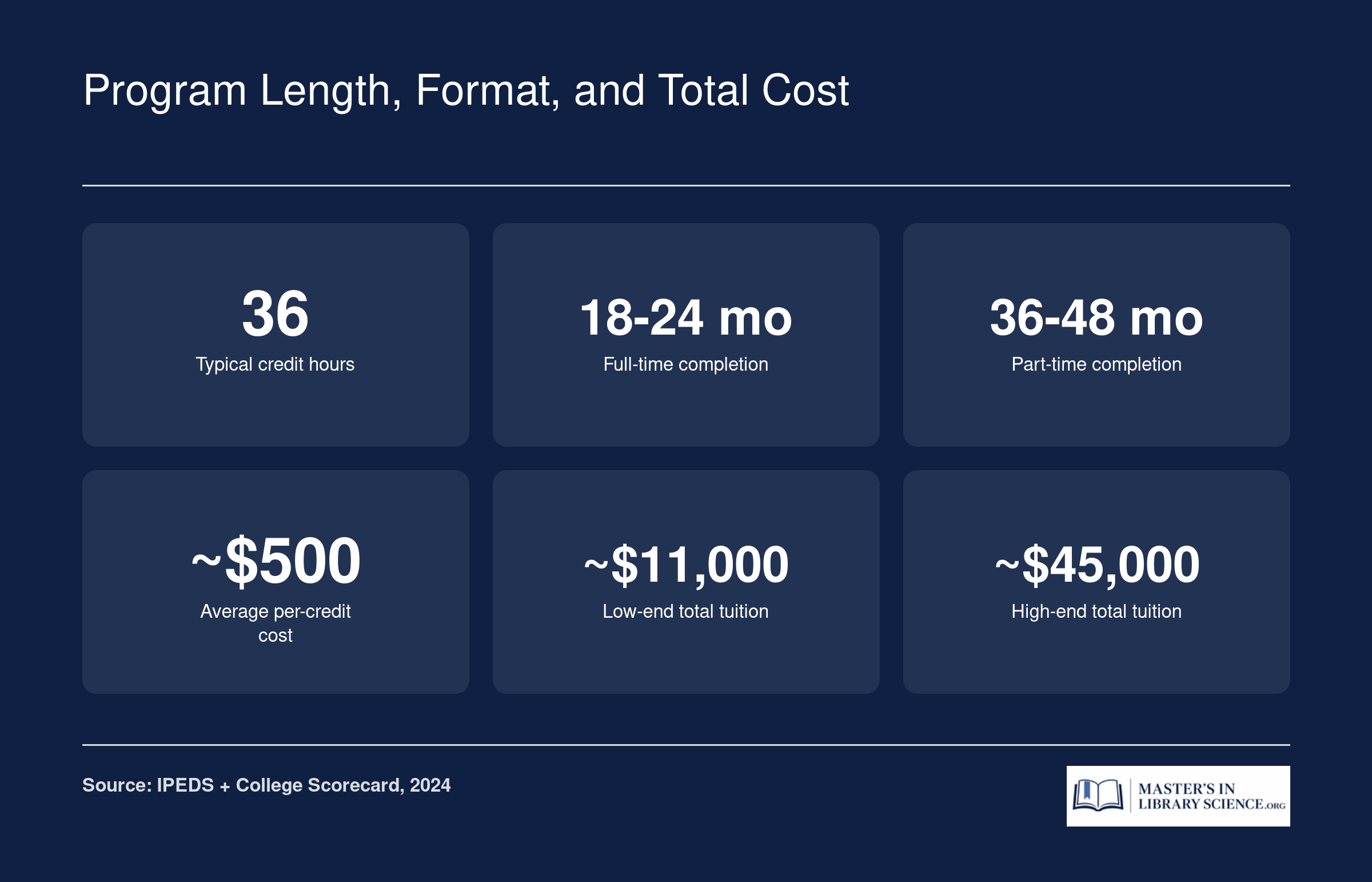
Most programs run 36 credits, take roughly two years part-time, and require a supervised K-12 practicum before graduation.
Public in-state tuition often totals $15,000 to $25,000, while private programs can exceed $40,000.
BLS reports a median wage near $64,400 for librarians and media collections specialists as of May 2024.
Becoming a school librarian in 2026 means clearing two bars, not one: an ALA-accredited Master of Library and Information Science (MLIS) and a state-issued K-12 library media credential. The good news is that most ALA accredited MLIS programs now run fully online, with asynchronous coursework and a supervised practicum you can complete in a local school.
This guide walks the full path: which online MLIS programs carry a school librarianship track, what admissions and GPA minimums look like, the K-12 practicum requirement, total program cost, state licensure rules, and the career outlook and salary you can realistically expect.
What an Online MLIS in School Librarianship Actually Covers
An online MLIS in school librarianship is a Master of Library and Information Science degree, accredited by the American Library Association (ALA), with a specialization built specifically for K-12 school library settings. It blends the core of any library science degree (cataloging, reference, information ethics, research methods) with coursework aimed at children, teens, and the realities of working inside a public or private school.
How It Differs From a General MLIS
A general MLIS prepares graduates for a wide range of settings: public libraries, academic libraries, archives, corporate research, and digital asset management. The school librarianship track narrows the focus and adds K-12 specific competencies, typically including:
Youth services and literature for children and young adults
Instructional design and co-teaching with classroom faculty
Educational technology and digital literacy instruction
Collection development for K-12 audiences, including age-appropriate selection and challenges to materials
Information literacy aligned to standards from the American Association of School Librarians (AASL)
In other words, a general MLIS graduate could pivot into a school setting with extra coursework, but if you already know your destination is a K-12 building, the online MLIS in youth services track is the most direct path.
Why You Need Both the Degree and a State Credential
This is the part that surprises career changers. In most states, working as a school librarian in a public K-12 building requires two things: the master's degree and a separate state-issued school librarian licensure (sometimes called an endorsement or certification). The MLIS gets you the subject expertise. The state credential gets you legally in the building. Some programs are designed to satisfy both in one sequence; others only cover the degree, and graduates handle licensure separately.
Who the Online Format Is Built For
Most school librarianship MLIS programs run fully or mostly asynchronous online, with a required practicum completed locally in a K-12 library. The format is built for working adults: classroom teachers adding a credential, paraprofessionals already working in school libraries, and career changers from publishing, education, or related fields who need to keep a paycheck while they study.
Ala-Accredited Online MLIS Programs With a School Librarianship Track
Not every online MLIS qualifies you to work in a K-12 school library. Two things must align: the program must hold accreditation from the American Library Association (ALA), and it must offer a school librarianship specialization (sometimes called school library media, youth services with a school track, or K-12 librarianship). Here is how to build a vetted shortlist without relying on marketing pages or paid rankings.
Start at the ALA Directory of Accredited Programs
Go to ala.org and find the Directory of Accredited Programs. This is the official list maintained by the ALA Committee on Accreditation, and it is the single authoritative source for which master's degrees count toward professional library credentials. If you want background on what that designation actually means, see this overview of ALA accredited MLIS programs. Filter or scan for programs offered fully online or in a hybrid format. The directory will not always tell you which schools have a school librarianship track, so treat it as your starting universe, not your final list.
Confirm the Specialization on Each University Site
Once you have a list of accredited programs, go directly to each university's School of Information, School of Library and Information Science, or equivalent department page. Look specifically for:
The exact name of the specialization (terminology varies by institution)
Total credit hours required to graduate
Whether coursework is 100% online or includes on-campus residencies
Whether the school librarianship track is available to out-of-state students (some are restricted)
If a program lists only a generic MLIS with no school library coursework, it likely will not prepare you for state licensure as a school librarian. For help weighing tradeoffs across institutions, this guide on how to choose a library science program walks through the decision factors.
Verify Tuition Directly From the Program
Tuition pages are often the least transparent part of a university website. Check the program's admissions or tuition section for per-credit cost. Some online MLIS programs charge a flat online rate regardless of residency; others maintain separate in-state and out-of-state tuition. Fees, technology charges, and practicum costs may not appear on the headline page. If the numbers are unclear, email the admissions office and ask for a full cost-of-attendance estimate for the school librarianship track specifically. Cost-conscious applicants may also want to compare options on this list of the cheapest library science degree online programs.
Cross-Check With Professional Associations
For a quality signal beyond accreditation, look at the American Association of School Librarians (AASL), a division of ALA, and your state library association. Both publish guidance on preparation pathways. For job outlook and salary context, use the U.S. Bureau of Labor Statistics at bls.gov, not program brochures.
Admissions, GPA Minimums, and the GRE Waiver Trend
Admissions for an online MLIS in school librarianship are generally less competitive than for many other graduate degrees, but the requirements still vary enough that you should read each program's checklist carefully before applying.
The Standard Admissions Stack
Most ALA-accredited online MLIS programs ask for a fairly predictable set of materials:
A bachelor's degree from an accredited institution (any major is typically fine)
An undergraduate GPA of 3.0 or higher, which is the common minimum across MLIS programs1
A statement of purpose explaining your interest in school librarianship
Two or three letters of recommendation, often a mix of academic and professional
A current resume or CV
The University of Alabama's online MLIS, for example, follows this template and admits students into a 36-credit program with a school library certification track.2
Do Online MLIS Programs Require the GRE?
In most cases, no. The GRE waiver trend has accelerated, and the majority of ALA-accredited online MLIS programs are now GRE-optional or do not require an exam at all. The University of Alabama and the University of Denver, for instance, do not require an admissions exam. A small number of programs still ask for scores: Louisiana State University's online MLIS currently lists the GRE as required.3 If you are weighing programs on cost and speed, dropping the GRE from your application list can save both time and roughly $220 in test fees, and the No-GRE Master's in Library Science Programs guide tracks which schools have dropped the exam.
Prerequisites and Application Timing
Prerequisites for the school librarianship track itself can differ. Some programs admit any bachelor's degree holder and build pedagogy coursework into the curriculum. Others prefer or require prior education coursework, and a handful of state-aligned tracks expect (or strongly favor) a current teaching license, since school librarian certification often layers on top of a teaching credential.
Application timing is split between rolling admissions, where you can apply year round and start in the next available term, and cohort-based programs with fixed fall or spring deadlines (commonly in the spring for fall enrollment). Rolling programs tend to be the faster path if you are ready to begin coursework soon.
Curriculum and the K-12 Practicum Requirement
An online MLIS with a school librarianship focus blends the standard library science core with a layer of K-12 specific coursework. Expect to take both, plus a supervised field experience before you graduate.
The Core MLIS Layer
Every ALA-accredited program builds on the same foundation, regardless of specialization:
Reference and information services
Cataloging, classification, and metadata
Information literacy and research instruction
Library management and collection development
These courses give you the professional vocabulary and technical baseline that any librarian needs, whether the workplace is a public branch, an academic library, or a middle school media center. For a fuller breakdown of the competencies these courses develop, see our guide to the skills you learn in an MLS program.
The School Librarianship Layer
On top of the core, school-track students take coursework aimed squarely at K-12 practice. Common required courses include children's and young adult literature, school library administration, instructional collaboration with classroom teachers, and educational technology integration. At programs like Syracuse,2 Old Dominion,3 the University of Denver,1 and the University of Missouri,4 this layer is shaped by the AASL National School Library Standards, which most accredited programs treat as the governing framework for what a school librarian should know and be able to do.
The Supervised Practicum
Before licensure, you have to log time in an actual school library under a credentialed supervisor. Typical requirements look like this:
University of Denver: 120 to 150 hours, 3 credits
Syracuse University: 100 to 120 hours, 2 to 3 credits
Old Dominion University: 100 to 120 hours, 3 credits
University of Missouri: 100 to 150 hours, 2 to 3 credits
Most programs do not formally require splitting hours between elementary and secondary placements, but several state credentialing agencies do. If your state issues a single K-12 endorsement, you may need to arrange experience at both levels even when your university would accept a single setting.
Placement Is Usually Your Job
In most online MLIS programs, finding the practicum site is the student's responsibility. The university approves the placement and assigns a faculty supervisor, but you identify the school, contact the host librarian, and confirm the arrangement fits your state's credential rules. Start that conversation at least one full semester before you plan to begin the hours.
Program Length, Format, and Total Cost
Most online MLIS programs with a school librarianship track cluster around the same credit load, but total cost swings widely depending on whether you choose a public in-state program or a private one. Here are the figures most prospective students ask about first.
An ALA-accredited MLIS with a school librarianship track is the academic foundation, but it is rarely the last step. Almost every public K-12 school requires a state-issued credential, often called a school library media specialist certification, library media endorsement, or school librarian license. Requirements vary widely, and missing one prerequisite can delay your start date by a full school year.
States That Require a Teaching License First
Several states treat school librarianship as an add-on endorsement to an existing teaching credential. In New York, candidates need an MLIS plus passing scores on the Library Media Specialist content test and the Educating All Students assessment, but a teaching license is not required if the MLIS program is registered for certification. Texas requires a valid classroom teaching certificate plus two years of classroom teaching experience before you can sit for the TExES School Librarian (150) exam. Pennsylvania issues a Library Science PK-12 certificate that requires Praxis Subject Assessments and an approved program. Georgia offers a Media Specialist certificate that can be earned without prior teaching, but pay scales reward those who hold a teaching credential too.
States Where the MLIS Stands Alone
California issues a Teacher Librarian Services Credential, which requires a prerequisite teaching credential plus an approved program of 30 or more semester units beyond the MLIS. North Carolina allows licensure through an approved MLIS school library program and the Praxis 5311 exam, with no separate teaching license required. Illinois issues a Library Information Specialist endorsement that can be added to a Professional Educator License, and the state accepts ALA-accredited programs paired with the Library Information Specialist content test. Florida offers an Educational Media Specialist (PK-12) certification through either a master's in educational media or by passing the FTCE Educational Media Specialist exam.
How to Verify Before You Enroll
Before you commit to a program, work through these checkpoints:
Open your state department of education website and search for "school library" or "library media" certification. Save the official requirements page.
Review the American Library Association's state-by-state certification guide to compare prerequisites side by side.
Email or call your state school library association. They track exam changes (Praxis cut scores, new state tests) faster than most university advisors.
Use the Bureau of Labor Statistics for salary and outlook context, but never rely on it for licensure rules. Always confirm with the state licensing board in writing.
Career Outlook and Salary for School Librarians
What the Federal Data Shows
The U.S. Bureau of Labor Statistics groups school librarians under Librarians and Media Collections Specialists (SOC 25-4022). For this occupation, BLS reports a median annual wage of roughly $64,400 as of May 2024. Employment is projected to grow about 3 percent from 2024 to 2034, roughly in line with the average for all occupations, with approximately 13,800 openings per year on average over the decade. Most of those openings come from workers retiring or moving into other roles rather than from new positions being created.
Why School Librarian Pay Often Looks Different
If you compare BLS numbers to what a friend earns at a local elementary school, the figures may not match. That is because school librarians (sometimes titled school library media specialists) are typically paid on the district teacher salary schedule, not the general library science salary scale. Pay is driven by years of experience, degree level, and the local cost of living, with a master's degree usually triggering a higher lane on the schedule. In higher-paying suburban districts, experienced school librarians with an MLIS can earn well above the BLS median.
Headwinds and Tailwinds
The job market is uneven. Some large urban districts have cut certified school librarian positions in recent years, replacing them with paraprofessionals or shared staff across buildings. At the same time, states that mandate a certified librarian in every school (or that have passed recent staffing legislation) are actively hiring and sometimes struggle to fill openings. Researching staffing trends in your target state matters as much as the national projection.
Adjacent Roles the Credential Opens
An ALA-accredited MLIS with a school librarianship focus is portable, and the careers in library science it unlocks extend well beyond a single building. Graduates commonly move into:
District library or media coordinator positions overseeing K-12 collections and staff
Instructional technology specialist or edtech coach roles
Public library youth services and teen services librarian positions
Curriculum, literacy coaching, or information literacy roles in larger districts
That flexibility is part of why the degree remains a practical investment even in districts where the traditional building-level role is under pressure.
Frequently Asked Questions
Below are the most common questions prospective students ask about earning an online master's in school librarianship. Answers reference the curriculum, licensure, and cost details covered earlier in this guide.
Are online MLIS programs in school librarianship ALA-accredited?
Yes, many are. The American Library Association accredits the master's degree itself, not the delivery format, so a fully online MLIS can carry the same accreditation as an on-campus program. Look for the ALA-accredited designation on the program page before applying. Schools like the University of North Texas, San Jose State, and the University of Alabama offer ALA-accredited online MLIS degrees with a school librarianship concentration.
How long does it take to earn an online MLIS in school librarianship?
Most students finish in two years of full-time study, covering roughly 36 to 42 credits plus a K-12 practicum. Part-time students typically take three to four years. A handful of programs offer accelerated tracks that compress coursework into 18 months, though the school-based practicum still has to align with a working academic calendar, which can extend the timeline.
Do you need a teaching license to become a school librarian?
It depends on the state. Some states, including New York and Pennsylvania, require an existing teaching license before adding a school librarian certification. Others, such as Texas, require classroom teaching experience but not a separate prior license. A growing number of states issue a standalone school librarian credential through the MLIS itself. Always check your state department of education before enrolling.
What is the cheapest online MLIS degree?
Public universities with flat in-state online tuition tend to be the most affordable. The University of North Texas, Valdosta State, and East Carolina University regularly appear among the lowest-cost ALA-accredited options, with total program costs in the range of 14,000 to 22,000 dollars. Out-of-state students should confirm whether the school offers a single online tuition rate regardless of residency.
Can you become a school librarian with an online master's degree?
Yes. State licensing boards and school districts evaluate the degree and accreditation, not whether courses were taken online or on campus. As long as the program is ALA-accredited (or state-approved for school library certification) and includes the required K-12 practicum, an online MLIS qualifies you for school librarian roles in public and private schools.
Do online MLIS programs require the GRE?
Most no longer do. Over the past several admission cycles, the majority of ALA-accredited online MLIS programs have dropped the GRE requirement, either permanently or as an ongoing waiver. Admissions decisions now lean on undergraduate GPA (commonly a 3.0 minimum), a statement of purpose, recommendations, and relevant work or volunteer experience in libraries or classrooms.