Best Online MLIS Programs in Maryland (2026)

Online Master's in Library Science (MLIS) Programs in Maryland

Compare ALA-accredited Maryland MLIS programs by tuition, format, and career outcomes

By Meredith SimmonsReviewed by MLIS Academic Advisory TeamUpdated May 7, 202610+ min read
Best Online MLIS Programs in Maryland (2026)

What to Know

  • The University of Maryland iSchool runs Maryland's flagship ALA-accredited MLIS, with about a 38 percent acceptance rate and online and hybrid formats.
  • McDaniel College complements UMD by offering the school library media specialist track for aspiring K-12 librarians in Maryland.
  • UMD MLIS students typically choose among four concentrations covering archives, youth services, data and analytics, and information management.
  • Maryland librarian salaries rank above the national median, supported by federal agencies, universities, and Baltimore-Washington public library systems.

Maryland's MLIS landscape is small but strong, anchored by the University of Maryland iSchool, one of the oldest and most respected library science programs on the East Coast. McDaniel College fills a niche in school library media, and most Maryland-relevant options now offer online or hybrid delivery.

The non-negotiable credential is ALA accreditation: it is what employers, public library systems, and the Maryland State Library expect when you apply for professional roles.

This guide walks through the best online MLIS programs in Maryland at a glance, then digs into the UMD iSchool, tuition and aid, admissions, specializations, salaries, and the steps to become a licensed librarian in the state.

Best Online MLIS Programs in Maryland at a Glance

Maryland has a small but high-quality set of graduate library science programs available in online or hybrid formats. Because ALA-accredited MLIS options are limited in-state, the University of Maryland dominates general library science training, while McDaniel College serves as the go-to choice for educators pursuing school library certification. The two programs below cover most online-eligible pathways MLIS-bound students in Maryland will consider.

We compared Maryland institutions offering graduate library science degrees that can be completed primarily or fully online, then layered in program-specific research about accreditation, certification alignment, and Maryland-focused features. Our goal is to help readers quickly see which program fits their career path rather than to declare a single winner.

Factors considered
  • Graduation and retention rates
  • Net price and student debt outcomes
  • Median graduate earnings ten years after entry
  • Online or hybrid delivery availability
  • Program-specific admissions and curriculum details
  • Alignment with Maryland licensure and certification
  • Topic-specific research findings
Data sources
  • NCES-IPEDS (federal institutional data: completion, retention, costs, enrollment) — nces.ed.gov
  • U.S. Department of Education College Scorecard (graduate earnings, debt, net price) — nces.ed.gov
  • Internal program database (program-level admissions, curriculum, and outcomes)
  • Independent program research (additional web research conducted for this article)

McDaniel College

#1

Westminster, MD · ~$22,000/yr (est.)

Best for: K-12 teachers pursuing school library certification

McDaniel College is a private liberal arts institution in Westminster best known among Maryland educators for its fully online School Librarianship master's. The program is built specifically around Maryland State Department of Education requirements, so PK-12 teachers can move toward Advanced Professional Certification in Library Media without leaving the classroom. Embedded fieldwork in Maryland public school districts and a small student-to-faculty ratio make it a practical pick for working educators.

  • Fully online, asynchronous format designed around working teacher schedules
  • Aligned with Maryland State Department of Education school librarian standards
  • Required practicum placed in Maryland PK-12 schools for hands-on experience
  • Coursework in children's literature, information literacy, and technology integration
  • No GRE required; portfolio-based admissions available for in-state educators
  • 2026 cohort adds modules on AI use and emerging tools in school libraries
  • Tuition reciprocity available for residents of bordering states

University of Maryland-College Park

#2

College Park, MD · $16,000/yr (net price)

Best for: Career changers targeting academic or federal libraries

The University of Maryland-College Park houses the state's only ALA-accredited MLIS through its iSchool, making it the default choice for students aiming at academic, public, special, or federal library careers. The hybrid format pairs online coursework with in-person opportunities at federal institutions in nearby Washington, D.C., including the National Archives and Library of Congress. Strong graduation and retention rates, paired with solid long-term earnings outcomes, reinforce its position as the flagship MLIS in Maryland.

  • ALA-accredited MLIS, the only one offered in Maryland
  • Hybrid delivery combining online coursework with in-person sessions
  • Electives in archives, digital curation, youth services, and diversity
  • Coursework covers digital asset management, information architecture, and ethics
  • Proximity to D.C. enables fieldwork at federal archives and national libraries
  • GRE waived; bachelor's degree and 3.0 GPA required for admission
  • Maryland Information Equity specialization track added for 2026
  • Accelerated 18-month full-time path available for in-state students
Inside the University of Maryland (UMD) iSchool MLIS Program

The University of Maryland's College Park iSchool runs one of the most established Master of Library and Information Science programs in the country, and it remains the anchor of graduate library education in Maryland. The degree is ALA-accredited, ranked among the top three programs nationally,1 and offered in both fully online and hybrid formats so working students across the state (and beyond) can attend without relocating.

Curriculum and Completion Timeline

The MLIS requires 36 credits,2 typically structured as a mix of core courses in information organization, reference, research methods, and management, followed by elective and specialization coursework. Students have up to five years to finish, but the average graduate completes the degree in roughly 2.2 years of part-time or accelerated study.2 The program reports a 96.3% retention rate,3 which reflects the cohort-style support the iSchool builds around online learners.

Signature Specializations

UMD lets students tailor the MLIS to a clear professional path rather than graduating as a generalist. Signature concentrations include:4

  • Archives and Digital Curation, for students aiming at archival work, records management, and digital preservation roles
  • Information Systems and Data Analytics, geared toward technology-forward library and information roles
  • School Library, which aligns with Maryland educator certification pathways
  • Youth Experience (Youth Services), for public library and children's/young adult specialists

These tracks shape elective sequences and capstone work, and several map directly to in-demand job categories in Maryland's public, academic, and special libraries. Students drawn to records and preservation work often pair the program with broader reading on archival studies degree pathways, while those pursuing public-facing roles look closely at online youth services librarianship tracks.

Format and 2026 Admissions Cycle

The online MLIS is delivered asynchronously with some synchronous touchpoints, while the hybrid option pairs online coursework with on-campus sessions in College Park. Either route earns the same ALA-accredited degree. For the 2026 cycle, the priority application deadline is January 6, 2026, and applicants need a minimum 3.0 undergraduate GPA to be considered competitive, along with the standard transcripts, statement of purpose, and recommendations.5

For Maryland residents who want a flagship-quality MLIS without leaving their job or their region, UMD's iSchool is the default benchmark every other program in this guide is measured against.

MLIS Tuition, Cost, and Financial Aid in Maryland

Sticker price tells only part of the story for an MLIS in Maryland. What you actually pay depends on residency, whether you study part-time, and which scholarships and assistantships you stack on top.

Published Graduate Tuition in Maryland

For the two ranked Maryland programs, published graduate tuition looks like this:

  • University of Maryland-College Park (iSchool MLIS): roughly $18,276 per year for in-state graduate students and about $38,207 for out-of-state students at the program level. UMD's own program materials estimate total degree cost near $34,200 in-state and $69,500 out-of-state, depending on pace and electives.
  • McDaniel College (MS in School Librarianship): roughly $10,044 per year at the graduate rate, with the same tuition for in-state and out-of-state students because it is a private institution running a fully online program.

Net Price and Typical Debt

Institution-wide net price (what students actually pay after grant aid at the undergraduate level) gives a rough affordability signal: about $15,678 per year at UMD and $21,916 at McDaniel. Median debt at graduation reported to the federal scorecard is around $19,000 for UMD students overall and $25,000 at McDaniel. Program-level debt figures specifically for MLIS graduates are not separately published.

Aid Sources Worth Pursuing

Several funding streams can meaningfully cut the net cost of an MLIS, and most students should plan to combine two or three. For a deeper rundown of national options, see our guide to scholarships for mlis students.

  • Graduate assistantships. The UMD iSchool offers a limited number of GA positions that can include tuition remission and a stipend. These are competitive and worth applying for early.
  • ALA scholarships. The American Library Association awards Spectrum Scholarships and several named scholarships (typically $2,500 to $5,000) for ALA-accredited MLIS students.
  • Maryland Workforce Shortage Student Assistance Grant. State residents preparing for high-need fields, including school library media, may qualify for this grant in exchange for a service obligation in Maryland.
  • Employer tuition benefits. Public library systems and Maryland school districts sometimes reimburse coursework for current employees pursuing the MLIS.

A Conservative ROI Frame

Maryland librarians earn solid but not extravagant salaries, so the math works best when you keep borrowing modest. If an in-state student finishes UMD around $20,000 in debt and steps into a librarian role paying in the $55,000 to $70,000 range, monthly payments stay manageable. Out-of-state distance students should weigh whether a comparably priced ALA-accredited program elsewhere pencils out better than UMD's nonresident rate, and our list of the cheapest library science degree online is a useful starting point for that comparison.

UMD MLIS Admissions Requirements and Acceptance Rate

The University of Maryland iSchool runs one of the most established MLIS programs on the East Coast, and admissions are competitive but not punishing. Recent cycle data show roughly 941 applicants, 357 admitted, and 169 enrolled, putting the acceptance rate near 38%.1 That places UMD in the moderately selective tier for ALA-accredited library science programs. Many MLIS programs nationally admit 60% to 80% of applicants, so UMD is more selective than the typical field, though far less competitive than top-tier law or business graduate programs.

GPA, Test Scores, and Academic Preparation

UMD does not publish a strict minimum GPA, but the iSchool generally expects applicants to be in good academic standing from a regionally accredited bachelor's program, with a 3.0 undergraduate GPA serving as a practical benchmark. The GRE is not required for the 2026 cycle, which aligns with a broader national shift: most ALA-accredited MLS programs with no GRE have either dropped or permanently waived the exam.2 International applicants do need to demonstrate English proficiency through the TOEFL (96 iBT minimum), IELTS (7.0), or Duolingo English Test (120).

Application Materials and Deadlines

UMD uses an online application with a $75 fee. For Fall 2026 entry, the priority deadline is January 6, 2026.2 Applicants submit:

  • A statement of purpose outlining career goals and fit with the iSchool's specializations
  • Three letters of recommendation, ideally mixing academic and professional references
  • Official transcripts from all post-secondary institutions
  • A current resume or CV

No specific undergraduate major or prior library coursework is required. Students enter from English, history, education, computer science, and many other backgrounds. Prior library, archives, or information work is helpful but not mandatory.

What the Numbers Suggest

With a 96.3% retention rate, an average time to degree of about 2.2 years, and class sizes typically between 10 and 40 students, UMD admits applicants it expects to finish.3 A focused statement of purpose and strong recommendations matter more than a perfect GPA.

MLIS Specializations Available in Maryland

Choosing a specialization shapes both your coursework and the kinds of library jobs you can step into after graduation. Maryland's MLIS programs, anchored by the University of Maryland (UMD) iSchool, offer four main concentration areas that map cleanly to distinct careers in library science.

The Four Core Specializations

  • Archives and Digital Curation: Coursework covers preservation, metadata, and managing born-digital collections. Graduates pursue roles as archivists, records managers, and digital curators in universities, museums, government agencies, and the National Archives, which has a strong presence in the Maryland and DC corridor.
  • Information Systems and Data: This track blends library science with database design, information architecture, and data analytics. It prepares students for work as data librarians, knowledge managers, and information architects in research libraries, federal agencies, and private firms.
  • School Library Media: Designed for aspiring K through 12 school librarians, this concentration combines instructional design, youth literature, and educational technology with classroom-ready practicum hours.
  • Youth Services / Services for Children and Youth: Focused on programming, collection development, and literacy for children and teens, this path leads to roles as youth services librarians and children's librarians in public library systems like Enoch Pratt Free Library and Baltimore County Public Library.

Maryland School Librarian Certification

UMD's School Library specialization is built to align with Maryland State Department of Education (MSDE) requirements for school library media certification. Students who complete the specialization, including the supervised internship and required coursework in instructional methods, can apply for state certification upon graduation.

Dual-Degree Options

UMD offers a dual MLIS / MA in History, which is popular with students aiming for archivist or special collections positions where deep subject expertise matters. If you're still weighing tracks, our guide on how to choose a concentration for library science program walks through the trade-offs. The combined program lets students count a portion of credits toward both degrees, shortening the total time to completion compared with pursuing them separately.

MLIS Salaries and Career Paths in Maryland

Maryland is one of the better-paying states in the country for library professionals, thanks largely to its proximity to federal agencies, major research universities, and dense public library systems in the Baltimore and Washington corridors. If you are weighing whether an MLIS makes financial sense, the good news is that you have several reliable, free sources to check current pay before you commit.

Where to Find Current Maryland Librarian Salary Data

Start with the Bureau of Labor Statistics Occupational Employment and Wage Statistics (OEWS) tool at bls.gov/oes. Look up SOC code 25-4022, Librarians and Media Collections Specialists, and filter by Maryland statewide. Then drill into the two metro areas where most jobs are concentrated:

  • Baltimore-Columbia-Towson
  • Washington-Arlington-Alexandria (the Maryland portion includes Montgomery and Prince George's counties)

Maryland consistently reports median wages for this occupation that run above the national median, with the D.C.-adjacent counties pulling the high end up because of federal library positions at agencies like the Library of Congress, NIH, and NARA.

Supplement BLS With Profession-Specific Surveys

BLS gives you a snapshot, but it lumps roles together. For a sharper library science salary picture, check:

  • The American Library Association's annual salary surveys, which break pay out by job title (cataloger, reference, director) and library type (academic, public, special).
  • The Maryland Library Association, which occasionally publishes regional pay scales and posts jobs with salary ranges attached.
  • Live job boards at the University of Maryland iSchool career services page, the Maryland.gov jobs portal, and individual county library system sites (Montgomery, Howard, Baltimore County, Prince George's).

Reviewing 15 to 20 active postings in the specialty you want will tell you more about realistic offers than any single statistic.

Common Career Paths

Maryland MLIS graduates typically move into one of four library science career tracks:

  • Public libraries: branch librarian, youth services, reference, and eventually branch manager or system director roles within county systems.
  • Academic libraries: subject liaison, instruction, scholarly communications, and archives positions at UMD, Johns Hopkins, Towson, and the USM institutions.
  • Federal and special libraries: research librarian and information specialist roles in the D.C. metro, often paid on the GS scale starting around GS-9 to GS-11 with an MLIS.
  • School library media: requires additional state certification through the Maryland State Department of Education.

For internal pay bands and promotion ladders, contact the Maryland State Library or the HR office of the specific system you want to work for. They will share school librarian certification details and salary scales on request.

How to Become a Licensed Librarian in Maryland

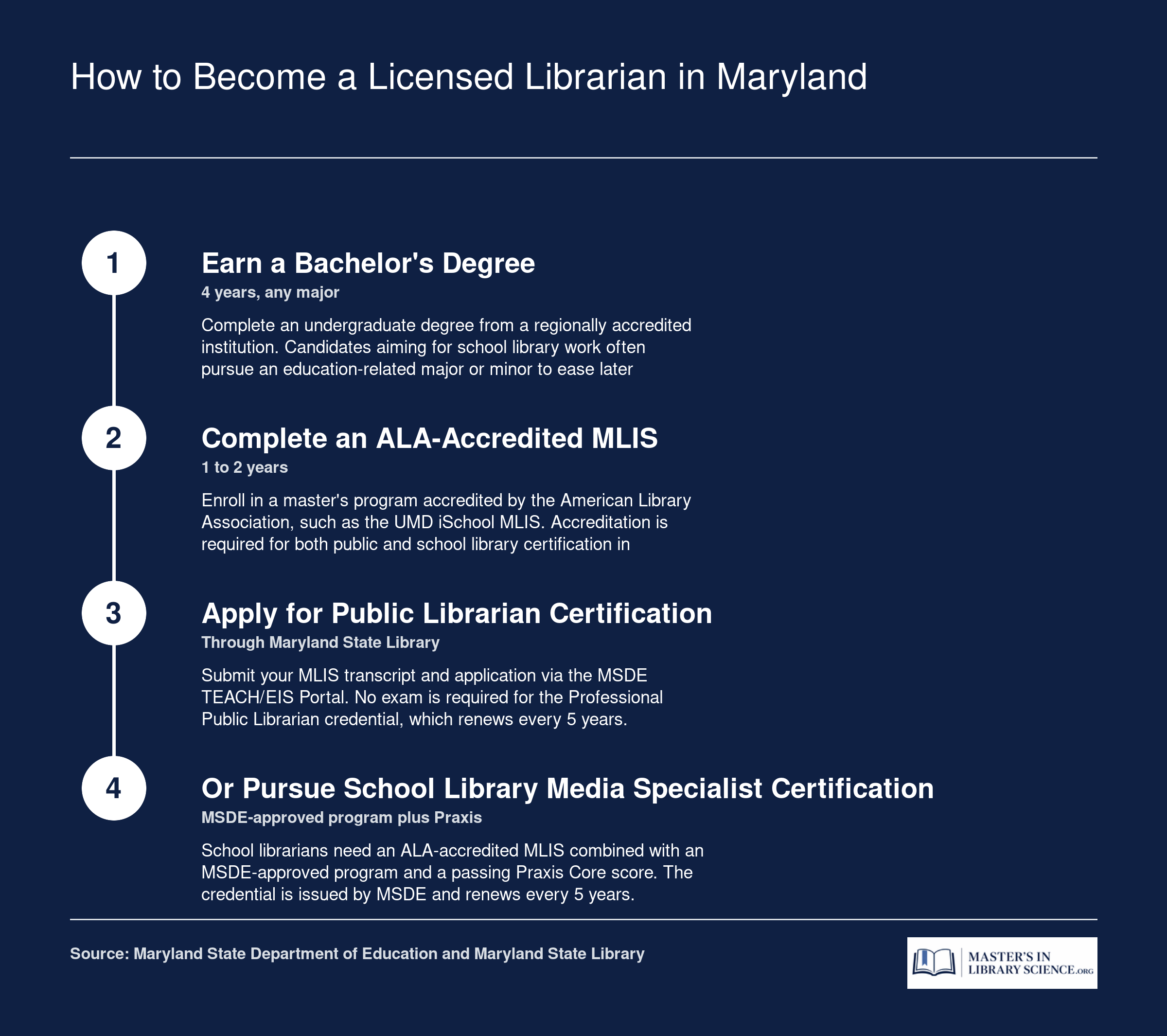
Maryland recognizes two main professional librarian credentials: public librarian certification through the Maryland State Library and school library media specialist certification through the Maryland State Department of Education (MSDE). Both build on an ALA-accredited MLIS, but the school path adds approved coursework and a Praxis exam.

Four-step credentialing path from bachelor's degree to ALA-accredited MLIS to Maryland public or school library certification.

Frequently Asked Questions About Maryland MLIS Programs

Below are quick answers to the questions prospective students most often ask about earning a Master's in Library Science in Maryland. Each response focuses on practical details like format, cost, accreditation, and licensure pathways in the state.

Can you get a Master's degree in library science online?
Yes. Many ALA-accredited programs, including the University of Maryland's MLIS, offer fully or largely online formats. Online students complete the same coursework as on-campus peers, often with asynchronous lectures and occasional synchronous sessions. This format is well suited to working adults in Maryland who want to keep their current library, school, or archives jobs while studying.
Is MLS or MLIS better?
Neither is inherently better. MLS (Master of Library Science) and MLIS (Master of Library and Information Science) are largely interchangeable in hiring. The MLIS label simply reflects the field's expansion into data, technology, and information management. What matters most to employers, including Maryland public libraries and school systems, is that the degree is ALA-accredited.
Which university is best for library science in Maryland?
The University of Maryland College Park iSchool is the only ALA-accredited MLIS program based in Maryland and is widely regarded as the state's flagship option. It offers on-campus, online, and hybrid pathways plus several specializations. Maryland residents seeking other ALA-accredited choices often consider out-of-state online programs, but UMD remains the in-state standard.
How much does an MLIS cost in Maryland?
Total tuition for the 36-credit UMD MLIS varies by residency and term. Maryland residents pay a lower per-credit rate than non-residents, and online students may qualify for specific tuition pricing. Students should also budget for fees, books, and technology. Graduate assistantships, scholarships, and federal loans are commonly used to offset costs.
How do you become a licensed librarian in Maryland?
To work as a professional librarian in a Maryland public library, you generally need an ALA-accredited Master's degree and must complete the state's Public Librarian Certification through the Maryland State Library within a set period after hire. School librarians need an MLIS plus a Maryland State Department of Education professional certification, which includes education coursework and Praxis exams.
Is the UMD MLIS ALA-accredited?
Yes. The University of Maryland's Master of Library and Information Science program is accredited by the American Library Association. ALA accreditation is the standard credential required by most public library systems, academic libraries, and school districts nationwide, including those in Maryland, so graduates are eligible for professional librarian roles across the country.

Recent Articles