New York offers ALA-accredited online MLIS degrees ranging from about $15,000 at SUNY campuses to over $60,000 at private universities.
Nearly all New York online MLIS programs have dropped the GRE for the 2025-2026 admissions cycle, easing application barriers.
Most MLIS degrees require 36 credits and offer concentrations in school media, archives, youth services, or data and information science.
ALA accreditation is required for New York State Public Librarian Certification and most professional library roles.
For working New Yorkers, an online MLIS opens doors to public library branches in Buffalo or the Bronx, K-12 school media centers, and academic libraries at SUNY and CUNY campuses, all without leaving your current job. Flexible online delivery makes it possible to keep earning while you credential up.
Every program featured here is ALA-accredited and offered fully or substantially online, the two non-negotiables for New York State librarian certification requirements.
Below you will find the 2026 rankings, a tuition comparison, GRE-free admission paths, specialization options, salary outlooks for New York graduates, and answers to the questions applicants ask most.
Best Online MLIS Programs in New York for 2026
These are the online and hybrid library science master's programs we recommend for students in the New York metro during the 2026 application cycle. The list spans fully online and hybrid formats, and every school is either ALA-accredited or a recognized pathway into school library certification. Work through the entries below to see which program matches your goals, timeline, and budget.
How this list was builtDetails
What went into the score: Institutional graduation rates, Retention and student support, Program flexibility and format, Regional employment relevance
Where the data comes from:
NCES-IPEDS federal institutional data — nces.ed.gov
Best for: Working professionals seeking flexible online study
Rutgers University anchors this list with a fully online Master of Information program in library and information science. The 36 credit curriculum blends theory and practice across collection management, digital reference, and information literacy, and it is designed for both career changers and working professionals. The program emphasizes community engagement and leadership in information services, backed by one of the region's largest public research universities. The institution's overall graduation rate is about 84 percent, and the average net price for aid recipients is around $24,400.
Master of Information: Library and Information Science — Online
36 credit hours required
Three zero-credit courses included
Concentration-specific electives available
Internship option recommended
Covers digital and physical collection management
Cataloging, classification, and collection development topics
Best for: Tech-focused learners pursuing digital information careers
Drexel University offers an ALA-accredited Master's in Library and Information Science centered on digital information management and applied technology. The 45 credit program takes about two years to complete and uses a hybrid delivery structure designed for working professionals. Specializations in archives, metadata, and user services give students clear tracks for a technology-forward MLIS. As an institution, Drexel's graduation rate is about 78 percent, and the average net price for aid recipients is roughly $38,500.
Online Master's in Library and Information Science (MLIS) — Hybrid
45 quarter credits required
Average completion time of two years
$1,000 per credit tuition
3.0 minimum GPA for admission
GRE scores not required
Specializations in archives, metadata, and user services
Best for: Budget-conscious students pursuing school librarianship
Southern Connecticut State University offers a fully online MLIS that combines a practical 36 credit curriculum with a public university setting. Students move through six core courses, an internship, and a capstone, then choose from specializations in school library media, digital information management, or academic libraries. The program has been ALA-accredited since 2020 and emphasizes hands-on preparation for libraries, archives, and information centers in the tri-state region. The institution-wide graduation rate is about 50 percent, and the average net price for aid recipients is near $20,900.
The Master of Library and Information Science (MLIS) Program — Online
36-credit degree requirement
ALA accredited since 2020
Six core courses plus five specialization courses
Field-based internship and capstone required
Specializations: School Library Media, Digital Information Management, Academic Libraries
New Jersey City University delivers a fully online, asynchronous Master of Arts in Educational Technology with a concentration in school library media. The 36 credit, project-based program is designed for practicing educators and leads to New Jersey certification, a useful credential for school library roles across the metro. It is noted as one of the most affordable options in the state, with field experiences that can often be completed at the student's own school. The institution-wide graduation rate is about 34 percent, and the average net price for aid recipients is about $16,100.
M.A. in Educational Technology: School Library Media Specialist Concentration — On-Campus
36-credit program
Online and asynchronous delivery
Project-based curriculum
Leads to New Jersey school library media certification
Requires a 3.0 GPA
30 hours of field experience
Optional STEM certificate
Noted as the most affordable option in New Jersey
St. John's University-New York
#5
Queens, NY · $30,000/yr
St. John's University offers a fully online, ALA-accredited Master of Science in Library and Information Science built around a 36 credit curriculum. Core courses and electives span public, academic, school, and archival librarianship, along with a social justice requirement that shapes the program. Rolling admissions and tuition that matches the on-campus rate add flexibility for working applicants. The university's overall graduation rate is about 66 percent, and the average net price for aid recipients is around $30,000.
Library and Information Science, Master of Science — Online
ALA-accredited 36-credit program
Four core courses plus seven electives
Social justice requirement
Specializations include academic, archives, public, records, and youth services
Rolling admissions
Requires 3.0 GPA and two recommendation letters
Tuition same as on-campus rates
Scholarships and graduate assistantships available
Kutztown University of Pennsylvania offers an affordable online Master of Library Science with a 36 credit structure and multiple pathways. The program is CAEP-accredited and recognized for school library media preparation, and the school reports a placement rate near 100 percent. Students can pursue the degree with or without K-12 certification, making it a flexible fit for both classroom teachers and career changers. The institution-wide graduation rate is about 54 percent, and the average net price for aid recipients is near $21,300.
Master of Library Science (MLS) — Online
36 credits required
CAEP-accredited with AASL recognition for school media
Nearly 100% placement rate reported
Available online or in person
Teaching certification or GRE scores required
Three recommendation letters required
Fall, spring, and summer admission deadlines
Cataloging, digital collections, and information retrieval focus
Long Island University's M.S. in Library and Information Science, offered through the Palmer School, is a 36 credit hybrid program aligned with New York State school library certification. It is built for working educators who want to lead technology integration and information literacy in K-12 settings, combining online coursework with meaningful in-person instruction. Graduates can pursue professional certification after three years of employment. As an institution, LIU's graduation rate is about 57 percent, and the average net price for aid recipients is roughly $33,100.
M.S. in Library and Information Science (School Library Media Specialist) — Hybrid
36-credit ALA-accredited degree
Hybrid format combining online and in-person work
Leads to New York State School Library Certification
Requires 3.0 GPA and two recommendation letters
GRE exam required for admission
Professional certification after three years of employment
Prepares educational change agents for K-12 settings
Emphasis on information literacy and technology leadership
The table below sorts New York MLIS programs by net price, the average annual cost institution-wide after grants and scholarships are applied. Net price is a useful comparison benchmark, but it is not a personalized quote: your actual cost depends on residency, aid eligibility, and credit load. SUNY and CUNY schools typically anchor the low end of the list, and non-New York residents at public universities should pay attention to the gap between in-state and out-of-state graduate tuition.
School
Sector
Avg. Net Price (Annual)
Graduate Tuition (In-State)
Graduate Tuition (Out-of-State)
Median Graduate Debt
University at Albany (SUNY)
Public
$17,167
$13,808
$27,468
$19,500
University at Buffalo (SUNY)
Public
$20,995
$14,530
$28,210
$19,000
St. John Fisher University
Private
$28,945
$20,706
$20,706
$23,250
St. John's University-New York
Private
$29,999
$36,227
$36,227
$25,000
Long Island University
Private
$33,062
$25,990
$25,990
$23,577
Syracuse University
Private
$38,793
$48,132
$48,132
$26,000
Pratt Institute
Private
$52,659
$40,372
$40,372
$26,000
Online MLIS Programs in New York That Don't Require the GRE
If standardized testing has been a barrier, here is some good news: as of the 2025-2026 admissions cycle, almost every ALA-accredited online MLIS program in New York has dropped the GRE requirement.2 You can apply to a strong slate of New York schools without ever sitting for the exam. For a broader look at this trend nationally, see our guide to No-GRE Master's in Library Science Programs.
Which New York MLIS Programs Skip the GRE
Five of the state's main online MLIS programs no longer require the GRE at all, and two more treat it as optional. Here is where each program stands for 2025-2026:
For the two GRE-optional programs, submitting scores is genuinely a choice. A strong score can strengthen a borderline file, but leaving it out will not hurt an otherwise competitive application.
What Admissions Committees Look at Instead
Without test scores in the mix, the rest of your file carries more weight. Across these seven programs, the published admissions criteria look broadly similar:
A completed bachelor's degree from an accredited institution
A minimum undergraduate GPA of 3.0 (programs will sometimes admit below this with strong supporting materials)
A statement of purpose explaining your interest in library and information science
Two or three letters of recommendation
A resume or CV, with library, archives, education, or information work counted as a plus
Some programs also ask for a writing sample or a short interview, particularly for specialized tracks like archival studies or youth services.
Practical Takeaway for Borderline Applicants
If your undergraduate GPA is below 3.0, do not assume you are out of the running. Lead with a focused, specific statement of purpose that names the type of librarianship you want to practice, and back it up with concrete experience: a job, internship, or volunteer role in a library, archive, school, museum, or information-adjacent setting. Recommenders who can speak to your work habits and writing will do more for you than a test score ever would.
How Much Does an Online MLIS Cost in New York?
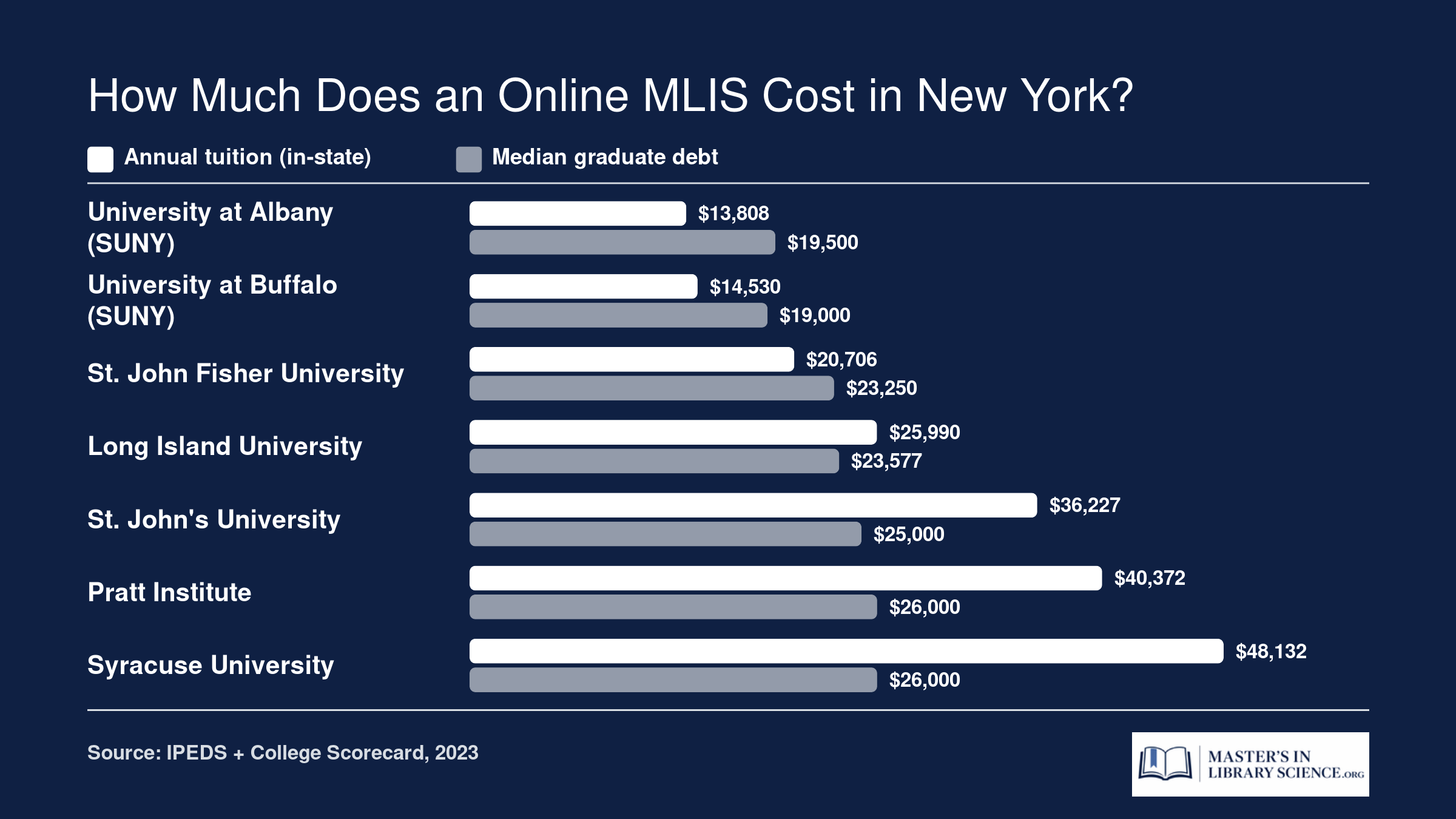
Most New York MLIS degrees run 36 credits, and total tuition can land anywhere from roughly $15,000 at a SUNY campus to $60,000 or more at a private university. The chart below compares published in-state tuition (one full year of full-time graduate study) at seven ranked NY programs so you can see how public SUNY pricing stacks up against private options like Syracuse and Pratt. Median graduate debt at completion clusters in the $19,000 to $26,000 range across these schools.
Questions to Ask Yourself
Which library setting do I picture myself working in: a K-12 school, a public branch, an academic library, or a special collection?
Do I need New York State school librarian certification, and does the program I'm considering lead to it?
Can I commit to an in-person practicum or fieldwork hours, even if the coursework is fully online?
MLIS Specializations Offered by New York Schools
Most New York MLIS programs let you tailor your degree to a career path. Picking the right concentration matters because it determines which jobs you can apply for, which state credentials you qualify for, and how much extra coursework you may need after graduation.
School Library Media (NYS Certification Track)
If you want to work as a K-12 librarian in a New York public school, you need a program that leads to New York State certification as a School Library Media Specialist. The University at Buffalo offers an online MS in School Librarianship with 100 field experience hours and 70 student teaching days built in. The University at Albany has a school library concentration within its MS in Information Science, and St. John Fisher University runs an online MS in Library Media with a Teacher Librarian concentration. Long Island University's Palmer School also prepares graduates for initial NYS school librarian certification. Expect required field placements, an edTPA or similar teaching assessment, and additional NY State exams (such as the Content Specialty Test) beyond the MLIS itself.
Archives, Preservation, and Art Librarianship
Pratt Institute is the standout for archives and cultural heritage work. Its dual MA/MS combining History of Art and Design with Library and Information Science places students in internships at institutions like the Met and the Whitney, with a focus on digital archives and rare books. This path leads to careers in museum libraries, special collections, and academic art libraries.
Data Curation, Digital Libraries, and Academic Roles
Syracuse University offers concentrations in Data Curation and Services, User Services and Community Engagement, and School Media. The University at Buffalo's Information and Library Science MS includes tracks in cataloging, digital libraries, law librarianship, music librarianship, and academic or special libraries. St. John's University offers specializations in academic librarianship, archival studies, records management, public librarianship, and youth services.
How Specialization Affects Your Career
A general MLIS opens doors to public and academic library work, but specialized concentrations can be gatekeepers. School library jobs require state certification. Archives roles often expect coursework in preservation and digital curation. Data curation tracks position graduates for emerging roles in research libraries and corporate information centers. When you map out careers in library science, choose the concentration that matches the credential, not just the topic.
Salary and Career Outcomes for MLIS Graduates in New York
New York is one of the strongest librarian job markets in the country, and MLIS graduates from the state's ALA-accredited programs tend to land in solid middle-class earnings territory within a few years of graduation. While program-specific 1-year and 4-year earnings data for these MLIS degrees is not yet published in federal outcomes reporting, longer-term institutional earnings figures and Bureau of Labor Statistics wage data for New York librarians give a reasonable picture of what to expect.
What New York MLIS Graduates Typically Earn
Ten years after enrollment, graduates of New York institutions offering MLIS degrees report median earnings in roughly the high $50,000s to high $70,000s. Syracuse University graduates report the highest figure in this group at about $79,000, followed by University at Buffalo near $71,000, St. John's University around $70,000, University at Albany near $68,000, and St. John Fisher University around $67,000. These numbers cover all alumni at each institution, not MLIS graduates specifically, but they signal that degrees from these schools generally lead to stable, salaried careers.
Program-level employment rates and the share of graduates earning above the poverty line are not yet reported for these MLIS programs, so we cannot quote precise post-graduation employment percentages here. Nationally, however, ALA-accredited MLIS programs report strong placement, and New York's dense library network supports that trend. For a broader view, see how library science salaries compare across other states.
Salary Expectations by Setting
Where you work matters as much as where you studied:
Entry-level public librarians in upstate New York and smaller systems typically start in the high $40,000s to mid $50,000s.
NYC and Long Island public librarians generally earn more, with NYPL, Brooklyn, Queens, and Nassau-Suffolk systems paying above the national librarian median of roughly $64,000.
Academic librarians at NYC universities often start in the low to mid $60,000s and move into the $80,000s with experience and tenure-track status.
Special and corporate librarians, including law firm librarians, medical librarians, and competitive intelligence roles in Manhattan, can reach $90,000 and up.
How Specialization Shapes Earnings
Track matters. Graduates who concentrate in data curation, digital asset management, or academic librarianship typically out-earn those on public library or school librarian tracks, especially in the NYC metro. School library media specialists earn on the teacher salary schedule of their district, which in downstate New York is often competitive with academic librarianship but follows a different trajectory. Prospective students weighing specific Library science jobs should factor these setting and track differences into their planning.
Frequently Asked Questions About NY MLIS Programs
Below are quick answers to the questions prospective students most often ask about pursuing an online MLIS in New York. Each response reflects current 2026 program norms and New York State certification requirements.
Is an MLS or MLIS better?
They are functionally equivalent. The MLS (Master of Library Science) was the dominant title through the late 20th century, and the MLIS (Master of Library and Information Science) evolved from it to reflect the field's expanded focus on information systems. The American Library Association accredits programs under a single standard regardless of the degree title, and fewer than 10% of accredited programs still use the MLS name. MLIS is now the most common naming for U.S. professional librarian roles.
What is the average salary for MLIS graduates in New York?
Salaries vary widely by setting and region. Public and academic librarians in New York City and surrounding metro areas typically earn more than the national librarian median, while upstate and rural positions tend to pay less. Specialized roles in law firms, corporate research, and academic medical libraries usually command the highest pay. For current figures, consult the U.S. Bureau of Labor Statistics state and metro wage data for librarians and media collections specialists.
What is the highest rated online Master's in library science?
Rankings shift year to year, but Syracuse University's iSchool and Rutgers (just across the state line) consistently appear among the top-rated ALA-accredited online programs available to New York residents. Within New York, Queens College (CUNY), the University at Buffalo, and St. John's University also draw strong reviews. The best fit depends less on rankings than on accreditation, specialization options, cost, and whether the program supports your certification goals.
Do New York MLIS programs require the GRE?
Most do not. As of 2026, the majority of ALA-accredited online MLIS programs serving New York applicants, including Queens College, the University at Buffalo, Syracuse, and St. John's, have made the GRE optional or dropped it entirely. Admissions decisions typically weigh undergraduate GPA, a statement of purpose, letters of recommendation, and relevant work or volunteer experience in libraries or related fields.
How long does it take to complete an online MLIS in New York?
Most New York online MLIS programs require 36 credits and take about 2 years of full-time study. Part-time students typically finish in 2.5 to 3 years, and a few accelerated tracks allow completion in roughly 18 months. Many programs cap enrollment at 5 or 6 years to ensure coursework remains current.
Does an online MLIS qualify me for NYS school librarian certification?
Only if the program is registered with the New York State Education Department as leading to Library Media Specialist certification. An ALA-accredited MLIS alone is not sufficient; you must complete a NYSED-approved program that includes required education coursework and supervised school library fieldwork. For public library work, an ALA-accredited MLIS qualifies you for the NYS Public Librarian Certificate, which is a separate credential.