The University of Rhode Island runs the only ALA-accredited MLIS based in Rhode Island, offered fully online to residents and non-residents.
Rhode Island librarians earned a mean annual wage of $74,470 in May 2023, with about 780 jobs statewide.
K-12 school librarians need a School Library Media Specialist Endorsement; public and academic roles do not require state licensure.
URI's MLIS supports multiple concentrations, letting students align coursework with school, public, academic, or special library careers.
Rhode Island's MLIS landscape is compact: the University of Rhode Island runs the state's only ALA-accredited program, and it serves both residents and out-of-state students through an online-friendly format with several concentration options.
Because in-state choices are limited, most applicants weigh URI against regional online programs like Simmons and Syracuse before committing. Cost, residency pricing, and specialization fit usually decide it.
This guide walks through the 2026 rankings, tuition and ROI, ALA accreditation and admissions requirements, specialization tracks, career and salary data for Rhode Island librarians, and the steps to earn a school librarian degree online endorsement if K-12 work is your goal.
Ranked: Best Online MLIS Programs in Rhode Island for 2026
The University of Rhode Island is the sole institution in Rhode Island offering an ALA-accredited online Master of Library and Information Studies. Rather than ranking by cost or earnings alone, the listing below reflects a composite of institutional quality indicators, online delivery format, and program breadth. URI stands out for offering three distinct concentration tracks, all fully asynchronous, giving Rhode Island residents and out-of-state learners multiple pathways into library and information science careers.
Factors considered
Institutional graduation and retention rates
Online delivery and format flexibility
Program breadth and concentrations
Accreditation and certification eligibility
Affordability and financial aid access
Data sources
NCES-IPEDS federal institutional data — nces.ed.gov
Best for: Rhode Island professionals seeking ALA-accredited flexibility
The University of Rhode Island delivers a fully online, ALA-accredited Master of Library and Information Studies with three concentration tracks: Digital Media, Information Equity and Critical Librarianship, and School Library Media. The school offering this program has a graduation rate of 73.3% and an 84% first-year retention rate, signaling solid student support. Rolling admissions and no GRE requirement make the program accessible to working professionals, and the School Library Media track qualifies graduates for K-12 certification recognized by Rhode Island and several neighboring states. Students can finish in as little as one year full-time or two years part-time, with mandatory internships supported by URI's extensive alumni network across New England.
Master of Library and Information Studies, Digital Media — Online
Fully asynchronous online format for working professionals
Covers digital preservation, multimedia systems, and info architecture
Hands-on project learning integrated into coursework
No GRE required for qualified applicants
Multiple start dates with rolling admissions
Financial aid and competitive in-state tuition available
Completable in one year full-time or two years part-time
Mandatory internship with local and regional placement support
For most Rhode Island residents weighing an MLIS, the University of Rhode Island is the in-state anchor. Knowing what it actually costs, and what regional alternatives charge, is the fastest way to judge whether the degree pencils out.
What URI Charges in 2026
URI lists its online MLIS at $951 per credit for the 2026 academic year.2 The program runs 36 to 39 credits depending on concentration and field experience requirements, putting the total tuition cost in the range of $34,236 to $37,089 before fees.3
Full-time annual graduate tuition is published at $17,116 in-state and $33,328 out-of-state.1 Notably, URI applies the same per-credit online rate to most MLIS students regardless of residency, which is a meaningful break for out-of-state applicants who would otherwise face the higher sticker price.
Simmons University SLIS (Boston): roughly $1,460 per credit for the online MSLIS, or about $54,000+ for a 36-credit program.
Syracuse University iSchool MSLIS: roughly $1,802 per credit, pushing total tuition past $65,000 for the 36-credit track.
Against those numbers, URI comes in $20,000 to $30,000 cheaper for the same ALA-accredited credential. That gap is the single biggest financial argument for staying in-state, and it holds even for students who could theoretically commute to Simmons. Cost-conscious applicants who can study anywhere may also want to scan the cheapest library science degree online before committing.
Translating the Numbers Into Monthly Reality
Program-level earnings and median debt figures are not yet published for URI's MLIS specifically, so any ROI conversation has to lean on broader benchmarks. Entry-level librarian salaries in Rhode Island generally start in the $48,000 to $55,000 range, with experienced public and academic librarians earning into the $70,000s.
If a student borrows the full $36,000 URI tuition on a standard 10-year federal repayment plan at current graduate loan rates (around 8%), the monthly payment lands near $435. On a $50,000 starting salary (roughly $3,200 per month after taxes), that is a manageable but not trivial commitment, around 13% of take-home pay.
The same loan math at Simmons or Syracuse pricing produces a monthly payment closer to $650 to $790, which can consume nearly a quarter of an entry librarian's net income. That is the practical reason cost matters: the credential is the same, but the repayment burden is not.
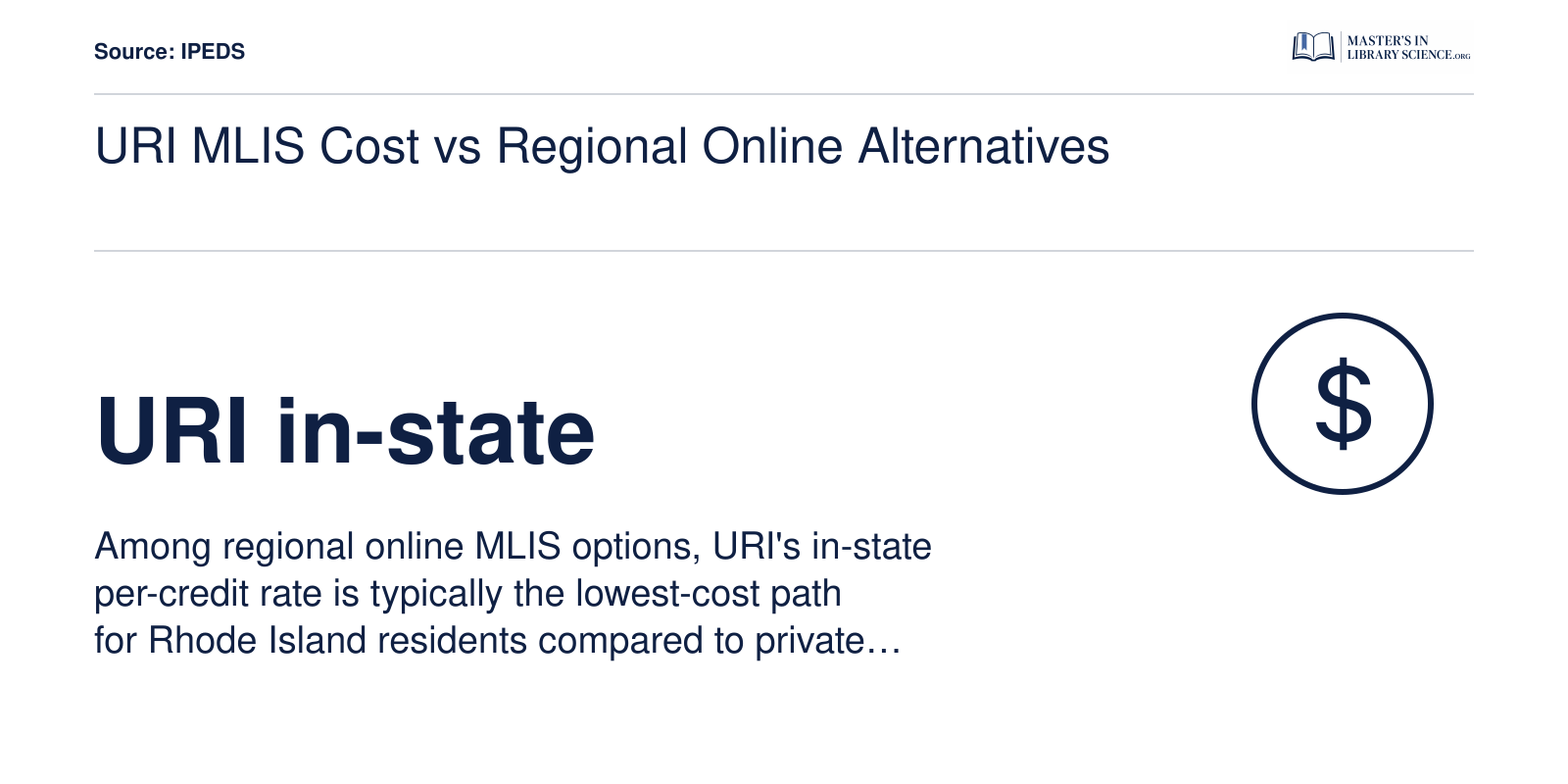
URI MLIS Cost vs Regional Online Alternatives
Total program cost varies widely depending on residency status and whether you choose a public or private library science program. Below is a snapshot of the cheapest published path for a Rhode Island student pursuing an online MLIS in the region.
ALA Accreditation & 2026 Admissions Requirements
Before you submit an application, it helps to understand two things: what makes a Rhode Island MLIS degree count nationally, and exactly what the University of Rhode Island expects in your file. Both factors shape whether you can finish on time and work as a librarian in the states where you want to live.
Why ALA Accreditation Matters
The University of Rhode Island's Master of Library and Information Studies is accredited by the American Library Association (ALA), and this is the credential that travels.1 Most public, academic, and special libraries across the United States and Canada require an ALA-accredited master's for professional positions, and many state-level school library media certifications either require it outright or accept it as the qualifying degree. Choosing an ala accredited online mlis programs means your diploma is portable: if you start your career in Providence and later move to Boston, Raleigh, or Seattle, your degree will still meet the baseline hiring requirement.
GRE Policy and GPA Expectations
URI does not require the GRE for 2026 admission. A GRE waiver is available, and the program evaluates applicants holistically without standardized test scores.1 You will need a completed bachelor's degree from a regionally accredited institution and a minimum undergraduate GPA of 3.00. Applicants slightly below that threshold are sometimes considered if the rest of the file is strong, but the 3.00 mark is the published expectation. If standardized testing is a sticking point, URI fits within the broader landscape of No-GRE Master's in Library Science Programs.
Required Application Materials
Applications are submitted through URI's online graduate portal. Plan to assemble:
A statement of purpose, typically 500 to 800 words, describing your interest in library and information studies and your career goals
Two letters of recommendation from academic or professional references
A current resume or CV outlining education, work, and any library, archival, or related experience
Official transcripts from every college or university attended
2026 Deadlines and Admissions Cycle
URI uses a fixed deadline rather than continuous rolling admissions for its primary intake. The 2026 fall application deadline is June 15, 2026.1 Applicants targeting a spring start should confirm the spring deadline directly with the Graduate School of Library and Information Studies, since spring availability can vary by cohort. Submitting four to six weeks before the deadline gives recommenders time to respond and lets the admissions office flag any missing documents while you can still fix them.
Questions to Ask Yourself
Which library setting fits my goals best: public, academic, school, or special librarianship?
Do I plan to build my career in Rhode Island or the broader New England region long-term?
Can I realistically commit to in-person practicum and fieldwork hours while completing online coursework?
Am I prepared to pursue any additional state certifications my chosen path may require?
Popular MLIS Specializations Available to Rhode Island Students
The University of Rhode Island offers the only ALA-accredited MLIS in the state, and its specialization tracks shape both your coursework and your eventual career path. Choosing a focus area early helps you align electives, practicum placements, and any required certification exams. If you're still weighing options, our guide on how to choose a library science program walks through the trade-offs in more detail.
URI's Main Specialization Tracks
URI structures its MLIS around several focus areas that reflect where library jobs actually exist in the region:
School Library Media: Prepares graduates to work as certified school librarians in K-12 settings, with coursework in youth services, curriculum integration, and instructional design.
Leadership and Management: Targets students aiming for department head, branch manager, or library director roles in public and academic systems.
Digital Media and Archives: Covers digital preservation, metadata, and special collections, useful for archival work at institutions like the Rhode Island Historical Society or academic special collections.
Information Equity and Community Engagement: Focuses on access, literacy programming, and serving underserved populations, a strong fit for urban public library systems.
School Library Certification and New England Reciprocity
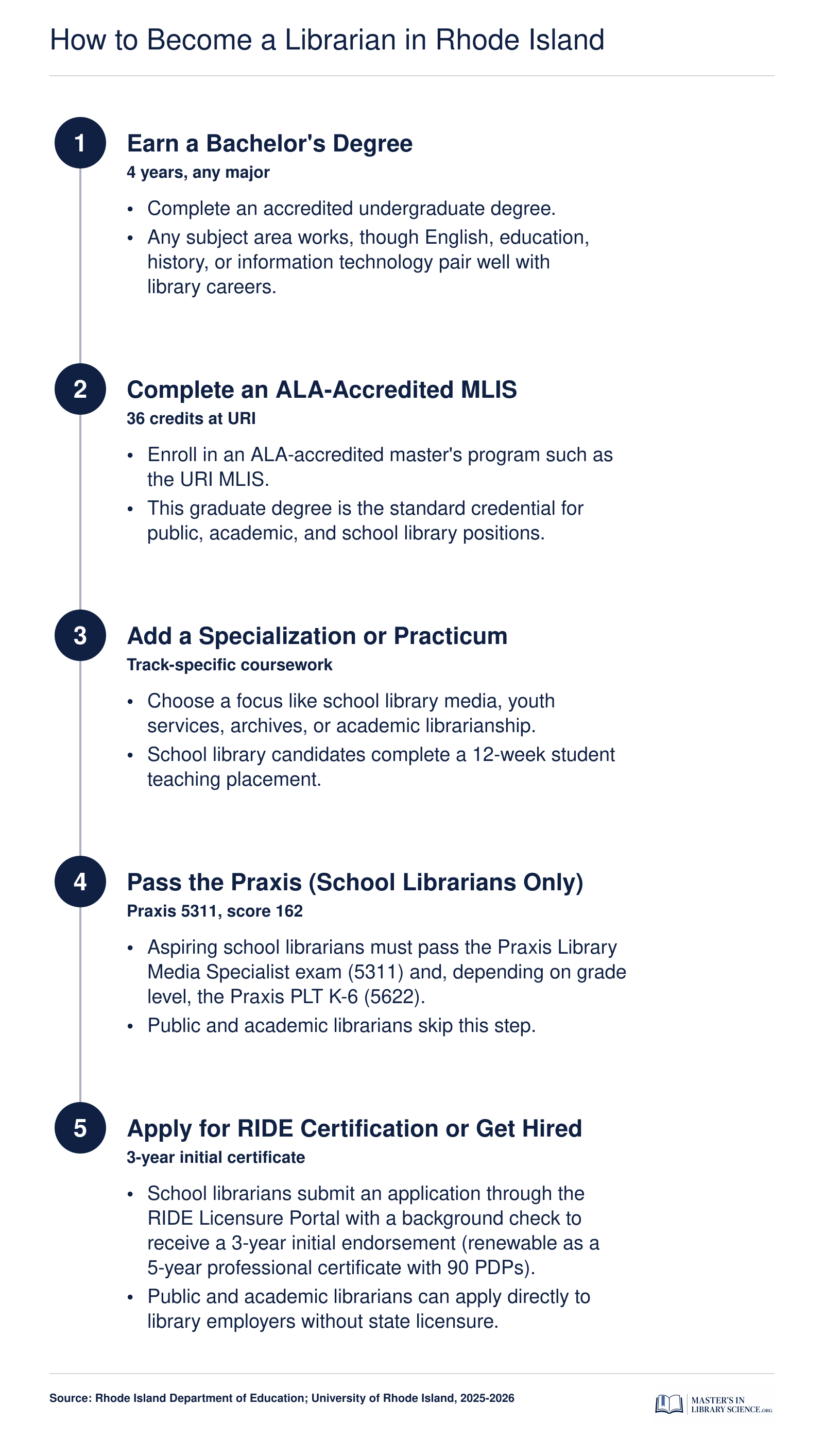
Rhode Island participates in the NASDTEC Interstate Agreement, which means a school library media certification earned through URI is generally recognized across New England, including Massachusetts, Connecticut, and New Hampshire, though each state may require additional paperwork or a state-specific exam. Rhode Island candidates pursuing this track must pass the PRAXIS Library Media Specialist exam (test code 5311) before full certification is issued by the RI Department of Education. For a state-by-state overview of requirements, see our school librarian licensure resource.
Aligning Specialization with Rhode Island's Job Market
Rhode Island's library employment is concentrated in three areas: academic libraries (Brown, URI, Providence College, RISD), public library systems coordinated through the Ocean State Libraries network, and K-12 school districts. Leadership and digital archives tracks tend to feed academic and special library roles, while school library media graduates fill openings in Providence, Cranston, Warwick, and smaller district schools.
How Specialization Affects Practicum and Exams
Your chosen track determines where you complete your practicum: school media students are placed in approved K-12 libraries, while archives students may work with university special collections or state archives. Only the school library media track requires PRAXIS testing; other specializations do not carry a state exam requirement.
The path to becoming a librarian in Rhode Island depends on the setting you want to work in. Public and academic librarians do not need a state credential, while K-12 school librarians must earn a School Library Media Specialist Endorsement from the Rhode Island Department of Education.
Librarian Careers and Salaries in Rhode Island
Rhode Island is a small but wage-friendly market for librarians and media collections specialists. According to BLS Occupational Employment and Wage Statistics (May 2023), the state employed roughly 780 people in this occupation, earning a mean annual wage of $74,470 (about $35.80 per hour).1 That puts Rhode Island noticeably above the national mean of $68,570 and the national median of $64,370 for the same role.2
Wage Percentiles: Rhode Island vs National
The Bureau of Labor Statistics publishes wage percentiles so you can see the full earnings curve, not just the average. Rhode Island state-level percentiles for Librarians and Media Collections Specialists (SOC 25-4022) are reported by the Rhode Island Department of Labor and Training alongside BLS OEWS data. The national figures provide a useful benchmark:
10th percentile (national): $38,690
25th percentile (national): $50,930
Median (national): $64,370
75th percentile (national): $80,980
90th percentile (national): $101,970
Because Rhode Island's mean wage runs about 9 percent higher than the U.S. mean, librarians working in the state generally sit in the upper half of the national distribution, particularly those in academic, special, or supervisory roles. For a broader view of how states stack up, see our library science salary by state comparison. The Providence-Warwick-Cranston metro area, which absorbs the bulk of state employment, tracks closely with the statewide numbers given how compact Rhode Island is geographically.
Connecting the MLIS to Real Earnings
For prospective students weighing the University of Rhode Island MLIS, the wage picture is the other half of the ROI equation. Early-career graduates typically start below the state mean while building experience in entry-level public library, school media, or paraprofessional roles, then move toward the state mean and 75th percentile as they take on cataloging leadership, branch management, academic liaison, or digital services positions.
Job Growth Outlook
Nationally, BLS projects 2 percent employment growth for librarians and media collections specialists from 2024 to 2034, with about 13,500 annual openings driven largely by retirements and turnover.3 Rhode Island's outlook generally mirrors the national trend, meaning steady rather than rapid hiring, with the strongest demand in school library media and academic library settings.
Frequently Asked Questions About RI MLIS Programs
Below are answers to the questions Rhode Island applicants ask most often about online MLIS programs, accreditation, and career outcomes. Use these as a quick reference alongside the program details earlier in this guide.
Is it worth getting a Master's in library science?
For most professional librarian roles, yes. An ALA-accredited MLIS is the standard credential for academic, public, and special library positions, and it is required for school library media certification in Rhode Island. The degree also opens doors to archives, digital curation, and information management work outside traditional libraries, which broadens long-term career flexibility.
Can you get a Master's degree in library science online?
Yes. Most ALA-accredited programs now offer fully online or heavily online MLIS options, including the University of Rhode Island. Coursework is typically delivered through asynchronous lectures and discussion boards, with occasional synchronous sessions. Online students complete the same curriculum and receive the same degree as on-campus students, which means the credential carries equal weight with employers.
Which university is best for library science in Rhode Island?
The University of Rhode Island is the only institution in the state that offers an ALA-accredited MLIS. URI's Graduate School of Library and Information Studies has been the regional anchor program for decades and serves students across New England through its online format. If you want an in-state Rhode Island MLIS, URI is effectively your option.
Is MLS or MLIS better?
Functionally they are equivalent. MLS (Master of Library Science) is the older title, while MLIS (Master of Library and Information Science) reflects the field's expansion into data, technology, and digital information. Employers treat ALA-accredited MLS and MLIS degrees identically. URI awards an MLIS, which signals current curriculum coverage of both library practice and information systems.
How long does the URI online MLIS take to complete?
URI's MLIS is a 36-credit program. Full-time students generally finish in about two years, while part-time students, who make up most of the online cohort, typically take three to four years. The program allows flexible pacing so working professionals can balance coursework with employment, and most courses run on a standard fall, spring, and summer schedule.
Do I need ALA accreditation to work as a librarian in Rhode Island?
For professional librarian positions in Rhode Island public and academic libraries, an ALA-accredited master's is the expected credential, and the Office of Library and Information Services follows this standard. School library media certification through the Rhode Island Department of Education also requires an ALA-accredited degree. Non-accredited programs may limit your eligibility for these roles.