Best Online MLIS Programs in Virginia (2026)

Online Master's in Library Science (MLIS) Programs in Virginia

Compare ALA-accredited MLIS degrees, tuition, admissions, and career paths for Virginia students

By Meredith SimmonsReviewed by MLIS Academic Advisory TeamUpdated May 7, 202616 min read
Best Online MLIS Programs in Virginia (2026)

What to Know

  • Only one Virginia program currently holds ALA accreditation, making it the default choice for most career paths.
  • Virginia employed about 2,090 librarians in 2025 with a median annual wage of $67,540.
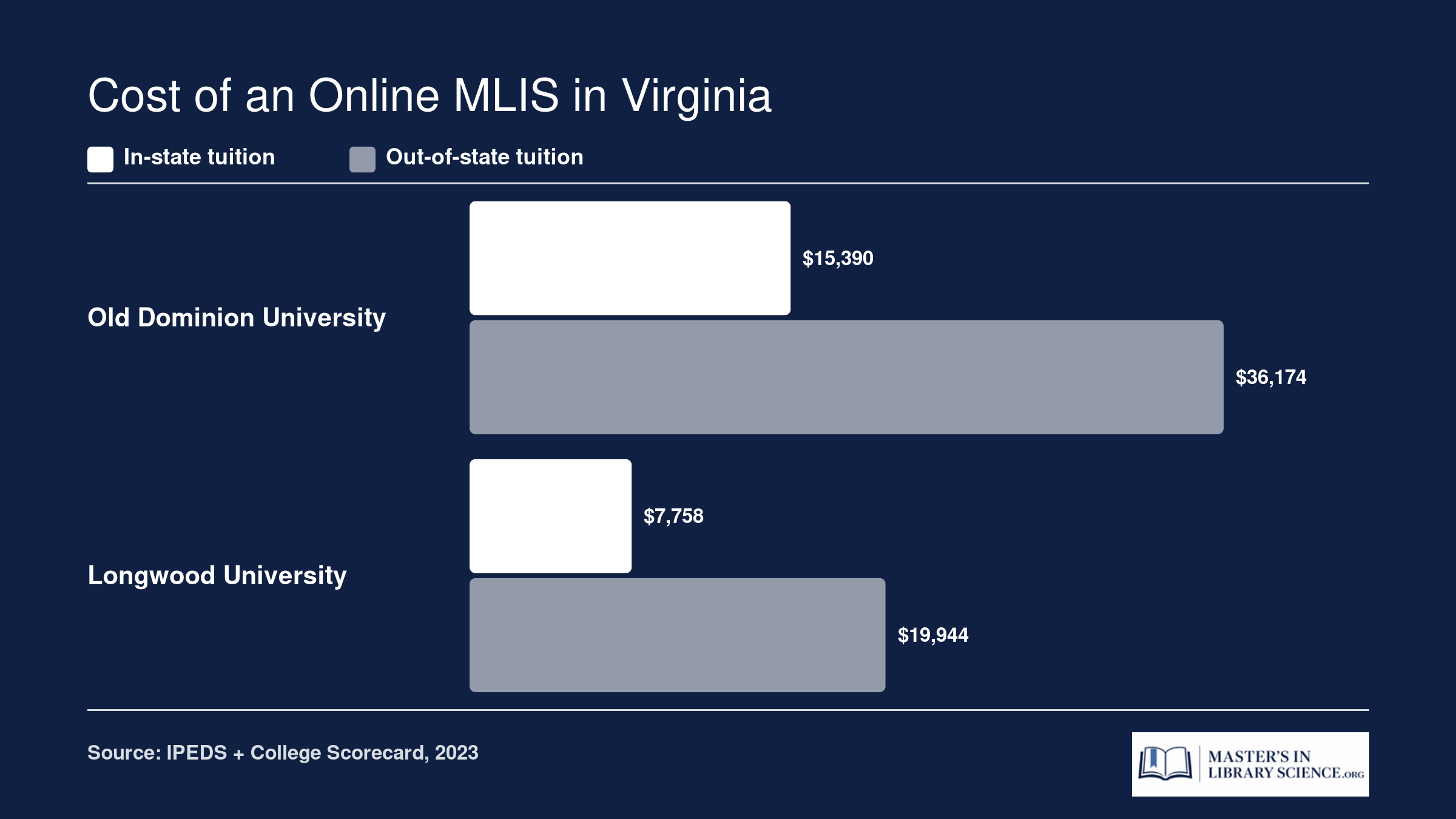
  • In-state tuition at Longwood undercuts Old Dominion, but out-of-state students face steep premiums at both schools.
  • K-12 librarian roles in Virginia require a master's degree plus the state school librarian endorsement.

Virginia offers a small but distinct lineup of online master's options for aspiring librarians: Old Dominion University, Longwood University, and Regent University. Each sits on a different accreditation path, which matters more than most applicants realize.

ALA accreditation is the dividing line for many academic, public, and federal library jobs, so we'll clarify exactly which Virginia programs hold it and which do not in the sections ahead.

Below you'll find a ranked comparison of the in-state options, a breakdown of tuition and total cost, admission requirements, popular specializations, and what the librarian job outlook looks like across Virginia in 2026.

Best Online MLIS Programs in Virginia for 2026

Virginia's online-eligible master's programs in library science are ranked here using a composite that favors quality and online-delivery fit, not the lowest sticker price or the highest reported earnings. The two schools below are the in-state options that currently support distance learners pursuing library and information studies or school librarianship endorsement. Use the tuition, net price, and graduation rate alongside each school's program details to gauge fit.

We built this list to surface Virginia institutions whose master's programs in library science are deliverable online or in a hybrid format suitable for working adults. Schools are ordered using a mixed quality signal that blends institutional outcomes with program-level fit for distance learners, then refined with topic-specific research about accreditation status, residency requirements, and Virginia-specific endorsement pathways.

Factors considered
  • Graduation and retention rates
  • Net price and student debt outcomes
  • Median graduate earnings after enrollment
  • Program-level admissions and curriculum details
  • Online or hybrid delivery suitability
  • Topic-specific research on accreditation and state pathways
Data sources
  • NCES-IPEDS (federal institutional data: completion, retention, costs, enrollment) — nces.ed.gov
  • U.S. Department of Education College Scorecard (graduate earnings, debt, net price) — nces.ed.gov
  • Internal program database (program-level admissions, curriculum, and outcomes)
  • Independent program research (additional web research conducted for this article)

Old Dominion University

#1

Norfolk, VA · $13,000 – $34,000/yr

Best for: Fully online learners pursuing library and information studies

Old Dominion University offers Virginia's most fully online pathway into the field, with a Master of Library and Information Studies plus stackable concentrations in School Librarianship and Youth Services. Coursework runs asynchronously, so working professionals can complete the degree from anywhere in the state, with rolling fall, spring, and summer starts and no entrance exam required. The graduation rate shown is institution-wide rather than program-specific, but the MLIS itself is built around practical training in cataloging, reference, digital resources, and information ethics.

  • Fully online, asynchronous coursework with flexible start terms
  • Core training in information organization and cataloging
  • Coursework in reference services and information ethics
  • Emphasis on digital resource management and emerging tech
  • Prepares graduates for libraries, archives, and information centers
  • No GRE or other entrance exam required for admission
  • Rolling admissions across fall, spring, and summer terms
  • Fully online, asynchronous coursework with flexible start terms
  • Core training in information organization and cataloging
  • Coursework in reference services and information ethics
  • Emphasis on digital resource management and emerging tech
  • Prepares graduates for libraries, archives, and information centers
  • No GRE or other entrance exam required for admission
  • Rolling admissions across fall, spring, and summer terms
  • Fully online, asynchronous coursework with flexible start terms
  • Core training in information organization and cataloging
  • Coursework in reference services and information ethics
  • Emphasis on digital resource management and emerging tech
  • Prepares graduates for libraries, archives, and information centers
  • No GRE or other entrance exam required for admission
  • Rolling admissions across fall, spring, and summer terms

Longwood University

#2

Farmville, VA · $19,000/yr

Best for: Virginia teachers adding PreK-12 library media endorsement

Longwood University runs a hybrid Master of Education in School Librarianship aimed squarely at Virginia educators seeking PreK-12 Library Media endorsement. The program combines weekly online instruction with monthly Saturday sessions in Farmville and uses a cohort model with field placements in partner Virginia school districts. Note that the listed graduation rate is institution-wide, and this program is hybrid rather than fully online, so applicants should plan for periodic in-person attendance.

  • Hybrid format with weekly online plus Saturday in-person sessions
  • CAEP-accredited with AASL national recognition
  • Two tracks: licensed teachers and initial licensure
  • Leads to PreK-12 Library Media endorsement in Virginia
  • Cohort-based learning with 25 to 39 total credits
  • Minimum 2.75 undergraduate GPA, no entrance exam required
  • In-state tuition around $450 per credit hour
  • Field placements through Virginia school district partnerships

ALA Accreditation Status for Virginia MLIS Programs

Accreditation is the single biggest factor that shapes where your MLIS will be accepted after graduation. In Virginia, only one program currently holds ALA accreditation, but two other in-state options offer alternative pathways that may or may not fit your career goals. Here is how to read the landscape.

Why ALA Accreditation Matters

Most academic libraries, federal libraries (including the Library of Congress), and a large share of public library systems require a master's degree from a program accredited by the American Library Association. Without that credential, you can be screened out of applicant pools before a hiring manager ever sees your resume. If you want maximum flexibility to move between library types or across state lines, ALA accreditation is the safer bet.

Old Dominion University: ALA Accredited

Old Dominion University's MLIS holds Initial Accreditation from the American Library Association, granted on January 20, 2022.2 ODU is currently the only ALA-accredited MLIS program based in Virginia.3 The program has follow-up reporting due in February 2026, and its next comprehensive review is scheduled for 2028 under the ALA's 2023 Standards.1 "Initial" simply means the program is in its first accreditation cycle; it carries the same weight as continuing accreditation for hiring purposes.

Longwood University: VDOE School Librarian Pathway

Longwood University does not offer an ALA-accredited MLIS. Instead, its school librarian licensure program prepares candidates for Virginia Department of Education (VDOE) endorsement through a CAEP-accredited education unit. This is designed specifically for people who want to work as a licensed school librarian in Virginia K-12 schools. It is a strong fit for current teachers adding an endorsement, but it generally will not qualify graduates for academic or federal library positions that require an ALA degree.

Regent University: Non-ALA MA in Library Studies

Regent University offers a Master of Arts in Library Studies that is not ALA-accredited. It can support careers in some special, church, or private library settings, and it can complement other credentials, but it does not meet the standard requirement for most public, academic, or federal library jobs.

A Simple Decision Rule

If you want flexibility across library types or plan to work outside Virginia, choose an ALA-accredited program. If your sole goal is to become a licensed school librarian in Virginia, the VDOE endorsement pathway can be enough.

Cost of an Online MLIS in Virginia

Virginia's two public MLIS pathways post very different sticker prices once you factor in residency. Old Dominion lists higher graduate tuition overall, while Longwood's School Librarianship M.Ed. comes in lower for in-state students. Out-of-state learners pay a sizable premium at both schools, and published net price figures cover the whole institution rather than the MLIS specifically.

Cost of an Online MLIS in Virginia

Admission Requirements for Virginia MLIS Programs

Admission requirements for Virginia's library science graduate programs vary by school, and policies shift from year to year. Use the guidance below as a starting framework, then confirm every detail directly with each university before you apply.

Start With Each Program's Official Admissions Page

The most reliable source for current requirements is the graduate admissions page for the specific program you are targeting. In Virginia, that means three primary online or hybrid options:

  • Old Dominion University's online Master of Library and Information Studies
  • Longwood University's MS in School Librarianship
  • Regent University's MA in Library Studies

Each of these pages typically lists the current GRE policy, minimum undergraduate GPA expectations (commonly around 2.75 to 3.0), application deadlines, and the full packet of required materials, which usually includes transcripts, a statement of purpose or personal essay, two or three letters of recommendation, and a current resume.

Verify GRE and GPA Policies Directly

GRE waivers and test-optional admissions have become common across MLIS programs nationally, but they are not universal and they can change from one cycle to the next. If you are weighing whether to skip the exam entirely, it helps to review which MLS programs require no GRE before committing to a testing timeline. Do not assume a program is test-optional based on what was true last year. Email the admissions office or program coordinator and ask in writing whether the GRE is required, waived, or optional for your intended start term. The same applies to GPA cutoffs, which sometimes have provisional admission pathways for applicants below the stated minimum.

Track Multiple Deadlines and Request the Handbook

Virginia programs often offer fall, spring, and summer entry points, each with its own deadline. The school librarianship track at Longwood may also have licensure prerequisites if you plan to work in K-12 settings, so request the program handbook to see the full list of courses, practicum expectations, and any background check or licensure paperwork. If you are still comparing concentrations, our guide to online MLIS school librarianship options can help frame the questions to ask. Set calendar reminders to revisit each program page two or three months before you intend to submit.

Use ALA and BLS for Context, Not Requirements

The American Library Association is the right reference for accreditation status, and the Bureau of Labor Statistics is useful for understanding the librarian career outlook. Neither sets admission rules. For anything tied to your application, the university's own graduate admissions office is the only authoritative source.

According to the Bureau of Labor Statistics Occupational Employment and Wage Statistics survey for librarians and media collections specialists (SOC 25-4022), Virginia employed roughly 2,090 librarians as of 2025, earning a median annual wage of $67,540. That places Virginia among the steadier state markets for library professionals nationwide.

Popular MLIS Specializations Offered by Virginia Schools

Virginia's MLIS landscape is small but covers the major career tracks well. Most students cluster into one of four specialization areas: school librarianship, academic libraries, public libraries, or special collections and archives. Your choice should be driven by the type of library you want to work in day to day, not just by which elective titles sound interesting in a catalog. If you are still weighing tracks, our guide on how to choose a concentration for library science program walks through the trade-offs in more depth.

School Librarianship at Longwood

Longwood University is the primary in-state pathway for students who want to become a licensed school librarian in Virginia public schools. Its program is designed to align with the Virginia Department of Education endorsement requirements, meaning coursework, practicum, and assessments are mapped to what VDOE expects for the school librarian add-on license. Keep in mind that the degree itself does not equal a license. To work in a K-12 building, you generally need an active Virginia teaching license first, then the school librarian endorsement layered on top. Budget time for the practicum and any required Praxis or VCLA testing your district expects.

Academic and Public Library Tracks at ODU

Old Dominion University offers a broader MLIS curriculum that suits students aiming at college, university, or public library careers. Coursework typically spans reference, collection development, information organization, and management, which maps cleanly onto entry-level academic librarian and public services roles. Students interested in careers in library science at the academic level should confirm the program's current ALA accreditation status before enrolling, since most college and university employers require an ALA-accredited degree for professional positions.

Special and Seminary Libraries at Regent

Regent University brings a Christian leadership and ministry angle that resonates with students targeting seminary libraries, faith-based academic institutions, or religious archives and special collections. If you see yourself in a theological library or a mission-driven nonprofit information setting, this framing can be a meaningful fit.

A Practical Tip

Pick your specialization by working backward from the job. Visit a school library, an academic reference desk, a public branch, and an archive if you can. The work environments differ dramatically, and course titles alone will not tell you where you will thrive.

How to Become a Librarian in Virginia: Pathway and Salary

Becoming a librarian in Virginia follows a fairly standard path: earn an ALA-accredited master's degree, gain practical experience through internships or part-time library work, and (if you want to work in a K-12 school) complete the state's school librarian endorsement. The specific steps depend on whether you are aiming for a public, academic, special, or school library role.

Wage Data for Virginia Librarians

For current wage figures, the most reliable source is the U.S. Bureau of Labor Statistics Occupational Employment and Wage Statistics (OEWS) program. Look up the Virginia state profile for SOC code 25-4022 (Librarians and Media Collections Specialists) at bls.gov/oes. The OEWS tables show 10th, 25th, median, 75th, and 90th percentile wages, so you can see the full salary range rather than just an average.

If you are weighing Northern Virginia roles, filter the same OEWS tool by the Washington-Arlington-Alexandria metropolitan area, which typically reports higher wages than statewide figures because of federal agency, university, and special library employers in the region. Smaller Virginia metros (Richmond, Virginia Beach-Norfolk, Roanoke) are also broken out separately. For a broader look at careers in library science, it helps to compare regional postings before committing to a track.

School Librarian Endorsement

To work as a school librarian in a Virginia public school, you need a Virginia Department of Education teaching license with a Library Media PreK-12 endorsement. The official requirements, including coursework areas and any required assessments, are published on the VDOE license endorsement page at doe.virginia.gov, and the underlying rules are set by the Virginia Board of Education's licensure regulations. Review both before enrolling, since some MLIS programs in the state are designed to satisfy the endorsement coursework and others are not. If you are still comparing programs, our guide on how to choose a library science program walks through the tradeoffs.

Networking and Job Search

Two professional associations are worth joining early. The Virginia Library Association (valib.org) hosts an annual conference, mentoring, and job board content relevant to public and academic librarians. The Virginia Association of School Librarians, formerly the Virginia Educational Media Association (vema-online.org), focuses on K-12 practitioners and is useful if you are pursuing the school endorsement.

Finally, look at active job postings before you finalize a program. Searching school district HR sites, the Commonwealth of Virginia jobs portal, ALA JobLIST, and individual university libraries will show you the credentials, years of experience, and salary bands employers are actually advertising right now in your target region.
Questions to Ask Yourself

Do I need an ALA-accredited MLIS for the library jobs I actually want, or will a non-accredited program work for my goals?
Can I afford the per-credit tuition without taking on heavy student debt over the next two to three years?
Am I committed to a specific library setting (academic, public, school, or special), or do I want a generalist degree that keeps my options open?

How to Choose the Right Virginia MLIS Program

Choosing among Virginia's MLIS options gets easier when you weigh four factors in order: accreditation fit, total cost, online format quality, and career-track alignment. Work through them in that sequence, because accreditation and career fit determine whether a program will actually qualify you for the jobs you want, while cost and format determine whether you can realistically finish.

The Four-Factor Framework

  • Accreditation fit: Most academic, public, and federal librarian roles require an ALA-accredited MLIS. K-12 school librarian roles in Virginia require a degree approved by the Virginia Department of Education (VDOE). Faith-based or specialized roles may not require either.
  • Total cost: Look beyond the per-credit rate. Add fees, technology charges, and any required residencies or practicum travel. In-state tuition matters if you are a Virginia resident.
  • Online format quality: Confirm whether courses are fully asynchronous, how often synchronous sessions meet, and what student support (advising, career services, practicum placement) is available remotely.
  • Career-track alignment: Match the program's specializations and licensure pathways to the specific role you want, whether that is academic reference, youth services, school librarianship, archives, or a niche setting.

If you want a deeper walkthrough of these tradeoffs, our guide on how to choose a library science program covers the same factors in more detail.

Matching Programs to Goals

Choose Old Dominion University (ODU) if you want maximum flexibility. ODU's online MLIS is the strongest fit for readers who prioritize ALA accreditation and want broad career options across public, academic, and special libraries.

Choose Longwood University if your goal is a Virginia K-12 school librarian position. Longwood's program is built around the VDOE school librarian endorsement, which is the credential public school divisions actually hire for.

Choose Regent University if you are aiming at faith-based institutions, Christian schools, theological libraries, or specialized contexts where ALA accreditation is not a hiring requirement. Regent's mission-aligned curriculum is a better cultural and professional match than a generalist program.

Your Next Step

Before you apply, contact each program's admissions office directly to confirm 2026 application deadlines, current accreditation and endorsement status, and tuition rates for your residency category. Policies and dates shift year to year, and a five-minute email or phone call can prevent a costly mismatch later. Build a short list of two or three programs, request information from each, and then apply where the four factors line up best.

Recent Articles