What you’ll learn in this article…
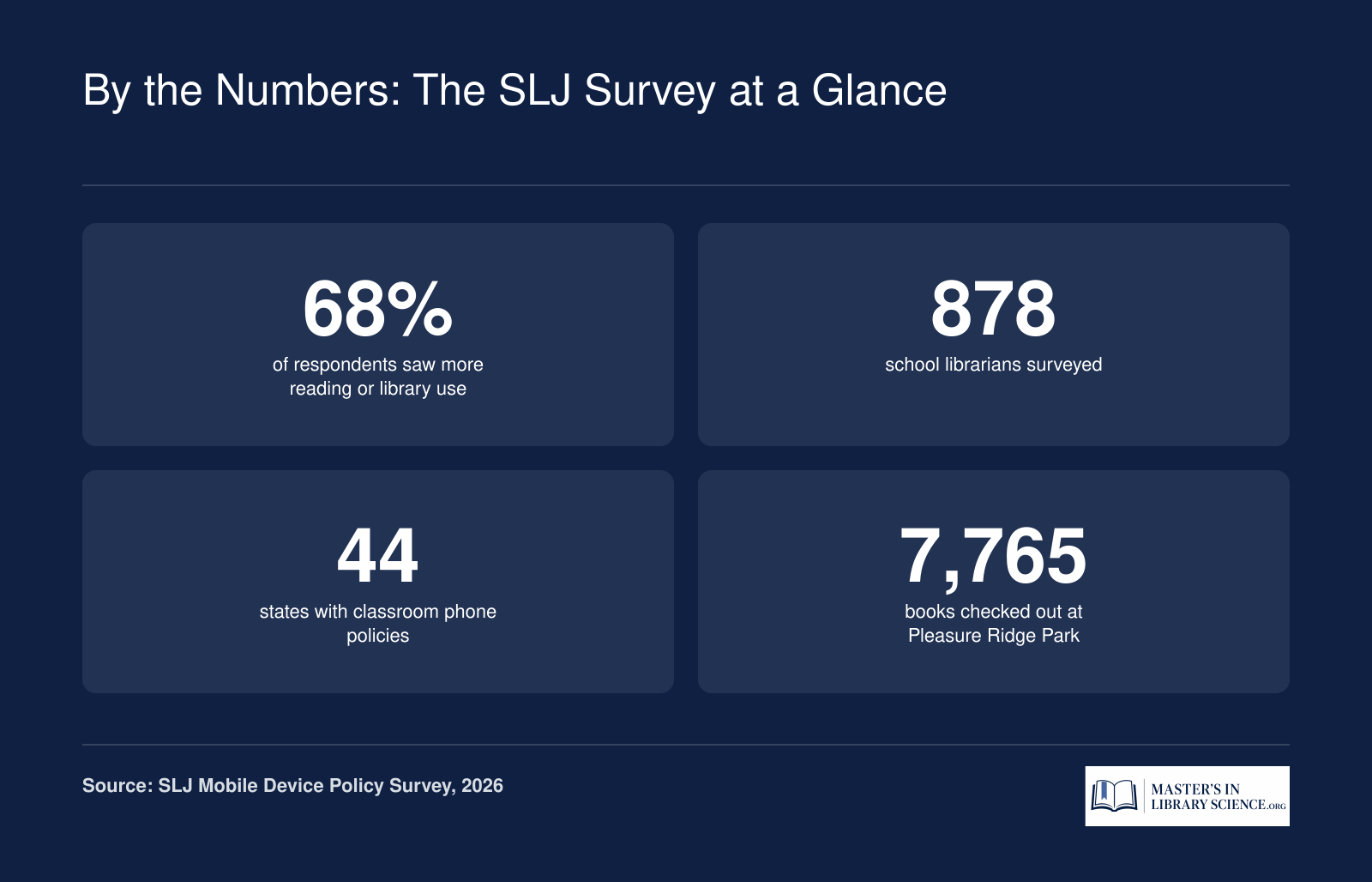
- 68% of surveyed librarians reported improved reading or library use.
- Pleasure Ridge Park High tripled library checkouts to 7,765 after a phone ban.
- 44 states adopted K-12 cell phone policies by May 2026.

New national survey data reveals cell phone bans dramatically increase library circulation and student engagement, with proven collection strategies and advocacy tips.
68% of school librarians reported that cell phone bans led to more student reading and library use, according to a spring 2026 SLJ survey of 878 educators. The finding challenges assumptions that restricting devices only reduces disruption: it reveals a direct path to revived circulation and engaged readers. From manga collection makeovers to policy advocacy, librarians are turning this evidence into action. Yet as districts race to adopt bans, equity gaps in digital access demand equal attention.
What do the numbers actually say about phone-free schools and reading? The 2026 School Library Journal (SLJ) Mobile Device Policy Survey provides the clearest picture yet. With 878 completed responses from U.S. school librarians and educators, the April 2026 survey found that 68% of respondents reported at least one of four positive impacts: more visible engagement with books and reading materials in classrooms, increased library circulation, more independent reading during free time, and higher library traffic.
The SLJ results align with a growing body of survey data. A USC Dornsife study on cell phone school policies (fielded September, November 2025) documented similar perceptions, while a Welsh government survey of 410 schools in March 2026 found that 66.3% had formal written policies, a policy momentum now echoed across 44 U.S. states according to Ballotpedia3. However, as a 2024 research synthesis noted2, rigorous causal evidence remains limited, and outright bans are often perceived as most effective based on classroom policy experiments. This means the SLJ numbers offer valuable, real-world confirmation that the trend toward restrictions is associated with observable literacy gains in school libraries.
For readers who want to dig deeper, the full SLJ survey methodology and demographic breakdown are typically posted on the SLJ website alongside the main article. You can also cross-reference with independent studies published in outlets like the Journal of Adolescent & Adult Literacy or working papers from the National Bureau of Economic Research (NBER). Many school districts now post their own device policy impact reports or pilot program results publicly, aggregating these provides a ground-level view of how bans are playing out. Professional associations such as the American Library Association (ALA) and the International Literacy Association (ILA) are increasingly releasing meta-analyses and position papers on the connection between phone bans and literacy outcomes, offering a broader research synthesis for library professionals.
A spring 2026 survey of nearly 900 school librarians reveals the dramatic shifts happening in libraries after cell phone restrictions take hold. The numbers below make a compelling case for policy change.
A bell-to-bell cell phone ban can transform a school library from a quiet study hall into a hub of active reading and discovery. At Pleasure Ridge Park High School in Louisville, Kentucky, the evidence is dramatic. For the 2025-26 school year, the school adopted a strict policy using Yondr pouches, magnetic pouches that lock and keep phones secured from the first bell to dismissal.
Every student receives a Yondr pouch at the start of the day. The pouch is locked magnetically and remains sealed until the final bell, effectively removing the temptation and distraction of smartphones from all instructional spaces, including the library. The policy, known as a bell-to-bell ban, covers the entire school day with no exceptions during class time.
The results were immediate and striking. The school library checked out 7,765 books this year1, more than triple the total from the previous year and nearly double the average annual circulation over the past decade. The surge occurred without any increase in student enrollment or additional staffing. Librarian Erin Reed described a dramatic shift in how students used their free time: rather than scrolling on phones, they began browsing shelves and reading.
One of the most notable changes was the influx of boys checking out manga and graphic novels. Reed saw an opportunity and overhauled the manga section, expanding the collection and even forming a student manga team to help curate and recommend titles. The series 'Case Closed' by Gosho Aoyama became one of the top five most popular series in the library, a testament to how targeted collection development can meet a sudden surge in demand.
The Pleasure Ridge Park experience shows that removing phones does more than boost numbers; it creates the mental space for previously reluctant readers to walk through the library doors, pick up a book, and discover that reading can be a rewarding use of their time. For school librarians, this case study offers a powerful argument: a phone-free environment can be the key to unlocking a lifelong love of books in students who never gave reading a chance.
We've seen an influx of boys coming to the library specifically for manga and graphic novels. The phone-free environment has truly transformed our space.
Manga and graphic novels consistently rank among the top choices for young readers who describe themselves as disengaged from traditional books. When cell phones disappear from the school day, these same students often rediscover the library as a space where stories feel immediate and visually compelling. Adapting your collection to capture this post-ban energy means moving beyond a few popular series to build a curated, dynamic graphic literature section.
State-level cell phone policies are moving faster than most educators realize. By May 2026, 44 states had enacted laws or policies addressing K-12 cell phone use, and the details vary widely.1 School librarians can use this momentum, paired with local data, to make a compelling case for phone-free learning environments that boost library engagement.
Understanding the legislative landscape gives you a starting point for local conversations. Among the 44 states with policies:
Examples illustrate the range: Kansas and Texas both require bell-to-bell bans for all K-12 schools, with phones stored away from the student's person all day.23 New York's phone-free schools law allows districts to choose between bell-to-bell and instructional-time restrictions, backed by $13.5 million in state funding.4 California simply requires every district to adopt some form of restriction by July 1, 2026.5
Start with your own circulation and visit data before and after a policy change, then pair it with the SLJ survey finding: 68 percent of respondents reported a positive impact on reading or library use after restrictions took hold.1 A one-page handout that places your local stats alongside national data and your state's policy stance, plus a quote from a teacher or student, can humanize the numbers.
When presenting to school boards or administrators, frame the library as a natural partner in implementation. Phone-free time can become library time, and your circulation surge becomes evidence that students are reading more, not just scrolling less.
Build alliances with classroom teachers, counselors, and parents. Together, you can submit joint letters, speak at board meetings, and propose pilot programs. A unified voice from multiple stakeholders makes it harder for decision-makers to dismiss the library's role as peripheral.
Librarians celebrating circulation gains must also confront a critical tension: cell phone bans can inadvertently exclude students who depend on devices for language translation, health monitoring, or family communication. To ensure policies are truly equitable, school librarians should move beyond headlines and investigate how bans affect the most vulnerable students, applying best practices in information services to diverse populations.
The specifics of any cell phone ban live in the fine print. Visit your district website and pull recent board meeting minutes to see exactly how the rule was written. Look for explicit exemptions for students with disabilities (communication apps), English learners (translation tools), or low-income families (after-school coordination). If these guardrails are absent, raise the issue with administrators before enforcement begins.
The U.S. Department of Education’s Civil Rights Data Collection (CRDC) provides discipline data broken down by race, disability status, and English learner status. Compare suspension or referral rates before and after a ban to identify disproportionate impacts, and use those numbers to push for equitable enforcement.
Both the American Library Association (ALA) and the American Association of School Librarians (AASL) offer curated resources on technology access, intellectual freedom, and equity. Their toolkits and position statements can help you frame conversations with school leaders, ensuring that any phone policy respects students’ diverse needs while still protecting the library’s role as a focused learning space, and learning how to get involved in library associations can amplify your advocacy.
Search library databases or Google Scholar using terms like “cellphone ban” AND “equity” or “cellphone policy” AND “disproportionate impact.” Peer-reviewed journals often publish studies examining unintended consequences. Catching these threads early allows librarians to help revise practices before they harden into routine.
Did you know? According to Pew Research Center, 28% of teens from low-income households earning under $30,000 per year rely exclusively on a smartphone for homework internet access. This stark digital divide highlights the need for equity in cell phone ban policies. When schools implement phone bans, ensuring access to devices and internet for these students is critical.
You can either drown in anecdotal impressions or build a data‑backed case that administration cannot ignore. Both approaches influence decision‑makers, but only one turns curiosity into sustained support. After a cell phone ban, the library’s role often shifts, and proving that shift’s value demands simple, repeatable metrics.
Start by pulling pre‑ and post‑ban comparison data: monthly circulation totals, door counts, program attendance, and ebook checkouts. Your library management system likely generates these reports automatically. For gaps like foot traffic or student sign‑ups, a shared Google Form or spreadsheet works well: just keep fields consistent (date, grade, activity) for clean analysis. Even a week‑by‑week tally posted visibly can motivate staff and students to participate in the data collection.
Numbers alone rarely win hearts. Pair them with pull‑quotes from student interviews or anonymous feedback forms. A ninth‑grader saying “I never touched a book until I had to, but now I check out manga every week” carries weight. Create a one‑page impact report for administrators: include a bar chart of circulation trends, a brief narrative, and a few standout student stories. Keep the language free of library jargon so it speaks to principals, school boards, and parents.
Ask teachers about classroom reading time and hallway chatter. Compare your data with discipline referrals or test‑score trends (when available) to show the ban’s broader ripple effect. Collaborating with counseling or technology staff can reveal shifts in student stress or device dependence, strengthening the argument that a phone‑free environment nurtures both literacy and well‑being. When multiple departments echo your findings, the case for continued support becomes unignorable.
Beyond the dramatic gains at Pleasure Ridge Park, librarians in districts with new cell phone restrictions are quietly documenting circulation increases that deserve wider attention. While the SLJ survey captures a national snapshot, individual school stories add persuasive detail for local advocacy. Tracking down these narratives requires looking beyond news headlines and into the channels where librarians share data.
State education departments and school boards often compile annual library reports that capture circulation metrics. After a district-wide cell phone policy change, these reports may reveal aggregate trends like double-digit checkout growth or sustained increases over multiple semesters. Reviewing public board meeting minutes can also surface presentations by librarians who have quantified the impact of phone-free environments.
Association publications such as AASL’s *Knowledge Quest* and state library association newsletters regularly feature member spotlights and case studies. These sources often include interviews with school librarians who describe how their programs evolved post-ban, from a surge in manga checkouts to an uptick in student-led book clubs. Archived issues and conference session handouts are rich hunting grounds for real-world examples of school library innovation.
District communications departments track usage numbers for public relations purposes and are often willing to share non-confidential aggregate data. A simple email inquiry about library circulation trends before and after a phone policy shift can yield compelling statistics, especially if you frame the request in terms of community impact.
School library blogs and social media accounts offer informal but vivid success stories. Librarians at schools with known bans frequently post about full shelves, a packed reading nook, or a reluctant reader who finally checked out a stack of books. Searching hashtags like #LibraryLife or #PhoneFreeSchool can surface peer perspectives that energize your own advocacy efforts.