School librarian certification is a state-issued credential required to lead K-12 library programs in most public schools.
Most states require an ALA-accredited MLIS plus a state-recognized school library media program for full licensure.
The Praxis 5311 and Texas TExES 150 are the two most widely used school librarian content exams.
Pathways range from full MLIS programs (2 to 3 years) to endorsement add-ons for current teachers.
Becoming a school librarian sounds straightforward until you start comparing states. One state hands you an endorsement after a few graduate courses; the next requires a full MLIS, a teaching license, and a content exam before you can step into a library.
Three pieces show up in nearly every pathway: a qualifying degree (usually an MLIS or MEd in school librarianship), a state-approved exam like the Praxis 5311, and, in many states, a current teaching license. Candidates exploring library science degree requirements will find that school library tracks add their own pedagogy and practicum layers on top of the standard MLIS core.
This guide walks you through the full roadmap, from defining the credential itself to mapping state-by-state requirements, exams, programs, costs, and salary outlook.
What Is a School Librarian Certification? (Certification Vs. Licensure Vs. Endorsement)
A school librarian certification is the state-issued authorization that allows you to work as the lead information professional in a K-12 school library. Without it, most public school districts (and many private and charter schools) cannot legally place you in a librarian role, even if you already hold a Master's in Library Science in School Librarianship Degree Online. Certification is granted by the state department of education, not by a university or by the American Library Association, which means the rules change every time you cross a state line.
Certification vs. Licensure: Same Idea, Different Labels
The terms certification and licensure are often used interchangeably, but in some states they carry distinct legal meaning. Licensure typically refers to the umbrella credential a state issues to all educators (the legal permission to work in a public school), while certification can describe the specific subject-area or role-specific credential layered on top. In practice:
States like Ohio and North Carolina issue a school librarian license.
States like Pennsylvania and Georgia issue a school librarian certificate.
A handful of states use both terms in the same regulation, which is why candidates should always read their target state's exact language.
What an Endorsement Adds
An endorsement is an add-on to an existing teaching license. Rather than pursuing a standalone librarian credential, a current classroom teacher completes additional library science coursework and exams to add school librarianship to the license they already hold. This pathway is the most common route in states such as Texas (where candidates often add the School Librarian certificate to a standard teaching certificate) and Illinois (which uses the Library Information Specialist endorsement).
Watch for Alternate Job Titles
The same certified role appears under several names depending on the state and district:
Library Media Specialist
Teacher Librarian (common in California's Teacher Librarian Services Credential)
School Library Media Coordinator (used in North Carolina)
School Librarian
When researching requirements, search all of these titles. A job posting for a Library Media Specialist and one for a Teacher Librarian usually require the same underlying state credential.
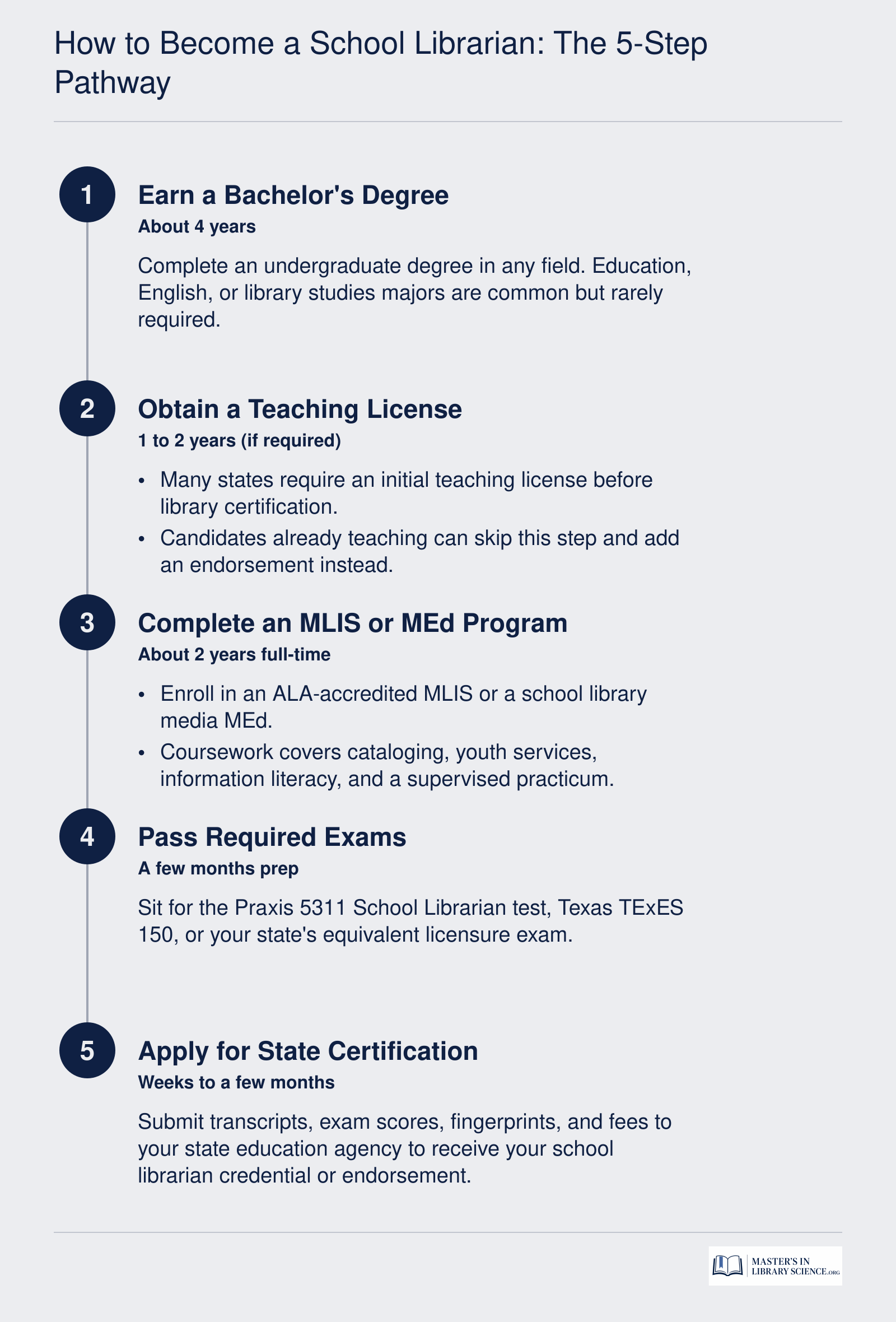
How to Become a School Librarian: The 5-Step Pathway
Most states follow a similar credentialing ladder for school librarians, though current classroom teachers often skip ahead by adding a library media endorsement to an existing license. Timelines below assume full-time enrollment.
School Librarian Qualifications: Degree, License, and Experience
Becoming a school librarian usually means meeting three layered requirements: an advanced degree, a state credential, and supervised field experience. The exact mix varies by state, but the underlying expectations are remarkably consistent.
Degree Requirements
Most states require a master's degree for full school librarian certification. The most common qualifying degrees are:
Master of Library and Information Science (MLIS) or Master of Library Science (MLS), often with a school library track
Master of Education (MEd) in School Librarianship or Library Media
Master of Arts in Teaching (MAT) with a library media specialization
A handful of states still allow entry with a bachelor's degree plus a state-approved school library endorsement program, but these pathways are shrinking. Programs accredited by the American Library Association (ALA) or recognized by the American Association of School Librarians (AASL) are the safest choice if you may move between states. For a broader view of MLIS degree requirements across specializations, the underlying coursework is largely consistent.
Teaching License and Alternative Routes
Many states, including Texas, Georgia, and Pennsylvania, require candidates to hold an active teaching license and log classroom teaching experience (often two years) before adding a school library credential. Other states offer alternative routes for career changers who hold an MLIS but have never taught, typically through added pedagogy coursework, a content exam, or a supervised induction year.
Practicum and Field Experience
Nearly every accredited program embeds a supervised practicum or internship in a K-12 library, generally 100 to 300 clock hours split between elementary and secondary settings. These hours must be completed under a certified school librarian and are required for both program completion and state licensure.
The Non-Teacher Pathway
States like New York, California, and Washington allow direct entry to school library work through an MLIS program with an embedded school library practicum, no prior teaching license required. California issues the Teacher Librarian Services Credential, which is added to a credential earned during the MLIS, making it one of the more accessible routes for career changers transitioning from public librarianship or academic library roles.
School Librarian Certification Requirements by State
Every state sets its own rules for school librarian certification, and the differences can be substantial: the credential name, the required degree, whether you must hold a teaching license first, and which exam you sit for all vary. The table below is a quick-reference snapshot for the states with the clearest published requirements.1 Use it to scope your options, then confirm details with your state Department of Education before enrolling in a program or registering for an exam.
How to Read the Table
The Credential Name column shows what the license is officially called in that state, which matters because job postings often use the state's term verbatim. Required Exam lists the content test (and any add-on tests) that candidates typically must pass. Most states also expect a master's degree or a state-approved preparation program; many require an existing teaching license as a prerequisite, though a growing number accept candidates who complete an integrated MLIS or library media program. If you are still weighing programs, our overview of ALA accredited MLIS programs is a useful companion to this table.
50-State Quick Reference (Selected States)
Alabama: Library Media Specialist. Praxis II Library Media Specialist (148); additional AECTP Praxis required.1
Arizona: NES Library/Educational Media (220) and Professional Knowledge (220).1
Iowa: Elementary/Secondary School Media Specialist. Praxis II Library Media (156).1
Kansas: Praxis II Library Media Specialist (153).1
Kentucky: School Media Librarian. Praxis II School Media Librarian (156).1
Louisiana: Praxis II Library Media Content (136); Principles of Learning and Teaching.1
Michigan: Library Media (ND) or School Librarian Specialist (NQ). MTTC Library Media Content (48); First Aid/CPR.2
Montana: Praxis II Library Media Content (150); Indian Education course.1
Pennsylvania: Praxis II Library Media (151); Praxis I and subject tests.3
South Carolina: Praxis II Library Media (151); Principles of Learning (K-12).1
Outliers and Things to Watch
A few states stand apart. California does not issue a generic library media certificate; it issues the Teacher Librarian Services Credential, which layers on top of a base teaching credential and requires CBEST plus a Commission-approved program. Georgia does not specify a single named exam, instead relying on completion of an approved preparation program. States like Michigan and Montana add unique requirements (CPR certification, Indian Education coursework) that can extend your timeline.
Because requirements change frequently, treat any third-party table, including this one, as a starting point. The EveryLibrary Institute maintains a useful national overview, and state agencies such as the Pennsylvania Department of Education and the Michigan Department of Education publish current rules. Always verify directly with your state DOE before applying.
Required Exams: Praxis 5311, Texes 150, and State Tests
Most states require candidates to pass at least one content-area exam to earn school librarian certification. The specific test depends on where you plan to work, but three exam systems dominate the landscape: the Praxis Library Media Specialist (5311), the Texas TExES Librarian EC-12 (150), and the National Evaluation Series (NES) Library Media Specialist test.
Praxis 5311: The Most Widely Accepted Exam
The Praxis 5311, administered by Educational Testing Service (ETS), is the standard content exam for prospective school librarians in many states. Key details from ETS and Praxis prep resources include:
Pennsylvania, for example, uses the Praxis 5311 as its required librarian content exam.3 Passing scores vary by state, so confirm the cut score with your state's department of education before testing. Pass rates on Praxis content exams generally hover around 45%, so structured preparation matters. ETS publishes a free study companion, and third-party providers like PraxisExam.org offer practice questions aligned to the five content categories.
TExES 150 and NES 220
Texas requires the TExES Librarian EC-12 (150), administered through Pearson under contract with the Texas Education Agency. If you plan to certify in the Lone Star State, review program options through this library science degree state guide before registering. Several western and plains states (such as Arizona, Oregon, and Washington) accept the NES Library Media Specialist (test 220), also delivered by Pearson. Both exams are computer-based and focus on similar competencies: collection development, instructional partnerships, information literacy, and program leadership.
Basic Skills and Prerequisite Tests
Some states require a basic skills exam before, or alongside, the content test. California has historically used the CBEST (California Basic Educational Skills Test) for credential candidates, including those pursuing the Teacher Librarian Services Credential, though waiver options have expanded in recent years. Other states layer in pedagogy or principles-of-learning tests. Always check your state's current requirements, since exam policies and passing scores are updated regularly.
MLIS and Online Programs That Lead to School Librarian Certification
Not every Master's in Library Science (MLIS) leads to a school librarian credential. To position yourself for licensure, you need a program designed for K-12 practice, not just general library science. The strongest signal is dual recognition: accreditation from the American Library Association (ALA) plus a school library track aligned with American Association of School Librarians (AASL) standards.
Why ALA Accreditation and AASL Alignment Matter
ALA accreditation establishes that the MLIS itself meets national quality benchmarks, which most states require for licensure as a school librarian. AASL alignment goes further by mapping coursework to the competencies specific to school settings: collection development for minors, information literacy instruction, collaboration with classroom teachers, and intellectual freedom in K-12 contexts. Together, these markers tell a state department of education that your degree was built for the job.
What to Look for in a Program
Before enrolling, verify that the program offers:
A state-approved school library curriculum, ideally approved in the state where you plan to work
An embedded practicum or field experience in a K-12 library, supervised by a certified school librarian
Coursework or workshops that prepare you for the Praxis 5311, TExES 150, or your state's required exam
Clear advising on how graduates apply for licensure after completing the degree
Programs Frequently Cited for School Library Tracks
Several universities are commonly named in school library circles for offering dedicated, often online-friendly tracks: the University of North Texas, San Jose State University, Rutgers University, Old Dominion University, and Valdosta State University. Each maintains a school library specialization within an ALA-accredited MLIS, and several deliver coursework fully or largely online. For broader MLIS degree options across regions, comparison tools can help narrow the field.
A Caution About Online Programs and Reciprocity
An online MLIS does not automatically qualify you in every state. State approval is granted program by program, so a degree approved in Texas may not transfer cleanly to New York or California without additional coursework or exams. Most online programs also require an in-person practicum in a local school, which you typically arrange with help from the program's field placement office. Always confirm requirements directly with your target state's licensing board before paying tuition.
Cost and Timeline: What to Expect
Budgeting for a school librarian credential means planning for both program tuition and a stack of smaller fees that add up. Your total investment depends heavily on which pathway fits your situation: a full MLIS, an endorsement add-on, or a state-approved alternative route.
MLIS Tuition Ranges
A full Master of Library and Information Science typically costs between $15,000 and $45,000 in total tuition. In-state public programs often come in under $20,000, while private universities and out-of-state rates push toward the upper end. Online MLIS programs are usually priced per credit and frequently waive nonresident surcharges, which can keep costs closer to the lower bound. Cost-conscious applicants often start their search with the cheapest library science degree online rankings to benchmark per-credit pricing.
Endorsement-Only Routes
If you already hold a teaching license, an endorsement or add-on certification is the faster, cheaper option. These programs generally require 12 to 18 graduate credits focused on school library media, with total tuition in the $4,000 to $10,000 range. Some districts offer tuition reimbursement for current teachers pursuing this credential.
Time to Credential
Full MLIS: 1.5 to 3 years, depending on full-time or part-time enrollment
Endorsement add-on: 6 to 12 months for current teachers
Practicum or internship: typically built into either pathway
Applicants who want to skip standardized testing can also weigh no-GRE Master's in Library Science programs when comparing timelines, since admissions prep adds weeks to the front end.
Additional Fees to Plan For
Beyond tuition, expect a layer of credentialing costs:
Required exams such as Praxis 5311 or TExES 150: roughly $120 to $200 per attempt
State licensure application fees: $50 to $200
Fingerprinting and background checks: $30 to $100
Transcript, testing accommodation, and renewal fees as applicable
Factoring these in early prevents surprises when you reach the application stage.
Career Outlook and Salary for Certified School Librarians
Understanding the financial and employment landscape helps you weigh the cost of an MLIS against long-term career returns. Here is what current Bureau of Labor Statistics (BLS) data shows for the field.
National Wage and Employment Data
The BLS classifies school librarians under the broader occupation of Librarians and Media Collections Specialists (SOC 25-4022).1 As of May 2023, the median annual wage for this group was $64,370, with total employment of approximately 133,760 workers nationwide.2
When you narrow the lens to elementary and secondary school librarians specifically, the numbers shift upward. This sub-group represented about 37% of all librarian employment (roughly 49,030 positions) and earned a mean annual wage of $71,800, noticeably higher than the broader occupation average.2
Job Growth Projections
BLS projects employment for librarians and media collections specialists to grow about 2% from 2024 to 2034, slower than the average for all occupations.1 Despite the modest growth rate, ongoing retirements and turnover in K-12 districts continue to generate openings, particularly in states with strict staffing mandates for school libraries.
How School Librarian Pay Actually Works
A key distinction: most certified school librarians are paid on the same teacher salary schedule as classroom teachers in their district. That means your earnings are typically determined by:
Years of teaching or library experience
Highest degree held (a master's usually triggers a higher pay lane)
District location and cost of living
Many districts add a stipend for librarians who manage building-wide collections, supervise aides, or hold National Board certification. Pay tends to be highest in metropolitan areas of California, New York, Washington, D.C., and parts of the Northeast, where teacher salary scales and library staffing requirements are strongest. For a wider view of how compensation varies across the field, see this breakdown of MLIS degree salary data and a state-level comparison of Master's in Library Science Expected Salary by State.
Frequently Asked Questions
Below are quick answers to the questions prospective school librarians ask most often. Specifics vary by state, so always confirm requirements with your state department of education before enrolling in a program.
Do you need a teaching license to be a school librarian?
It depends on the state. Many states require school librarians to first hold a valid teaching license, then add a school library media endorsement on top of it. Other states issue a standalone school librarian or library media specialist certificate that does not require prior classroom teaching credentials. Check your state department of education to see which model applies before choosing a program.
How long does it take to get certified?
Most candidates complete the process in one to three years. If you already hold a teaching license and a bachelor's degree, adding a library media endorsement may take about a year of coursework. Earning a full Master's in Library and Information Science (MLIS) with school library coursework typically takes two years full time, or longer part time.
Can you get certified online?
Yes. Many ALA-accredited MLIS programs and state-approved school library certificates are offered fully or mostly online. The caveat is that supervised practicum or field experience hours usually must be completed in person at a school site, and the program must be approved by your state for licensure purposes.
What is the difference between certification and endorsement?
Certification (or licensure) is the credential that authorizes you to work in a specific role, such as a school librarian. An endorsement is added to an existing teaching license to expand what subjects or roles you are qualified to teach. In some states, school library work is an endorsement; in others, it is a separate certification.
Can I become a school librarian without a teaching background?
In some states, yes. States that issue a standalone school library media certificate often allow candidates to qualify through an MLIS with a school library concentration plus a supervised practicum. In states that require classroom teaching experience first, you would need to earn a teaching license before adding the library credential.