Google AI Training in Georgia Libraries: A Practical Guide for MLIS Students

No-cost AI certifications and career training via Georgia libraries: what this means for future librarians.

By Meredith SimmonsReviewed by MLIS Academic Advisory TeamUpdated July 20, 202619 min read
Google Partners with GA Libraries: Free AI Training for MLIS Students

What you’ll learn in this article…

  • Georgia library cardholders gain free access to Google AI and career certificates.
  • Over 70% of certificate graduates see positive career outcomes within six months.
  • Learning licenses are limited and distributed on a first-come, first-served basis.

Introduction: Google's Free AI Training Lands at Georgia Public Libraries

Public libraries are rapidly evolving into AI literacy hubs, and the most ambitious librarians are already building the skills to lead that transition. On July 17, 2026, Google and the Georgia Public Library Service unlocked free, self-paced AI and career training for every one of the state’s library cardholders.1 The partnership directly targets the digital skills gap that keeps many residents and library professionals from engaging with generative AI and STEM Programming in Libraries. For students in online MLIS programs, this move signals that AI fluency is shifting from a nice-to-have to a core credential for career-ready librarians.

The Google–georgia Public Library Service Partnership Explained

On July 17, 2026, Google and the Georgia Public Library Service (GPLS) announced a partnership that instantly turns every public library in the state into a free gateway for high-demand career training and artificial intelligence skills. Any Georgia resident with a public library card can now enroll in Google Career Certificates and the Google AI Professional Certificate at no cost, simply by obtaining a learning license through their local library.

Libraries as Digital Workforce Hubs

This partnership highlights a powerful shift in public librarianship: libraries are no longer just book repositories but are evolving into digital workforce development centers. By hosting these credentials, Georgia libraries directly support economic mobility and digital equity for their communities. Library staff can guide patrons toward certifications in cybersecurity, data analytics, UX design, and now AI, helping them compete for roles with over 150 employers on Google’s job placement platform, including AT&T and Deloitte.

Proven Results and Accessible Design

The program is completely self-paced, online, and requires no college degree or previous experience. According to Google, over 70% of certificate graduates report a positive career outcome within six months, demonstrating the tangible value of this no-cost upskilling.

As GPLS and Google leaders noted at the launch, the collaboration aims to meet people where they are and deliver skills that lead to sustainable careers, whether they're pursuing Georgia librarian certification or switching fields. For MLIS students, especially those in Georgia's online MLIS programs, this initiative offers a real-time case study in how public libraries can lead tech literacy and workforce development in the AI era.

What AI and Career Certifications Are Available?

For librarians and MLIS students, professional development in artificial intelligence, reflecting the broader evolution of libraries, can take two complementary forms: a focused primer on using generative AI tools daily, or a full career change into a tech field. Google's partnership with the Georgia Public Library Service makes both available at no cost.

Google AI Professional Certificate: AI skills for everyday work

The Google AI Professional Certificate is a beginner-friendly, self-paced program that requires no college degree or prior experience. It consists of seven short courses totaling about 7 to 8 hours, designed for non-technical professionals who want to apply AI to common workplace tasks. The curriculum is hands-on, featuring over 20 activities and a capstone project.

The certificate covers these modules: - AI Fundamentals: Understanding what generative AI is and how large language models work. - AI for Brainstorming and Planning: Using AI to generate ideas and outline projects. - AI for Research and Insights: Leveraging tools like NotebookLM to synthesize information. - AI for Writing and Communicating: Improving drafts, emails, and reports with AI assistance. - AI for Content Creation: Creating images, presentations, and other media. - AI for Data Analysis: Interpreting and visualizing data with Google AI Studio. - AI for App Building: Exploring no-code AI-powered application development.

Learners practice with tools such as Gemini, NotebookLM, and Google AI Studio, all of which are accessible through a standard web browser.

Google Career Certificates: six paths to in-demand jobs

Beyond AI literacy, the partnership offers Google Career Certificates in six distinct fields, some of which, like data analytics, align with data science for librarians. Like the AI certificate, these are self-paced, online, and require no degree or experience. The available specializations are: - Cybersecurity - Data Analytics - Digital Marketing and E-commerce - IT Support - Project Management - UX Design

Each program dives deeper into job-ready skills. Graduates gain access to a dedicated job placement platform that connects them with over 150 employers, including AT&T, Deloitte, and Google. Google reports that more than 70% of certificate completers see a positive career outcome, such as a raise, promotion, or new job, within six months.

No-cost, no-prerequisites, and self-paced

Both the AI Professional Certificate and the Career Certificates are completely free for Georgia library cardholders. Because they are self-paced, students can fit study around work, school, or family commitments. There are no application fees, textbooks to buy, or hidden charges, just a library card and a willingness to learn. This accessibility removes common barriers to tech education and allows library staff and patrons alike to build skills, including the top skills employers look for in library science degree graduates, that are immediately applicable on the job or in a career pivot.

How MLIS Students Can Access the Free Training

Securing free, self-paced AI training through this partnership comes with a practical reality: the GPLS learning licenses are limited and distributed on a first-come, first-served basis. Acting promptly is the best way to claim a spot, though a waitlist is available if initial licenses run out.

Obtain a Georgia Public Library Card

Before anything else, you need a valid Georgia public library card. Cards are issued free of charge at any Georgia public library if you live, work, or attend school in the state. Both PINES and non-PINES library systems participate, and many libraries offer an e-card option that you can apply for online. If you already have a card, confirm it is in good standing.

Register for a GPLS Learning License

Once you have your library card, visit the Georgia Public Library Service website to register for a learning license. The form asks for your full name, email address, county, and library card number. After submitting, you will receive a confirmation email with further instructions. Licenses last six months, and you may re-apply after they expire if you need more time.

Activate Your License on Coursera

The confirmation email contains an invitation link to the Google Career Certificates program on Coursera. Click the link and create a Coursera account if you don’t have one, or log into an existing account. The learning license automatically unlocks the catalog of certificates. You can then enroll in any track, including the AI Professional Certificate.

Hardware and Connectivity Requirements

These courses are designed for desktop or laptop computers, though tablets may work. Supported browsers include Chrome, Edge, Firefox, and Safari. A reliable broadband connection is essential for streaming video lessons and completing interactive labs. If you lack a suitable device, many Georgia libraries offer device loans or have public computers available for cardholders.

Staying on Track

Because the license is time-limited, pacing matters. You can study at your own speed, but mapping out a weekly schedule will help ensure you complete one or more certificates within the six-month window. Libraries may also host study groups or provide dedicated learning spaces, so ask at your local branch about additional support.

How Georgia Libraries Are Supporting AI Learning on the Ground

What does day-to-day support look like when a public library rolls out free AI training programs?

Across Georgia, library systems are moving beyond simply advertising the partnership and are actively working to create environments where patrons can succeed. The shift involves staff development, technology upgrades, and community-focused outreach.

Staff development and digital literacy coaching

Library staff often serve as the first point of contact for patrons navigating the Google Career Certificates and AI Professional Certificate. To meet this need, many branches are incorporating AI literacy into their internal training. Workshops and peer-learning sessions help librarians become comfortable discussing generative AI, prompt writing, and responsible use. This coaching model allows staff to guide users through enrollment, troubleshoot technical issues, and explain how these certifications might translate into local job opportunities.

Technology access and rural connectivity

For patrons in rural areas, lack of reliable internet and up-to-date devices can be a barrier. Georgia libraries are addressing this gap through extended computer lab hours, mobile hotspot lending, and Wi-Fi-boosted parking lots. Some systems are using state and federal connectivity grants to upgrade broadband infrastructure at branch locations, ensuring that online coursework streams smoothly even in underserved communities.

Community outreach and partnerships

Libraries are also collaborating with local workforce agencies, community colleges, and small business development centers to host information sessions about the no-cost certificates. These events often include Q&A panels with past certificate earners or local employers, giving attendees a sense of how AI skills apply in practical workplace settings. By connecting the training to real-world career paths, libraries help demystify artificial intelligence and position themselves as inclusive hubs for lifelong learning.

Globally, 67% of libraries are exploring or implementing AI technologies, yet only 12% have formal AI training programs, according to a 2025 Clarivate report.

Why AI Skills Are Critical for Future Librarians

Librarians who develop AI skills will guide patrons through an algorithm-driven information landscape; those who ignore it risk falling behind public demand. This contrast between reactive and proactive approaches directly shapes a library's ability to deliver modern reference services.

AI literacy transforms everyday reference work: patrons expect answers from AI tools, so librarians must evaluate and explain them. Detecting hallucinations, refining prompts, and interpreting machine-generated summaries are now as essential as teaching database navigation once was. Data analysis skills also help librarians identify community needs, assess collection gaps, and advocate with evidence.

Digital equity is equally vital. Libraries bridge the digital divide, but AI can widen it if access and understanding are uneven. Librarians versed in AI can design inclusive programs that demystify the technology, helping patrons use it safely and critically, a role central to the profession's mission of equal access to information.

For MLIS graduates, AI competencies are a strong differentiator in a competitive job market, as Library Hiring Trends 2026 shows. Employers increasingly value candidates who can manage AI-driven discovery layers, implement chatbot reference services, or lead digital literacy initiatives. Combining an MLIS program with Google's AI Professional Certificate, for instance, positions graduates for emerging roles in data services, instructional technology, or digital strategy, paths explored among MLIS alumni career paths. Libraries are platforms for skill-building, and AI literacy is the newest chapter in that story.

Ethics, Bias, and Responsible AI: What the Training Covers

Not all AI training programs emphasize responsible use, but Google's AI Professional Certificate weaves ethical considerations throughout its curriculum.

What the Certificate Teaches About AI Ethics

The certificate introduces the ACT approach to responsible AI: Ask, Check, Tell. Learners are taught to ask the right questions, check outputs against original sources, and tell others about AI limitations. Bias evaluation is explicitly covered, with modules showing how to spot and mitigate biased results. The curriculum warns that AI can produce inaccurate or biased content, reinforcing the need for human oversight and responsible judgment. No dedicated privacy module exists, but the emphasis on verifying information aligns with foundational ethical practices.

Connecting to Library Values

For MLIS students and librarians, these lessons resonate deeply with the ALA Library Bill of Rights and its commitments to intellectual freedom, equitable access, and user privacy. The ACT approach mirrors librarians’ professional duty to critically evaluate sources and guide patrons toward reliable information. The certificate’s stress on human oversight fits naturally with the librarian’s role as an information mediator.

Where the Curriculum Falls Short

However, from a librarian’s perspective, the absence of a dedicated privacy module is a notable gap. Library ethics demand strong protections for patron confidentiality, and AI tools often rely on data collection that could conflict with this principle. Additionally, the certificate does not specifically address library-specific scenarios like recommending AI tools to patrons or integrating AI into library services while upholding the ethical standards of professional library associations, including the ALA’s Code of Ethics.

Supplementing with Library-Specific Guidelines

Librarians pursuing this credential should supplement it with resources like the privacy and AI guidelines from major library organizations, or modules from library schools such as the University of Georgia’s library science program, which may offer deeper dives into ethical AI in library contexts. These supplements help bridge the gap between general AI ethics and the unique responsibilities of library professionals.

Questions to Ask Yourself

How comfortable are you using AI tools like chatbots and data analyzers?
As libraries adopt AI for research, cataloging, and patron services, your fluency can shape user experiences and inform new programming.
Can you guide patrons toward ethical and responsible AI use?
Patrons need help evaluating AI outputs for bias, verifying information, and understanding privacy risks. Without this support, misinformation can spread unchecked.
Are you prepared to become a digital literacy leader in your community?
Public libraries now serve as hubs for workforce AI training. Taking initiative will position you to close digital skills gaps and advocate for equitable access.

Continuing Education Credit and Professional Development

Free AI training for Georgia libraries from Google sounds like a no-brainer for librarians, but the real question is whether it will count toward the continuing education credits needed to maintain certification. Georgia’s state-certified librarians must earn a set number of CE hours each renewal period, and courses must typically be pre-approved by the Georgia Board of Librarianship. As of 2026, none of the Google Career Certificates or the Google AI Professional Certificate have received that pre-approval.1

Georgia’s CE Credit Structure and Acceptance Policies

The state board provides guidelines on what qualifies for credit, favoring formal coursework from accredited institutions or established professional development providers. However, self-paced online certificates from industry partners like Google are not automatically recognized. Librarians who complete these programs should be prepared to submit a petition for individual course approval, detailing how the skills align with professional competencies.

Petitioning for Credit and Reciprocity Considerations

While the process can add a layer of bureaucracy, many librarians have successfully earned credit for non-traditional learning. Reciprocity with other states’ certification requirements is another factor. If another state’s board accepts these Google certificates, Georgia librarians moving or seeking multi-state credentials may find smoother transfers, though no broad reciprocity agreements currently guarantee this.

Resume Value Beyond Formal Credit

Even without formal CE credit, the resume value is significant. As libraries increasingly integrate AI into services, job postings frequently list AI literacy and tech project management as desirable skills. Earning a Google AI Professional Certificate signals hands-on competency to hiring managers and can set an MLIS job seeker apart in a competitive market. For many, that career edge justifies the time investment.

Comparing Georgia’s AI Training Options for Librarians

What other free or low-cost AI training opportunities are available to library professionals in Georgia beyond the Google partnership? While the Google Career Certificates and AI Professional Certificate through the Georgia Public Library Service represent a massive step forward, a growing ecosystem of AI training options already exists across the state for librarians and the public. From professional association webinars to university online modules and grassroots library workshops, MLIS students and early career librarians can choose from several free or affordable programs tailored to different needs. Below is a comparative overview of the most relevant offerings.

ProgramProviderDeliveryCostKey Topics
Responsibly Implementing AI in Libraries and ArchivesGeorgia Library Association (GLA)Zoom webinarFree or very low-cost for membersEthical, responsible AI implementation in libraries and archives
AI Literacy for AllUniversity of Georgia (UGA) Digital Education CouncilOnline courseFree with UGA email (MyID)Core AI concepts, generative AI, responsible use
AI Hub ModulesUGA Office of InstructionOnline modulesFree for UGA communityGenerative AI literacy, productivity with Copilot/Gemini, NotebookLM, research with AI
AI Workshop SeriesRewrite & Rise and Fulton County Library SystemIn-person seriesFreePractical ChatGPT for career, productivity, small business; ethical use
AI for Everyday LifeDeKalb County Public LibraryIn-person programFreeEveryday AI tools, safety and ethics
Practical AI Skills for LibrariansResearch Data Management Librarian Academy (RDMLA)Self-paced e-learning on CanvasFreePractical AI skills for library services, data management

Library-Specific AI Education

Two programs directly target the professional development of librarians. The Georgia Library Association's "Responsibly Implementing AI" webinar 1 focuses on ethical frameworks for library and archive settings, helping librarians navigate bias, privacy, and algorithmic transparency. It is delivered live via Zoom, likely at no cost for members. The RDMLA course "Practical AI Skills for Librarians" 6 offers self-paced learning on Canvas, covering hands-on AI applications in cataloging, user services, and research data management. Both are excellent, zero-cost ways for MLIS students to build a niche in AI-informed library practice.

AI Literacy for Academic Communities

UGA provides robust online modules through its AI Hub 3 and the Digital Education Council's "AI Literacy for All" course 2. While these require a UGA email for free access, they are ideal for MLIS students enrolled at UGA. Modules cover generative AI concepts, responsible use, and productivity applications like Copilot, Gemini, and NotebookLM. They blend theory with tool-specific training, preparing students to lead AI literacy initiatives as academic librarians.

Community Library Workshops

The Fulton County Library System's AI Workshop Series, in partnership with Rewrite & Rise, covers practical career tools 4, and DeKalb County Public Library's "AI for Everyday Life" program explores everyday tools and safety 5. While less tailored to librarians, they model how public libraries can become AI literacy hubs and offer MLIS students firsthand experience with community-driven digital equity programming.

Taken together, these free ai training mlis students georgia resources complement the new Google partnership by providing diverse, accessible paths for continuing education ai for librarians georgia. Aspiring and current librarians can now assemble a personalized suite of ai literacy programs for public librarians georgia, blending theory, ethics, and hands-on tool training without financial barriers.

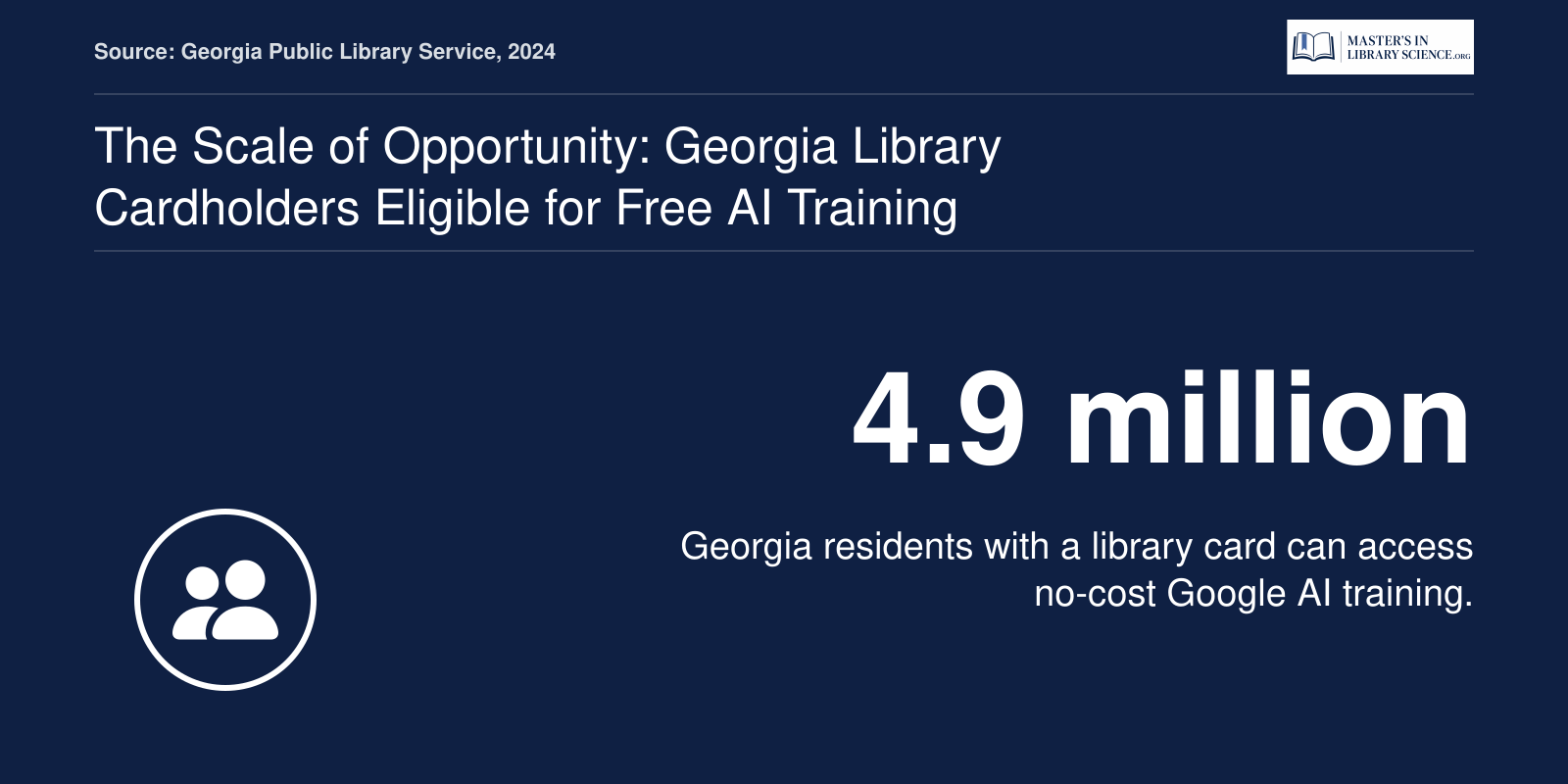
The Scale of Opportunity: Georgia Library Cardholders Eligible for Free AI Training

In 2024, Georgia's public libraries served over 4.9 million active cardholders across 60 library systems and 408 facilities. That reach represents nearly half of the state's population, and now every single one of these patrons can pursue free AI and career certifications through the Google partnership.

4.9 million Georgia public library cardholders in 2024, representing 44% of residents, eligible for free AI training.

The Future of AI Training in Public Libraries

With over 70% of Google Career Certificate graduates experiencing a positive career outcome within six months, the Georgia Public Library Service partnership sets a precedent for libraries as AI-ready career launchpads. This model is poised to reshape how MLIS students prepare for librarianship and how institutions deliver digital equity.

Shaping Library School Curricula in Georgia

Georgia’s masters in library science programs may soon embed these free credentials into course sequences. A school could encourage or require the Google AI Professional Certificate as a tech competency milestone, blending generative AI, prompt writing, and applied AI tasks into an existing information technology or digital services class. The self-paced, online format makes it easy for students to complete alongside degrees, and library school partnerships with the state library service could streamline licensing. Accreditation bodies like the American Library Association already emphasize technological proficiency; offering a no-cost industry-backed AI credential aligns directly with those expectations.

A Blueprint for Other States

The Georgia partnership’s structure using library infrastructure to deliver vendor-awarded certificates is highly replicable. Other state library systems will likely observe the outcomes, particularly the reported career advancement rates. If the model proves effective, similar agreements with Google or other tech providers could multiply. Libraries in under-resourced areas could prioritize these programs to close local digital skills gaps, making MLIS graduates natural facilitators of AI literacy hubs. The self-contained, no-prerequisite design removes traditional barriers, allowing any library cardholder to participate regardless of prior education.

Evolving Librarian Roles

As libraries become active AI training centers, modern librarian roles expand. Beyond information retrieval, librarians will act as AI tutors, guiding patrons through certificate courses and helping them apply AI tools ethically. They become digital equity stewards, providing information services to diverse populations and ensuring marginalized communities gain access to high-demand skills. This partnership illustrates how future-ready librarians can blend instructional design, community outreach, and technology advocacy to meet workforce development needs.

Recent News

Recent Articles