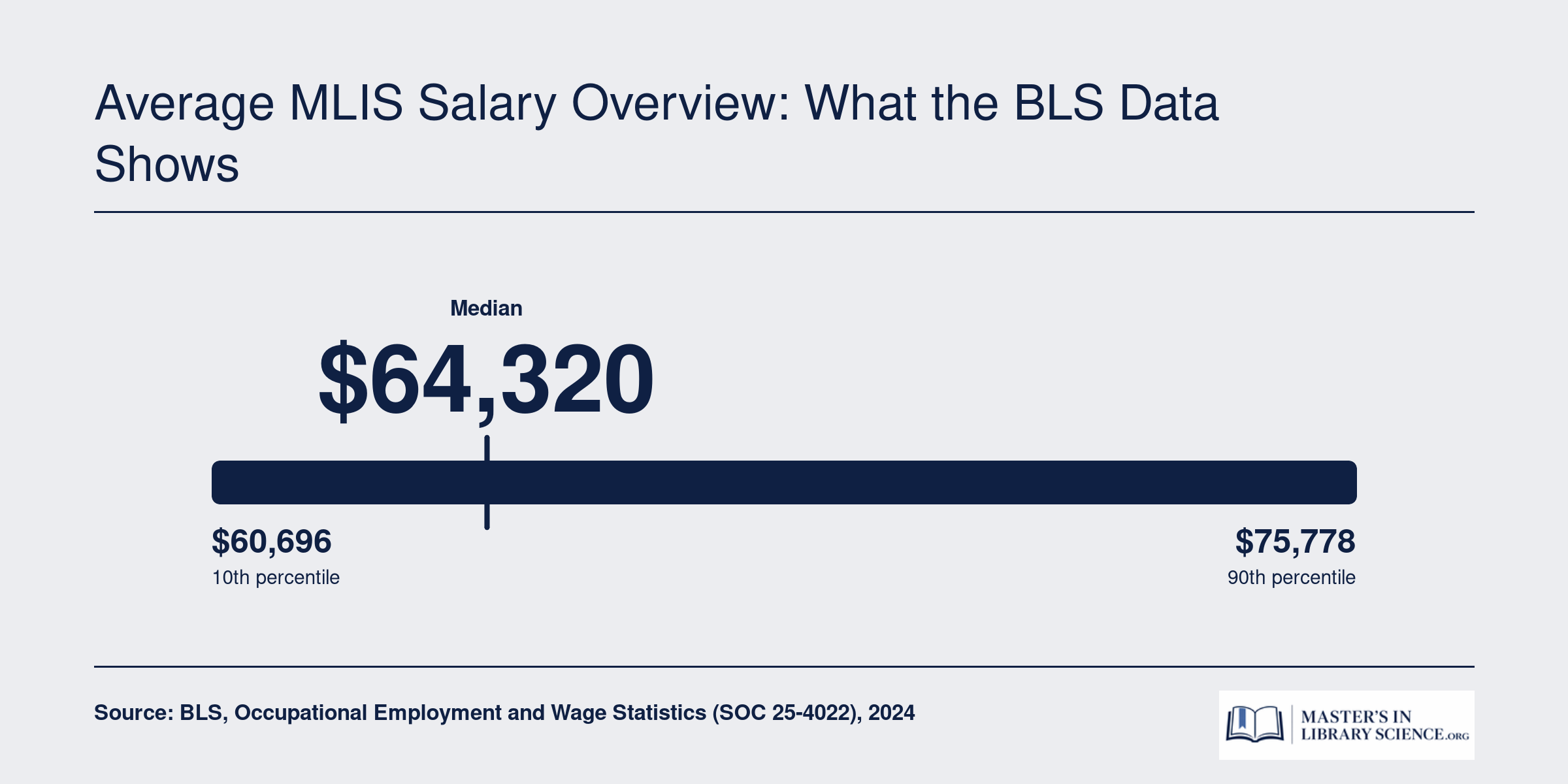
BLS reports a median annual wage of $64,320 for librarians and media collections specialists with an MLIS degree.
Top-paying states can nearly double the national librarian median salary of $61,190.
Non-traditional MLIS careers in corporate and tech sectors often command higher salaries than public library roles.
Credentials like the Certified Archivist designation translate directly into measurable pay increases.
Librarians and library media specialists with an MLIS earn a median salary of $64,320 per year, according to the Bureau of Labor Statistics. That figure, however, only tells part of the story.
MLIS careers now reach well beyond the traditional library setting into UX research, data management, digital asset curation, and information architecture, roles where salaries can climb considerably higher. Your actual earning potential depends on the path you choose, the sector you work in, and where you live.
This guide breaks it all down: compensation across eight distinct career paths, the highest-paying states for library science salary, salary differences by employer type, and the long-term job outlook shaping this field through 2034.
Average MLIS Salary Overview: What the BLS Data Shows
The Bureau of Labor Statistics reports a median annual wage of $64,320 for librarians and media collections specialists, placing MLIS holders in a competitive position among master's-level professionals. Archivists, curators, and museum workers, another common MLIS career track, earn a comparable median. The full pay range spans roughly $60,696 to $75,778, though top earners and entry-level professionals can fall well outside that band.
MLIS Salaries by Career Path: 8 Roles Compared
An MLIS opens doors to a surprisingly wide range of careers, and compensation varies significantly depending on the path you choose. Below is a look at eight common roles, drawing on BLS occupational data and salary aggregators like Glassdoor and Payscale where direct BLS codes do not exist. Note that salary estimates for newer or non-traditional roles can fluctuate across sources, so treat the figures below as useful benchmarks rather than guarantees.
Traditional Library Roles
Academic Librarian (BLS SOC 25-4021): Median salaries for general librarians land around $76,000 per year, with a typical range of roughly $57,000 to $93,000.1 Academic librarians at research universities often earn toward the higher end of that spectrum.
School Librarian (BLS SOC 25-4021): School librarians share the same SOC code and similar pay bands, though compensation is largely shaped by district salary schedules and geographic location.
Library Director/Principal Librarian: Senior leadership roles push well beyond the median. Principal librarian salaries have been reported in the range of $154,000 to $247,000, reflecting the administrative scope of these positions.1
Archival and Records Roles
Archivist (BLS SOC 25-4031): Archivists generally earn slightly less than librarians at the median level, though specialized archivists in corporate or federal settings can exceed the general librarian median.
Records Manager: Glassdoor and Payscale data place records management specialists near a $63,000 median, with higher pay common in regulated industries like healthcare or finance.3
Emerging and Non-Traditional Roles
Digital Asset Manager: This role lacks a dedicated BLS code but draws on core MLIS competencies in metadata and taxonomy. Salaries are often comparable to or above the general librarian median, particularly in media, publishing, and tech sectors.
UX Researcher: MLIS graduates who pivot into user experience research can command competitive salaries in the technology industry, frequently exceeding traditional librarian pay. Because UX research is classified under broader BLS categories, precise median figures specific to MLIS holders are limited.
Data Curator (BLS SOC 25-4031): Grouped with archivists in federal data, data curators working in academic or scientific research settings may see salaries in line with or above the archivist median, especially when strong technical skills are involved.
Specialization matters. Research librarians, for example, have reported median earnings around $151,735 according to Glassdoor4, while business librarians come in near $137,869.5 These figures illustrate how domain expertise can dramatically shift your earning trajectory beyond the general librarian baseline. For a geographic breakdown of how library science salary figures vary across the country, see our state-by-state guide. And if you are still weighing which careers in library science align with your goals, our career overview covers each path in greater detail.
Highest-Paying States and Metro Areas for MLIS Careers
Geography plays a major role in determining your MLIS salary. The national median for librarians (SOC 25-4022) sits at $61,190, but top-paying states can nearly double that figure.1 Understanding where the money is, and what it actually buys, helps you target your job search strategically.
Top 10 Highest-Paying States for Librarians
According to BLS wage data, these states offer the highest median annual pay for librarians:1
Hawaii: $119,950
California: $92,400
New York: $85,050
Connecticut: $83,200
Massachusetts: $82,600
Alaska: $79,550
New Jersey: $78,300
Washington: $73,450
Maryland: $72,200
New Hampshire: $71,000
Every state on this list pays well above the national median, with Hawaii standing out at nearly twice the benchmark.
Cost-of-Living and Tax Context
High salaries do not always translate to high purchasing power. Hawaii's top-ranked wages come alongside the nation's highest cost of living and an 11.0% top state income tax rate. California ($92,400 median) carries a 13.3% top rate, while New York adds 10.9% and New Jersey 10.75%.1
By contrast, three states on the list levy no state income tax at all: Alaska, Washington, and New Hampshire. A librarian earning $79,550 in Alaska or $73,450 in Washington may keep more take-home pay than a peer earning $85,050 in New York once taxes and living costs are factored in.
Maryland (5.75%) and Massachusetts (5.0%) offer a middle ground, combining above-average wages with moderate tax burdens.
What This Means for Your Job Search
When evaluating offers, look beyond the raw salary figure. Compare state tax rates, housing costs, and employer benefits. Remote or hybrid MLIS roles, which have expanded significantly in information management and digital services, can let you earn a high-paying metro salary while living in a lower-cost area. Earning your MLIS programs online from an accredited institution gives you the flexibility to relocate wherever your purchasing power is strongest. Salary data from sources like BLS and Librarian Salary by State from WageByState.com can help you model realistic take-home scenarios before you commit to a move.
Salary by Employer Type and Non-Traditional MLIS Careers
Where you work matters as much as what you do. MLIS graduates spread across a wide range of employer types, and compensation can vary significantly depending on the sector you choose.
Pay Ranges by Employer Category
Here is a general comparison of five common employer types for MLIS holders, based on available salary data and industry patterns:
Public libraries: Typically offer entry-level salaries in the mid $40,000s to low $60,000s, varying by region and budget. Pay growth can be modest but steady.
Academic institutions: Salaries for university librarians generally range from the low $50,000s to around $75,000, with higher pay at research-intensive institutions.
Federal and state government agencies: Base salaries are often competitive with academic roles, but total compensation stands out when you factor in pension plans, generous health benefits, and structured pay increases. Federal librarian positions follow the GS pay scale, providing predictable advancement.
Corporate and special libraries: Private-sector library and information roles at law firms, hospitals, or consulting companies often pay above public library benchmarks.
Tech companies: Roles involving data management, content strategy, or research in the technology sector frequently pay 20 to 40 percent more than comparable public library positions, particularly in major metro areas.
Why Government Roles Deserve a Closer Look
Government librarian salaries may appear similar to public library pay on paper, but the full compensation picture often tells a different story. Federal and state positions typically include defined-benefit pensions, employer-matched retirement contributions, and comprehensive insurance packages. Over the course of a career, these benefits can add tens of thousands of dollars in annual value. Regional cost-of-living differences also play a role; for a state-level breakdown, see our guide to Master's in Library Science Expected Salary by State.
UX researcher: Median salaries are frequently reported in the $106,000 to $119,000 range for experienced professionals1, though earlier-career roles may start closer to $72,500 to $88,000.2 Strong overlap with MLIS training in user needs analysis and qualitative research.
Information architect: Reported median pay varies widely, with some estimates in the $46,000 to $60,000 range3, though senior roles at tech companies can push well above that.
Knowledge manager: Typically earns in the $80,000 to $100,000 range at mid-career, organizing institutional information for large organizations.
Taxonomy specialist: A natural fit for cataloging expertise, with salaries often falling in the $70,000 to $95,000 range depending on industry.
Data curator: Growing demand in research institutions and healthcare, with pay generally in the $60,000 to $90,000 range.
UX researcher and information architect roles in major tech hubs like San Francisco, Seattle, and New York can exceed $110,000, particularly for candidates who build complementary technical skills. Adding SQL, Python, or user testing tools like Maze or UserTesting to your toolkit during your MLIS program can meaningfully boost your competitiveness and starting salary in these fields.
Note that salary estimates for non-traditional roles draw from sources like PayScale, ZipRecruiter, and industry salary surveys rather than a single standardized dataset. Ranges should be treated as approximate benchmarks rather than guarantees.
Factors That Influence Your MLIS Salary
Your MLIS salary is not fixed by the degree alone. Several controllable factors can move your earnings significantly in either direction.
Certifications and Licensure
Professional credentials often translate directly into higher pay. The Certified Archivist (CA) credential, awarded by the Academy of Certified Archivists, is associated with a documented salary premium for archivists and records managers. In K-12 settings, state-specific school librarianship certification is frequently required and determines placement on district pay scales, meaning the right credential can bump you into a higher salary tier from day one.
Dual-Degree Salary Advantages
Combining an MLIS with a second professional degree is one of the most effective ways to push earnings well above MLIS-only peers. A JD paired with an MLIS opens the door to law librarianship roles at major firms and courts, where salaries regularly exceed six figures. Similarly, an MBA plus MLIS positions graduates for corporate information management and competitive intelligence roles in the private sector, where compensation reflects business-side expectations rather than library-sector norms.
Specialization as a Salary Lever
The concentration you choose within your MLIS program matters. Specializations in health informatics, data science, and digital archives tend to command higher salaries because they align with employer demand in healthcare, technology, and government sectors. Generalist librarian roles, while valuable, typically sit closer to median pay.
Online vs. On-Campus Programs
Prospective students often worry that earning an MLIS online will limit their earning potential. Current evidence shows no meaningful salary penalty for graduates of ALA-accredited online programs compared to their on-campus counterparts. Employers focus on accreditation status and relevant experience, not delivery format.
MLIS Job Outlook and Long-Term Earning Potential
Projected Job Growth
The Bureau of Labor Statistics projects that librarian and library media specialist employment will grow by approximately 3% from 2024 to 2034, roughly in line with the average for all occupations. That steady pace, combined with retirements and turnover, is expected to produce around 14,500 annual openings throughout the decade. While overall growth appears modest, demand is shifting toward roles that did not exist a generation ago.
Return on Investment
A typical MLIS program costs between $30,000 and $60,000, depending on whether you attend an in-state public university or a private institution. Compared to bachelor's-only library workers, MLIS holders earn a meaningful lifetime earnings premium. Even a conservative $10,000 to $15,000 annual salary advantage over a 30-year career translates to $300,000 to $450,000 in additional earnings, well exceeding the initial tuition investment.
Expanding Demand Beyond Traditional Libraries
Growth in digital services, data governance, and AI-driven information management is broadening the MLIS labor market in significant ways. Employers in healthcare, finance, technology, and government increasingly seek professionals who can organize, curate, and secure large-scale information assets. Specializations such as records management position graduates for these corporate and government roles. These emerging positions often carry higher salaries than traditional library jobs, which means the long-term earning ceiling for MLIS graduates continues to rise as organizations recognize the value of information expertise.
FAQ: MLIS Salary and Career Questions Answered
Below are quick answers to the most common questions prospective students ask about MLIS pay and career prospects. Each response points back to the article section where you can find a fuller breakdown.
How much do librarians make with a master's degree?
According to the U.S. Bureau of Labor Statistics, librarians and library media specialists earned a median annual wage of $64,370 in May 2023. Earnings vary widely by setting and experience, with the top 10 percent making more than $99,800. See the BLS data overview section for percentile ranges and how the median compares across roles.
What is the highest-paying job with an MLIS?
Among traditional MLIS career paths, library directors, academic library administrators, and specialized roles such as law librarians and corporate or competitive intelligence librarians tend to top the pay scale, often exceeding $90,000. Data and metadata roles in tech-adjacent settings can pay even more. The 8 roles comparison section details typical salary ranges for each path.
Is a master's in library science worth it financially?
Financial value depends on your target role, employer type, and location. Public library positions tend to pay less than academic, government, or corporate roles. With a BLS-reported median near $64,370 and steady demand, most graduates can recoup tuition, especially with in-state or assistantship pricing. The bottom line conclusion section weighs costs against earnings in more detail.
What state pays librarians the most?
BLS data consistently shows the District of Columbia, California, Washington, Maryland, and Massachusetts among the highest-paying areas for librarians, with mean wages well above the national average. Major metros like Washington D.C., San Jose, and Seattle lead the metro rankings. The highest-paying states and metros section lists current figures and cost-of-living context.
What is the job outlook for library science careers?
The BLS projects employment of librarians and library media specialists to grow about 3 percent from 2022 to 2032, roughly average for all occupations, with around 13,800 openings expected each year. Growth is stronger in academic, archival, and information management niches. The job outlook section covers long-term earning potential and emerging specializations.
MLIS salaries range from roughly $50,000 in traditional library roles to $110,000 or more in non-traditional paths like UX research and data governance. With a median librarian wage of $64,320 and steady 3% projected job growth through 2034, the degree is financially sound, especially when you pair it with in-demand specializations and credentials like the Certified Archivist designation.
Your next step: explore ALA accredited MLIS programs that align with the career path and employer type that fit your goals. Use the salary benchmarks in this guide as a starting point during job negotiations, and treat specialization as the fastest lever for moving your earnings upward.