What you’ll learn in this article…
- UNC's new SDIS keeps all ALA-accredited MLIS programs intact.
- North Carolina residents pay $17,000 to $22,000 for the full degree.
- 95% of graduates find employment or further study within six months.

The July 2026 launch of UNC's School of Data and Information Sciences reshapes the MLIS landscape. Here's how it affects admissions, curriculum, and career paths.
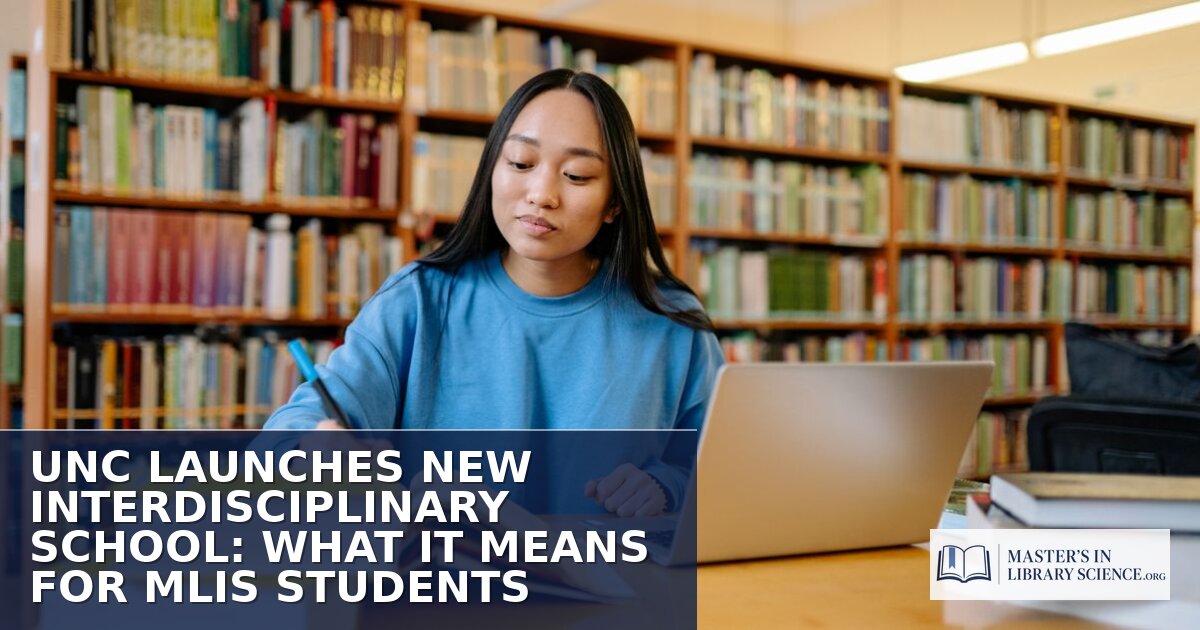
On July 1, 2026, UNC-Chapel Hill launched the School of Data and Information Sciences (SDIS), merging the School of Information and Library Science (SILS) and the School of Data Science and Society. All SILS degree programs, including the ALA-accredited MLIS, continue with the same curriculum, faculty, and accreditation. The merger does not dilute the library science identity; instead, it embeds MLIS students in a broader data and information ecosystem. Faculty with dual appointments, cross-disciplinary centers like CITAP, and joint health informatics initiatives signal that future librarians will graduate with deeper, applied data fluency alongside core LIS competencies.
The new school brings together the former School of Information and Library Science (SILS) and the School of Data Science and Society. All existing degree programs continue, now enriched by interdisciplinary centers like CITAP and the Carolina Health Informatics Program. Faculty with joint appointments across the university further integrate data science with library and information studies.
Applying to an MLIS program often means choosing between a thesis track and a coursework-only degree, but at UNC, the focus is squarely on a professional, project-based curriculum that prepares you for the workplace without requiring a research thesis. That practical orientation is reflected in the admissions process, which looks for evidence of your commitment to the field rather than test scores.
Like many MLIS programs no GRE required, UNC's MLIS program does not require the GRE.1 The admissions committee bases decisions on a holistic review of your academic history, professional experience, and personal motivation. You'll submit an online application through the UNC Graduate School with the following materials:1
International applicants must also demonstrate English proficiency with a minimum TOEFL score of 90 (iBT), an IELTS band score of 7.0, or a Duolingo score of 110.1
The program is moderately to highly selective, though UNC does not publish its acceptance rate. A minimum undergraduate GPA of 3.0 is expected1, but the admissions committee considers upward grade trends and post-baccalaureate coursework. Strong statements of purpose and letters of recommendation can offset a GPA that falls slightly below the threshold.
There are no prerequisite courses1, but familiarity with technology, basic programming, or research methods can be helpful. The program values diversity of background; successful applicants have come from humanities, social sciences, and STEM fields alike.
UNC offers fall admission only, with a priority deadline typically in early January and a final deadline in March. The online MLIS option follows the same timeline. Apply early to be considered for mlis scholarships and to ensure space in the cohort. Before submitting, proofread all materials carefully and tailor your statement to UNC's unique interdisciplinary environment under the new School of Data and Information Sciences.
For those evaluating the cost to become a librarian, the UNC Chapel Hill Master of Library Science (MSLS) program costs range from $17,000 to $22,000 for North Carolina residents and $40,000 to $50,000 for out-of-state students for the 2025-2026 academic year.1 These estimates cover the full 36-credit curriculum within the newly formed School of Data and Information Sciences, which absorbed the former School of Information and Library Science without altering degree requirements.
During 2024-2025, in-state students paid $292.46 per credit and out-of-state students paid $1,634.50 per credit.2 Annual tuition increases are projected at 3% for residents and 10% for non-residents in 2026-20274, meaning per-credit costs are edging upward. Still, the overall program cost ranks among the more affordable MLIS programs online for North Carolina residents.
Beyond tuition, expect mandatory fees of $1,000 to $1,500 per year.3 The annual cost of attendance, which includes living expenses, books, and health insurance, is estimated between $40,000 and $60,000.3 The wide range reflects individual housing choices and lifestyle.
UNC offers federal Direct Unsubsidized and Graduate PLUS loans to qualified students.3 Federal Work-Study may be available depending on need and campus funding.3 Graduate assistantships, often the most valuable form of support, typically include a stipend and partial or full tuition remission. Availability varies by department and funding cycles, so early inquiry with SDIS is recommended.
SILS historically awarded merit-based scholarships; while the new school structure may bring changes, the same commitment to funding students is expected. Check the SDIS website for application deadlines, which often fall in late winter or early spring. External awards from library associations for MLIS students can further offset costs.
For many prospective MLIS students, the online vs on-campus MLIS program choice comes down to flexibility versus immersion. UNC's program has long been recognized for offering multiple paths to the same degree, allowing students to select a format that fits their current work, family, and geographic circumstances.
Students in online MLIS programs typically complete coursework asynchronously, logging in on their own schedule to access lectures, discussions, and assignments. This format appeals to working professionals who need to maintain full-time employment while earning their degree. The trade-off is often a reduced level of spontaneous networking and fewer in-person interactions with faculty and peers. On-campus study, by contrast, places students in a residential academic community with access to campus libraries, research centers, and face-to-face collaboration. Some students blend both through a hybrid arrangement that combines online convenience with periodic campus intensives.
The creation of the UNC School of Data and Information Sciences (SDIS) in July 2026 preserved all degree programs from the former School of Information and Library Science (SILS). While the academic home has changed, the MLIS curriculum and its delivery options are expected to continue unchanged. Because administrative restructuring can sometimes prompt adjustments to schedules or enrollment procedures, prospective students should visit the official UNC SILS website for the most current descriptions of online, on-campus, and hybrid pathways. Contacting the admissions office directly is the best way to confirm that a preferred format remains available and to receive personalized advice about sequencing courses around a work schedule.
Professional organizations such as the American Library Association (ALA) and the Special Libraries Association (SLA) maintain active discussion forums where current MLIS students and recent graduates share their experiences. These platforms often include candid discussions about the realities of balancing an online course load with a job or about the networking advantages of being physically present on campus. While these conversations are anecdotal, they can help applicants weigh the subjective factors that matter most to them.
General workforce data from sources like the Bureau of Labor Statistics (BLS) can provide context for the library and information science job market, but such resources do not detail how delivery format affects career outcomes. The school itself remains the primary authority on how its MLIS modes prepare students for professional roles. Reaching out to program coordinators can clarify whether certain specializations are more commonly pursued online or on campus according to student demand.
Accreditation by the American Library Association (ALA) is the professional standard that qualifies graduates for librarian positions in public, academic, and school libraries nationwide. UNC holds ALA accreditation for both the Master of Science in Library Science (MSLS) and the Master of Science in Information Science (MSIS) degrees, which together comprise the MLIS offerings at Chapel Hill.
The programs received continued accreditation in 2022, following a comprehensive review by the ALA Committee on Accreditation. This status remains fully intact through the current cycle, which runs to 2029.1 The creation of the School of Data and Information Sciences (SDIS) on July 1, 2026, does not alter the accredited status of these degrees. No re-application or reaccreditation is triggered by the administrative merger.2
Accredited programs submit periodic narrative reports and host site visits to demonstrate compliance with ALA standards. UNC filed an interim report in February 2026, and the next full review is scheduled for 2029.1 The move into SDIS keeps the same faculty, curriculum, and assessment processes that met ALA standards, now supported by the broader resources of the combined school. The ALA’s process focuses on program outcomes and student learning, not organizational charts, so the transition presents no risk to accreditation.
Graduates of the MSLS or MSIS programs earn degrees from an ALA-accredited institution, a requirement for many librarian positions across the country. Employers and licensing bodies will continue to recognize the credentials without interruption. The SDIS merger does not change the degree names or the recorded accreditation, ensuring that UNC MLIS graduates remain competitive in the job market.
The UNC Chapel Hill MLIS program offers two distinct specializations in 2026: the on-campus Archives and Digital Curation concentration and the online Curation and Management of Digital Assets program.
The merger into the School of Data and Information Sciences removes barriers between library science and data science. MLIS students can now pursue graduate certificates in applied data science or tailor their electives with courses in machine learning, data visualization, and information systems. These interdisciplinary options mirror the growing interest in data science for librarians and prepare graduates for emerging roles. Additionally, structured dual MLIS degree paths let students combine the MLIS with a master's in data science or health informatics, further expanding career potential.
Through the Carolina Health Informatics Program, eleven SDIS faculty collaborate across medicine, pharmacy, nursing, and public health. MLIS students can engage with health data management projects and clinical information systems, building competencies aligned with health librarianship certification requirements. This exposure builds the kind of cross-sector expertise that modern health sciences libraries demand.
Library and information science has entered an era where data literacy and interdisciplinary collaboration are central to professional growth. For students comparing ALA-accredited MLIS programs in North Carolina, the newly restructured University of North Carolina at Chapel Hill, now housed within the School of Data and Information Sciences, presents a distinct option alongside the state's two other accredited providers: UNC Greensboro and North Carolina Central University.
UNC's MLIS program, formerly part of the School of Information and Library Science, now benefits from a formal merger with the School of Data Science and Society.1 All SILS degree offerings remain intact, but the school's identity has expanded to integrate data science faculty, applied research centers, and cross-listed courses. This means MLIS students can access, for example, the Master of Applied Data Science program's core coursework, joint faculty appointments, and initiatives like the Center for Information, Technology and Public Life, resources not replicated at other universities in the state.
UNC Greensboro's MLIS emphasizes traditional library service, school media, and archival management within a tight-knit, liberal arts environment. North Carolina Central University's program similarly provides a strong foundation in information organization, digital resources, and community engagement. While both are well-regarded, neither operates within a school explicitly built around the convergence of data and information sciences. UNC's new structure signals an institutional commitment to preparing librarians who can navigate big data, AI ethics, and digital curation from day one.
Prospective students who envision careers in research data management, digital scholarship, or technology policy may find UNC's integrated model more aligned with emerging job market demands. Those seeking a classic library education with a smaller cohort feel might prefer UNCG or NCCU. All three remain ALA-accredited, but the depth of data-related faculty and projects available at UNC now sets it apart.
Career outcomes for MLIS graduates from UNC show strong job placement and a path into both traditional and emerging library roles. The program reports that within six months of earning their degree, 95% of graduates are employed or pursuing further education.1
Shortly after graduation, most MLIS alums land full-time positions. Early-career salaries for UNC MLIS graduates typically fall between $50,000 and $55,000.1 That range aligns with the lower end of statewide librarian earnings in North Carolina, where the 25th percentile is around $49,750. Median pay for librarians in the state is $62,360, and experienced professionals in metro areas like Charlotte and Raleigh often earn considerably more, with median wages of $65,580 and $67,990 respectively.2
The program prepares students for a variety of roles. Common job titles include data librarian, digital curation specialist, academic librarian, archivist, and community engagement librarian. For a broader view, explore what you can do with an MLIS degree besides being a librarian. Employers span public and private sectors: graduates work at universities, public library systems, government agencies, and technology companies. The newly formed School of Data and Information Sciences (SDIS) only broadens these prospects, as employers increasingly seek information professionals who are comfortable with data tools and interdisciplinary collaboration.
UNC's MLIS program maintains a dedicated career services team that helps students with resume reviews, interview preparation, and job search strategies. Students also benefit from early career tips for librarians offered by the team. With the merger into SDIS, MLIS students gain access to a wider professional network that includes data scientists, health informatics specialists, and communication scholars. This can open doors to roles in knowledge management, user research, and information architecture that sit at the intersection of library science and data science.
The strong placement rate and diverse career pathways make the UNC MLIS a reliable choice for those looking to enter or advance in the field.
Understanding potential earnings helps MLIS students plan their careers. The 2024 Bureau of Labor Statistics data provides the most recent salary benchmarks for library and information roles in North Carolina.
| Occupation | Employment | Mean Annual Wage | 25th Percentile | Median Annual Wage | 75th Percentile |
|---|---|---|---|---|---|
| Librarians and Media Collections Specialists | 3,990 | $62,070 | $49,610 | $59,860 | $70,840 |
| Library Science Teachers, Postsecondary | 270 | $79,710 | $61,430 | $77,390 | $88,170 |
Will UNC's MLIS program remain the same under the new School of Data and Information Sciences? Yes. The ALA-accredited MLIS degrees continue unchanged, now strengthened by integrated data science resources and interdisciplinary research centers like CITAP. This merger opens doors for library students to engage with emerging fields such as digital curation and AI ethics while preserving the profession's core values. To see how the program aligns with your goals, explore our mlis specialization guide or visit the official SDIS website.