Your Complete MLIS Guide: From First Semester to First Job
A semester-by-semester roadmap covering coursework, specializations, internships, salary expectations, and career strategies for new library science graduate students.
Start networking and planning internships in your first semester, not your last.
MLIS tuition ranges from roughly $12,000 to $40,000, making funding strategy a major factor in long-term ROI.
The median librarian salary is $64,370, but specialization, sector, and state can shift earnings by $15,000 or more.
Online MLIS programs suit working professionals, though on-campus options offer stronger in-person networking opportunities.
The ALA-accredited MLIS remains the standard entry credential for professional librarian positions in the United States, required by the vast majority of public, academic, and school library employers. That credential requirement has not changed, but the path to it has: roughly two-thirds of accredited programs now offer fully online options, making the degree accessible to working library professionals without requiring a career pause or relocation.
A recent post in r/LibraryScience captures a trajectory many new students share.1 The poster, starting Syracuse University's online MLIS program in summer 2026, brings nearly a decade of school library experience and is aiming toward teen or academic librarianship. The combination of existing practical knowledge and new formal credentials is common, but it does not eliminate the decision fatigue that hits early: which specialization fits your goals, how to fund a program that can cost $12,000 to $40,000 in tuition alone, how to network while working full-time, and when to start building toward the job market. Knowing how to choose an MLIS program is only the first step.
Those decisions compound quickly, and getting the sequencing wrong, especially around specialization choice and fieldwork planning, can add semesters and cost.
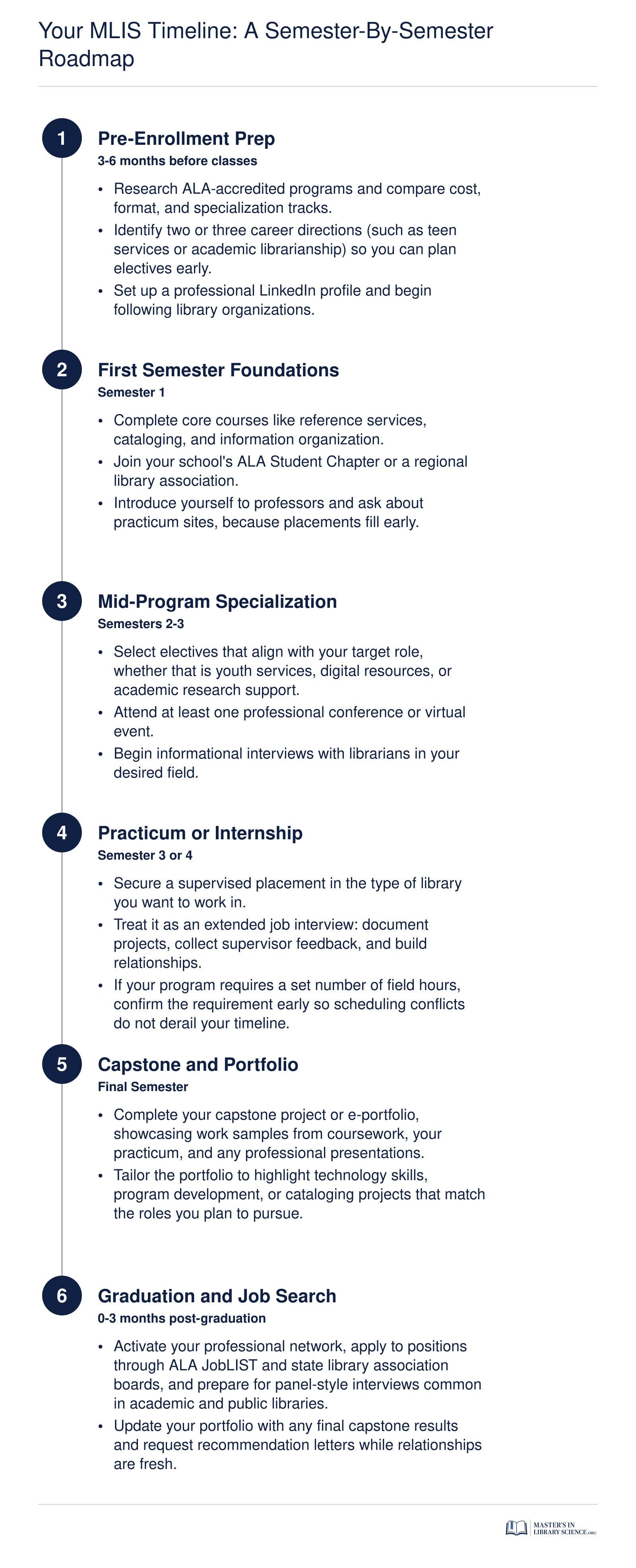
Your MLIS Timeline: A Semester-By-Semester Roadmap
Most MLIS programs take two years (four to five semesters) to complete, but what you do outside of class matters just as much as your coursework. Sequencing is critical: networking and internship groundwork should start in your very first semester, not after coursework ends. The roadmap below breaks the degree into six actionable stages so you can plan ahead and avoid common timing mistakes.
How to Choose Your MLIS Specialization
Some MLIS students arrive with a decade of library experience and a clear destination in mind; others enroll knowing only that they love books and information work. Both paths can lead to satisfying careers, but the specialization you choose in your first year shapes coursework, internship placements, and the jobs you'll be competitive for at graduation.
The Major Tracks at a Glance
Most programs cluster electives around a handful of established specializations. Here's what each looks like in practice:
Public librarianship: Reference desk shifts, programming for adults and families, collection development, and community outreach. Often involves working with diverse patron populations and navigating municipal budgets.
Academic librarianship: Instruction sessions for undergraduates, research consultations with faculty, subject liaison work, and managing scholarly databases. Most academic positions expect or prefer a second master's in a subject area for tenure-track roles.
Youth and teen services: Storytimes, summer reading programs, teen advisory boards, readers' advisory, and partnerships with schools. Strong overlap with educational pedagogy.
Archives and preservation: Processing manuscript collections, writing finding aids, handling rare materials, and managing institutional records. Increasingly requires digital preservation skills.
UX research: User testing on library websites and discovery systems, accessibility audits, and service design. These skills also translate to private-sector tech roles.
Data librarianship: Supporting researchers with data management plans, statistical software, and repository deposits. Growing fast at R1 universities.
Digital humanities: Building scholarly digital projects, text encoding, geospatial mapping, and supporting faculty research infrastructure.
Let Prior Experience Guide, Not Limit, You
A candidate with ten years in a school library who is considering teen services or academic librarianship is a useful example. That background is a real asset for youth services (deep knowledge of adolescent development, school partnerships, curriculum) and transferable to academic instruction work (teaching experience translates directly to information literacy sessions). The choice often comes down to setting preference: public-facing programming versus the research-oriented culture of a university. Reviewing MLIS alumni career paths can help you see how professionals with similar backgrounds have navigated that decision.
Weigh Demand Alongside Interest
The Bureau of Labor Statistics projects 2% job growth for librarians and library media specialists between 2024 and 2034, with about 13,500 openings annually.1 Growth is modest in aggregate, but uneven across specializations. Data librarianship, UX research, and digital asset management are growing faster than the headline number suggests. Emerging non-traditional roles, including website developers, social media content producers, documentary filmmakers, digital collections specialists, and historic site managers, draw on MLIS training in ways that are not always visible on the job board.2 Understanding the full range of library science careers can reframe how you think about your specialization.
Test Before You Commit
One practical rule: in your first semester, take one elective outside your assumed track. A future public librarian who tries an archives course, or a presumed academic librarian who samples UX, often discovers either a strong confirmation or an unexpected pivot. Reviewing what skills you learn in an MLS program can also clarify which tracks align with your strengths. The cost of one elective is low; the cost of two years in the wrong specialization is not.
Questions to Ask Yourself
Do you see yourself working directly with patrons (teens, students, community members) or behind the scenes with metadata, systems, and digital collections?
Public-facing roles like teen services or reference require strong communication and programming skills, while technical services and systems work favor attention to detail, database management, and comfort with metadata standards. Many MLIS graduates find they thrive in one setting but struggle in the other, so early clarity helps you choose electives, internships, and specializations that align with your natural strengths and career satisfaction.
Are you drawn to a specific institution type (public library, university, archive, museum, corporation) or open to exploring?
Each sector has distinct cultures, funding models, and career ladders. Public libraries emphasize community engagement and circulation, academic libraries focus on research support and instruction, archives prioritize preservation and access, and corporate roles often blend knowledge management with business intelligence. Your answer shapes coursework, networking targets, and geographic flexibility, since academic positions are concentrated near universities and special collections roles may require relocation.
Would you be satisfied if your career never involved a physical library building at all?
Information professionals increasingly work as UX researchers, taxonomists, data curators, and digital asset managers in tech companies, government agencies, and consulting firms. These roles often pay more than traditional librarianship and rarely require manning a reference desk. If you define your identity by the library space itself rather than information work broadly, you may pass up lucrative opportunities or feel constrained by shrinking library budgets.
Online Vs. On-Campus MLIS: Key Differences and Strategies
One of the first decisions you will face is whether to pursue your MLIS online or on campus. This choice is rarely about preference alone. Working professionals, like the Syracuse University online student profiled on Reddit who has spent nearly a decade in a school library, often need the flexibility of a remote format. The good news: ALA-accredited online programs from institutions such as Syracuse and San Jose State University are well established, and the gap between formats is smaller than you might think if you approach it strategically.
Pros
Flexibility lets working professionals keep their jobs and income while earning the degree on their own schedule.
Geographic freedom opens access to top ALA-accredited programs regardless of where you live, including fully online options like San Jose State's MLIS.
Total cost is often lower once you factor in the elimination of commuting, relocation, and campus fees.
Large alumni networks at established online programs, such as San Jose State's, provide built-in professional connections across the country.
Virtual student chapters and online communities through groups like ALA Connect offer structured peer engagement outside the classroom.
Cons
Building a close peer cohort and strong faculty mentoring relationships requires more deliberate effort without hallway conversations or shared study spaces.
Practicum and internship placements typically require you to identify and arrange sites in your own local area rather than relying on a campus pipeline. On-campus programs like UCLA offer access to 300 or more internship sites.
Spontaneous networking opportunities, from guest lectures to library association meetups, happen less naturally for remote students.
Hands-on skills labs and specialized equipment access are limited compared to on-campus programs that maintain in-person lab facilities.
Feeling isolated or disconnected from the program's culture is a common challenge that online students must actively work to overcome.
Essential skills for MLIS students break into three practical buckets that prepare graduates for modern library work: foundational library and information science (LIS) competencies, technical data abilities, and familiarity with emerging technology. The question "What are the essential skills for future librarians?" is best answered not with a single list but by examining how daily work is changing. Technology now shapes nearly every library service, from how users search for materials to how librarians manage collections and teach information literacy.
Foundational LIS Skills
These remain the bedrock of effective library service. A strong reference interview technique helps you connect patrons with accurate information efficiently. Collection development skills involve evaluating, selecting, and deselecting resources to meet community needs, now often across physical and digital formats. Information literacy instruction, increasingly vital in the age of misinformation, trains patrons to critically evaluate sources. These competencies are emphasized in ALA-accredited MLIS programs through core coursework and hands-on practice, and understanding skills for future librarians can help you prioritize what to study first.
Technical and Data Skills
Modern librarians handle more than books. Understanding metadata standards like Dublin Core and MARC ensures resources are discoverable in integrated library systems. Basic coding in Python or SQL lets you manage data sets, automate repetitive tasks, and extract insights from usage statistics. Digital preservation tools such as Archivematica or Preservica are needed to maintain access to born-digital materials. The impact of technology on library services is clearest here: digital resource management and automated cataloging have replaced many manual processes, so graduates who can navigate these systems have an advantage. Free resources like Library Carpentry workshops offer hands-on training in data and software skills for libraries, often at no cost.
Emerging Technology and UX
AI-assisted cataloging tools, from automated subject tagging to generative AI for metadata enhancement, are beginning to appear in library workflows. Data visualization skills help you present collection usage trends to stakeholders, while user experience (UX) research methods (such as usability testing and journey mapping) improve the design of library websites and spaces. These competencies show how technology is reshaping services: librarians now act as interpreters and designers of digital experiences, not just curators. Students interested in the growing online MLIS digital libraries specialization will find these UX and data skills especially relevant. Affordable ways to build these skills include Coursera's "Metadata: Organizing and Discovering Information" course and the Google UX Design Professional Certificate, both available as low-cost monthly subscriptions. Contributing to open-source library projects on platforms like GitHub also provides real-world experience with collaborative technical work.
Building Skills Without Breaking the Budget
Many of the most valuable skills can be developed alongside your MLIS coursework for little or no expense. Library Carpentry workshops, offered regularly online, teach the fundamentals of data cleaning, regular expressions, and version control. The Metadata MOOC on Coursera offers an accessible introduction to organizing digital information. Open-source contribution opportunities, such as improving documentation for the Koha library system or the Islandora digital asset management platform, allow you to build a portfolio while helping the community. Prioritizing even one technical skill per semester can quickly transform your professional readiness without overwhelming your schedule.
MLIS Salary Expectations by Role, State, and Sector
The table below draws on 2024 data from the Bureau of Labor Statistics Occupational Employment and Wage Statistics program. Keep in mind that these figures reflect the broader profession, not specifically MLIS program completers. Actual earnings vary by employer type, geographic region, years of experience, and specialization. Reviewing the spread from the 25th to 75th percentile gives you a more realistic picture than the median alone.
Occupation
Total Employment
25th Percentile
Median Salary
75th Percentile
Mean Salary
Librarians and Media Collections Specialists
131,830
$50,920
$64,320
$80,640
$69,180
Librarians, Curators, and Archivists
238,010
$40,410
$57,100
$74,800
$60,220
Library Science Teachers (Postsecondary)
4,100
$62,130
$78,630
$97,020
$84,320
Highest-Paying States for Library Professionals
Geographic location plays a major role in librarian compensation. The table below ranks the top states by median annual salary for librarians and media collections specialists, based on the most recent Occupational Employment and Wage Statistics from the U.S. Bureau of Labor Statistics (2024 data). Keep in mind that several of these top-paying states also carry a higher cost of living, so your actual purchasing power may vary. When planning your post-graduation job search, weigh salary figures against local housing, tax rates, and living expenses to get a realistic picture of take-home value.
State
Median Annual Salary
25th Percentile
75th Percentile
Estimated Employment
Washington
$94,400
$70,240
$108,380
2,830
District of Columbia
$93,740
$76,770
$107,040
940
California
$86,590
$66,560
$105,520
10,030
Maryland
$81,690
$64,440
$101,620
3,270
Nevada
$79,710
$63,970
$82,700
650
New Jersey
$79,380
$62,820
$99,210
3,510
Delaware
$78,300
$63,310
$92,780
330
Alaska
$78,280
$62,600
$94,710
330
New York
$77,080
$61,360
$96,970
11,020
Connecticut
$76,380
$61,340
$96,160
2,430
Massachusetts
$75,790
$60,470
$94,630
5,120
Oregon
$75,360
$58,270
$89,090
1,650
Minnesota
$75,260
$60,720
$84,390
2,290
Virginia
$74,320
$59,710
$83,370
4,750
Georgia
$73,500
$56,530
$80,990
3,450
Funding Your MLIS: Assistantships, Scholarships, and ROI
The median librarian salary sits at $64,370 per year, but whether an MLIS degree pays off depends largely on how you fund it. A typical MLIS program costs between $12,000 and $40,000 in tuition alone, and many students graduate with $30,000 to $40,000 in debt. The right mix of assistantships, scholarships, and employer support can dramatically shift that equation. For a detailed breakdown of earnings by role and sector, see our guide to library science salary data.
Graduate Assistantships: Earn While You Learn
Graduate assistantships are the gold standard for MLIS funding because they often combine a tuition waiver with a living stipend. At ALA-accredited MLIS programs, assistantship stipends commonly range from $10,000 to $20,000 per academic year, and many cover all or most of tuition. These positions also give you a professional portfolio before you graduate: you might work in reference, instruction, digital projects, or collection development.
Availability: Assistantships fill fast. Apply the moment you receive your admission letter. Many schools assign them on a first-come, first-served basis.
Resume impact: A graduate assistantship counts as library experience, which can be the deciding factor in a competitive job market.
Networking: You build relationships with faculty and library staff who can become mentors and references.
Scholarships That Target LIS Students
External scholarships can stack on top of assistantships or stand alone. The American Library Association awards over $300,000 annually in scholarships for MLIS students, including the Spectrum Scholarship for students from underrepresented racial and ethnic groups.1 Spectrum recipients also receive leadership and professional development support beyond the cash award.2
State library associations offer smaller but more accessible awards. For example, the Pennsylvania Library Association provides two $2,000 MLIS scholarships each year for residents or employees of the state who complete at least three credits during the scholarship year.3 Institution-specific scholarships, like those at San José State University's iSchool, can range from $500 to $3,250.4
ALA Spectrum Scholarship: Annual award for diversity in LIS; includes professional development.
IMLS Laura Bush 21st Century Librarian Program: Funds universities, not individuals, so ask your program if they participate. You could receive a funded position.5
CIRLA Fellows Program: Offers academic library work experience with financial support while you study.2
Knowledge River: A University of Arizona initiative that blends tuition support with a graduate-assistant-style work commitment, focused on diversity in cultural heritage institutions.2
Employer Tuition Reimbursement
If you already work in a library, check your benefits. Many school districts, public library systems, and universities reimburse a portion of graduate tuition, sometimes fully. This path works best for part-time or online MLIS students who can continue working while studying. Even partial reimbursement reduces borrowing and lets you graduate with far less debt.
Calculating ROI: What You Pay vs. What You Earn
Return on investment in library science varies sharply by specialization, sector, and location. Using the BLS median of $64,370 as a baseline, you can project a reasonable payback timeline if you keep total debt under one year's starting salary. Specializations in data management, user experience, or corporate information services often pay higher, while school and small public library roles start lower but offer loan forgiveness paths.
Aggressive funding strategy: Combine a tuition-waiver assistantship with one or two small external scholarships, and you could finish your MLIS with zero debt.
Conservative route: Rely solely on federal loans at a private institution, and your monthly payments may exceed $400 for a decade.
Apply early, investigate every small scholarship, and treat funding as a long-term career decision. The less you borrow, the more freedom you have to take the library job you want, not the one that just pays the bills.
The $64,370 median is just the midpoint: the spread from the 25th to the 75th percentile can run $15,000 to $20,000 or more, depending on specialization, sector, and state. That range matters enormously when you calculate return on investment, because landing in the upper half versus the lower half changes how quickly your degree pays for itself.
Internships, Networking, and Building Your Professional Portfolio
Hands-on experience and professional visibility matter more than coursework alone when hiring committees evaluate new MLIS graduates.
Structuring Your Internship Over Four Semesters
You can begin shaping your fieldwork plan the moment you enroll. Use the first semester to identify target institutions: reach out to library directors, browse job boards like INALJ, and talk to your program's internship coordinator. Make a shortlist of places that match your specialization, whether that is a public library teen space or a university special collections unit. By semester two, start submitting applications. Many MLIS programs require a practicum proposal, so draft it early with a clear learning objective and a potential supervisor's name.
During semesters three and four, complete your required hours. If your schedule allows, pursue a second placement in a different library type. A mix of experiences, say, a school librarian degree online practicum followed by a public library digital services internship, shows adaptability and widens your professional network. Treat each placement as a chance to collect evidence for your portfolio, not just to check a degree requirement.
Building an E-Portfolio That Reflects Your Growth
An e-portfolio is your living resume, and you can build it as you progress through classes. Collect artifacts from every course: pathfinders, metadata records, programming plans, collection analysis papers, and research essays. Host them on a simple platform like WordPress or GitHub Pages, both free and straightforward to maintain.
For each artifact, write a brief reflective annotation explaining what you learned, how the project connects to professional competencies, and what you would do differently. This kind of self-assessment signals to employers that you think critically about your work. Update the portfolio each semester, and by graduation it will be a curated showcase ready to share with hiring managers.
Engaging With Professional Associations
Joining the American Library Association as a student member gives you access to ALA Connect, a hub for discussion forums and committee work. State chapters often offer even more intimate networking opportunities and can alert you to local job openings. Aim to attend at least one conference (virtual attendance counts) before graduating. Conferences let you sit in on sessions about emerging issues, meet alumni from your program, and sometimes participate in resume review booths.
Sites like INALJ compile job listings and host volunteer-run networking groups. Following their social media feeds or email digests keeps you informed about trends in hiring. Start building relationships early; a librarian who remembers your thoughtful question at a panel might become a reference or mentor later.
Addressing Real-World Challenges as Portfolio Material
Modern libraries face interconnected challenges that MLIS students should understand and document. Literacy promotion efforts now extend into digital skills coaching, while digital equity gaps mean patrons need help with devices, hotspots, and online forms. Collection management increasingly involves negotiating e-book licenses and curating open educational resources. Students interested in information services to diverse populations should pay special attention to how these gaps affect underserved communities. When you design a program plan or evaluate a digital repository in class, frame it to show awareness of these pressures. Hiring committees notice candidates who can articulate how their work addresses community needs, not just theoretical ideals. Use your portfolio annotations to draw direct lines between your class projects and these pressing issues.
Job Search Strategies for New MLIS Graduates
Job searching as a new MLIS graduate splits into two broad approaches: pursuing traditional library postings (public, academic, school, special) or targeting information roles outside libraries entirely, including data librarianship, user experience research, information architecture, and digital humanities work. The first path is familiar but competitive; the second often pays better but requires you to translate your training into language non-library employers recognize. Most graduates do well to pursue both at once.
Start with Authoritative Labor Data
Before applying anywhere, ground your expectations in real numbers. The Bureau of Labor Statistics (BLS.gov) publishes occupational outlook and wage data for librarians, archivists, and adjacent information roles. Filter the industry tables to see which sectors employ information professionals outside of libraries, such as management consulting, scientific research, or software publishing. This tells you where the hiring is actually happening and what salary ranges to anchor your negotiations to.
Mine iSchool Placement Reports
Most top MLIS programs publish career services pages with placement data, sometimes listing specific employers, job titles, and starting salaries for recent graduates. Programs at schools like the University of Washington, the University of Michigan, and Simmons University MLIS program often share this information publicly. Even if you attend a different program, these reports reveal which employers actively recruit MLIS talent and what titles are realistic targets. Pair this with your own program's career office, which may have additional data on regional employers.
Use Professional Associations Strategically
The American Library Association (ALA), the Special Libraries Association (SLA), and the Association for Information Science and Technology (ASIS&T) all maintain job boards, salary surveys, and workforce trend reports. Annual conferences are particularly useful: presentation slides and proceedings often include workforce data and hiring forecasts that never appear elsewhere. Student memberships are usually discounted, and the job boards frequently list positions you won't see on general sites like Indeed or LinkedIn.
Reverse-Engineer Career Paths with LinkedIn
LinkedIn's alumni tool lets you filter by your school and degree to see where graduates currently work. Browse profiles of people in roles you want and study the skills section: what technical tools, certifications, and methodologies recur? If three out of five data librarians list SQL and Python, that is a clear signal for skill-building. This same technique works for identifying which employers reliably hire from your program, giving you a realistic target list rather than a wish list. For a broader look at where the degree can take you, explore MLIS career outcomes from graduates across specializations.
Common Questions About MLIS Programs
Whether you are just starting to research MLIS programs or already enrolled, certain questions come up again and again. Below are answers to the most frequently asked questions, drawn from current program data, professional discussions, and the practical realities of library science careers in 2026.
What are the essential skills for future librarians?
Strong information literacy, digital fluency, and community engagement skills top the list. Cataloging, metadata management, and research methodology remain foundational, but employers increasingly value competencies in data analysis, user experience design, and cultural responsiveness. Communication and adaptability matter just as much as technical know-how, especially as libraries expand their roles in digital equity and public programming.
What is the impact of technology on library services?
Technology has reshaped nearly every dimension of library work. From integrated library systems and discovery platforms to 3D printers and digital archives, libraries now operate as technology hubs. MLIS students should expect coursework in database management, digital preservation, and emerging tools like AI-assisted reference. Understanding how to evaluate, implement, and teach new technologies is now a core professional expectation.
What are best practices for cataloging digital resources?
Effective digital cataloging relies on standardized metadata schemas such as Dublin Core, MARC, and MODS. Consistent use of controlled vocabularies, authority files, and persistent identifiers ensures discoverability and interoperability. MLIS programs increasingly teach linked data principles and digital asset management systems. Hands-on practice with institutional repositories or digital collections projects during your degree helps build real competency.
How do you promote literacy in local libraries?
Successful literacy promotion combines programming, partnerships, and outreach. Libraries run story times, summer reading challenges, ESL conversation groups, and digital literacy workshops. Building relationships with schools, community organizations, and local media amplifies reach. MLIS students interested in public or school librarianship should seek coursework or fieldwork focused on youth services, adult education, or community engagement strategies.
What are the biggest challenges facing modern libraries today?
Budget constraints, staffing shortages, and rapidly evolving technology are persistent challenges. Libraries also face increasing demand for digital services, questions around intellectual freedom and content access, and the need to serve diverse populations equitably. Climate resilience and disaster preparedness for physical and digital collections are growing concerns as well. MLIS curricula are evolving to address these realities directly.
How should MLIS students choose a specialization?
Start by reflecting on the type of library environment you want to work in: public, academic, school, special, or corporate. Then consider which daily tasks energize you, whether that is reference work, cataloging, youth programming, or data management. Talk to professionals in roles you admire, explore elective offerings at your program, and use practicum placements to test your interests before committing.
Is an MLIS worth it for non-library careers?
Yes, for many professionals. MLIS skills in information organization, research, taxonomy design, and data governance transfer well to roles in UX research, knowledge management, content strategy, records management, and competitive intelligence. Employers in healthcare, tech, legal, and government sectors hire MLIS holders for positions that may never use the word "librarian" in the title.
How long does a typical MLIS program take?
Most ALA-accredited MLIS programs require 36 to 42 credit hours and take about two years of full-time study. Part-time and online formats often extend the timeline to three or four years. Some programs offer accelerated options that can be completed in as few as 12 to 18 months, particularly for students who already hold related experience or coursework.